National Human Rights Commission Recommends Raising Statutory Retirement Age to 65
"Extending Retirement Age Without Measures Will Leave Youth in Despair"
Criticizes Opposition Parties for Opposing Semiconductor 52-Hour Workweek Exemption
"Difficult to Decide on Applying Labor Standards Act to Workplaces with Fewer Than Five Employees"
Kim Moon-soo, Minister of Employment and Labor, said on the 10th, "Because youth are the vulnerable group, we must prioritize the vulnerable," adding, "By extending the retirement age, the number of jobs available for youth has been halved. Therefore, it is difficult to extend the retirement age."
At a press briefing held at the Government Complex Sejong on the same day, Minister Kim made these remarks in response to a question asking, "Are youth jobs the priority and continuous employment secondary?" His statement prioritized youth amid concerns that a uniform extension of the retirement age without wage system reform in primary labor markets such as large corporations and public institutions would reduce youth employment opportunities.
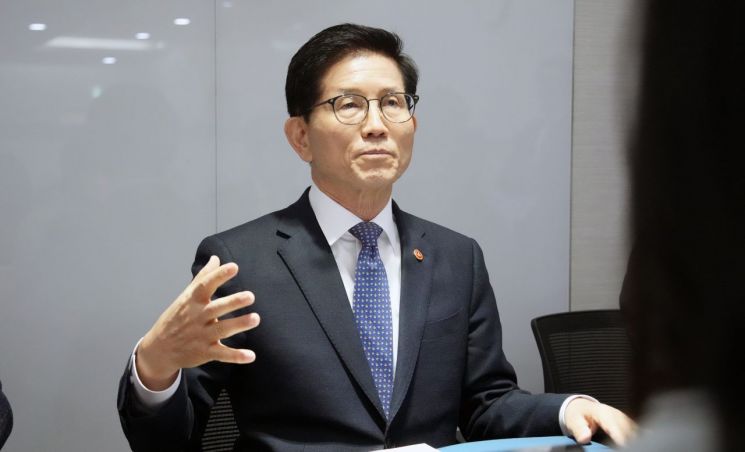 Minister of Employment and Labor Kim Moon-soo is answering questions related to current issues with the press corps at the Government Complex Sejong on the 10th. Photo by Ministry of Employment and Labor
"Human Rights Commission Only Says Nice Things... Youth Are More Labor Vulnerable"
On the same day, the National Human Rights Commission recommended to the Prime Minister and Minister Kim that the statutory retirement age be increased from the current 60 to 65. The rationale was that if the retirement age does not align with the National Pension benefit starting age (65), income discontinuity may occur, which could pose a significant threat to individuals. However, the Human Rights Commission pointed out that the government should prepare support measures to ensure that the statutory retirement age extension does not negatively impact youth hiring.
Minister Kim described the recommendation as "a very difficult issue," noting, "They said all the nice things, but (the retirement age extension and youth hiring issues) conflict." He added, "The retirement age extension directly conflicts between youth seeking new employment and current employees," and "the government is deeply considering this."
He stated, "Youth who have never had a job are more labor vulnerable than employees nearing retirement," emphasizing, "The government must prioritize caring for the vulnerable." He continued, "The number of unemployed youth exceeded 430,000 and continues to rise," stressing, "We must put even one of these youth into the labor market, but if we extend the retirement age without any measures, youth will truly be in despair."
Discussions on retirement age extension and continuous employment are underway at the Economic, Social and Labor Council, a social body under the President. Although discussions intensified last year, the Korean Confederation of Trade Unions (KCTU), representing labor, suspended talks following the emergency martial law incident in December, slowing progress. The council has urged KCTU to participate but plans to reach a conclusion next month even if they do not return.
Regarding this, Minister Kim said, "I met with KCTU on Saturday (the 8th)" and "I told them they need to make a decision." However, he explained, "KCTU finds it difficult to decide due to internal circumstances," adding, "If mishandled, organizational problems could arise." He also mentioned, "It will be difficult to respond immediately to the Human Rights Commission's recommendation," noting, "We must reply within 90 days, but we do not have the authority to respond at will."
Minister Kim also revealed frequent contact with KCTU. He said, "At least the KCTU executive body should express their stance on retirement issues at the Economic, Social and Labor Council meetings," adding, "It is a very difficult issue, but we meet often." He further stated, "KCTU holds significant decision-making power in South Korea's economy and labor relations," urging, "Given their influence, we ask them to demonstrate strong leadership."
Regarding expanding youth employment, Minister Kim explained the government's role has limits. He lamented, "Companies must hire youth, but overall Samsung, banks, and construction sectors are reducing staff," adding, "This year, graduates are flooding the market, but the number of unemployed youth increased by about 20,000 compared to a month ago, reaching over 430,000." When asked if there is no sharp solution due to the poor economic situation, he replied, "That is correct."
"Will Support Semiconductors to the Maximum... Must Avoid Nationality Discrimination Against Filipinos"
Minister Kim interpreted the opposition from opposition parties to the Semiconductor Special Act, which includes exempting semiconductor R&D personnel from the 52-hour workweek, as "a lack of intention to revive the Korean economy." Emphasizing that "semiconductors are the representative driver of the Korean economy," he said, "If we cannot even save semiconductors, we have no right to talk about the economy," adding, "If the law cannot be changed and the Ministry of Employment and Labor is asked to handle it administratively, we are willing to do so."
On the 11th, Minister Kim plans to meet semiconductor R&D personnel along with Minister Ahn Deok-geun of the Ministry of Trade, Industry and Energy to listen to their opinions regarding improvements to working hours. He said, "After hearing their opinions, we will try to help as much as possible." He also stressed, "What will South Korea live on? The situation is very difficult, so we must speak frankly about the reality of our industry."
Regarding criticism that the pilot project for Filipino domestic caregivers has not expanded into a full project and that prices are high due to the application of the domestic minimum wage, Minister Kim explained, "Regarding foreign workers, the government must avoid any elements that could reveal discrimination based on nationality, while complying with current International Labour Organization (ILO) conventions, World Trade Organization (WTO) regulations, the domestic constitution, and the Labor Standards Act."
On the expansion of the Labor Standards Act to workplaces with fewer than five employees, he said external research, consultations with related associations, and other measures are underway. Minister Kim stated, "We cannot conduct a full survey, but by examining samples, we are categorizing types such as restaurants, beauty salons, bakeries, coffee shops, manufacturing, and wholesale and retail businesses to estimate how much wages would increase when applying the minimum wage and Labor Standards Act regionally, and how many convenience stores and restaurants might close."
He also gave examples, saying, "If applied fully, closures would increase, so instead of full application, in the first year for workplaces with fewer than five employees, they would only close on four national holidays; in the second year, a few days of annual leave would be given; and later, all public holidays would be observed, implementing this step by step." However, he added, "I am not confident in judging how much workers would like this or how many business owners would close. The economy is difficult now, and even Homeplus is closing, so it is not easy."
© The Asia Business Daily(www.asiae.co.kr). All rights reserved.
![Clutching a Stolen Dior Bag, Saying "I Hate Being Poor but Real"... The Grotesque Con of a "Human Knockoff" [Slate]](https://cwcontent.asiae.co.kr/asiaresize/183/2026021902243444107_1771435474.jpg)
















