Target Coordinates Entered Incorrectly, Three Verification Steps Missed
Air Force Chief of Staff: "No Attachment to Position... Recovery Comes First"
The KF-16 fighter jet friendly fire incident that occurred on the 6th in the Pocheon area of Gyeonggi Province is evaluated as an accident involving a combination of chance and human error. Initially, the problem began with an incorrect input of target coordinates, but the pilots of the flight formation failed to properly carry out the three-step target coordinate verification process, leading to an unprecedented friendly fire accident. The Air Force has decided to implement measures such as strengthening the duplicate verification procedure for target coordinates.
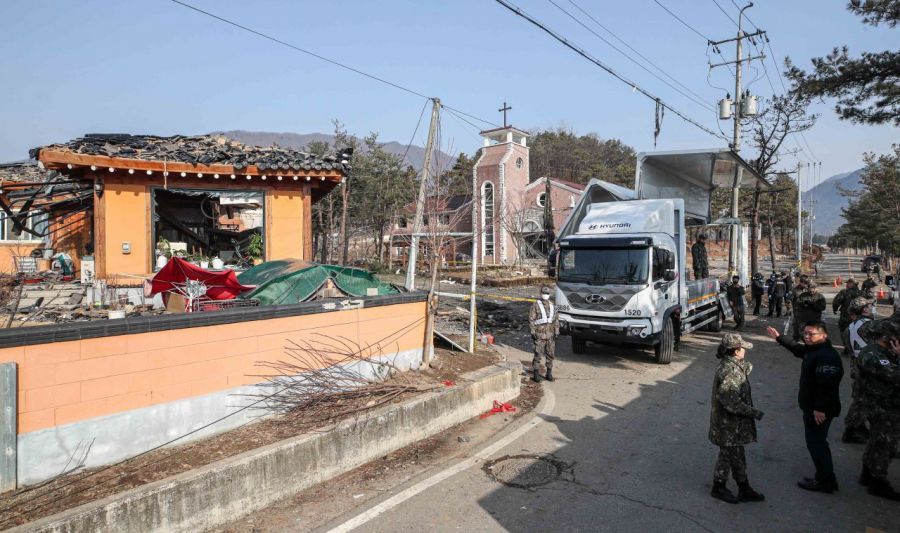
On the morning of the 10th, the Air Force announced the interim investigation results and recurrence prevention measures related to the KF-16 fighter jet friendly fire incident, containing these details. Prior to this, Air Force Chief of Staff Lee Young-soo issued an apology statement, saying, "All responsibility lies with me," and "I bow my head in apology for disrupting the peaceful daily lives of the people and causing property damage due to this unprecedented friendly fire accident."
According to the Air Force's interim investigation results, the incident originated from an incorrect input of target coordinates on the previous day (the 5th). The pilot of aircraft No. 1 read out the coordinates, and the pilot of aircraft No. 2 entered them into the Joint Mission Planning System (JMPS), but mistakenly input the latitude coordinate ‘×× 05.×××’ as ‘×× 00.×××’. It has not been determined whether the pilot of aircraft No. 1 misread the coordinates or the pilot of aircraft No. 2 misheard and input them incorrectly.
Notably, during this process, they did not verify whether the coordinates entered into the JMPS matched the actual coordinates. Typically, pilots print out the coordinates entered in the JMPS on a 'lineup card' for confirmation, but on that day, an error occurred, and the coordinates were not printed. The pilot of aircraft No. 2 recorded the normal 14 coordinates, including the (bomb) drop points, on the lineup card by hand and copied it to share with the pilot of aircraft No. 1.
The problem was that no verification was conducted between the coordinates in the JMPS and those manually recorded on the lineup card. A senior Air Force official explained, "Even if the (lineup card) printout did not occur, they should have compared it by looking at the (JMPS) screen, but this process was not done. This is similar to double-checking a bank account number when making a transfer."
On the day of the accident, the 6th, the pilots also failed to detect the incorrect input of target coordinates. Typically, pilots save the information stored in the JMPS to a USB-type Data Transfer Cartridge (DTC) before flight and upload it to the fighter jet. In the case of the pilot of aircraft No. 1, the incorrectly input target coordinates were uploaded to the fighter jet via the DTC as is, while the pilot of aircraft No. 2 manually entered the target coordinate information into the fighter jet because the DTC device malfunctioned and data was not saved, using the coordinates handwritten on the lineup card.
As a result, incorrect coordinates were entered into aircraft No. 1, and accurate coordinates into aircraft No. 2, but neither pilot recognized this. Even during the second verification process after takeoff, the pilot of aircraft No. 1 did not detect the incorrect input. An Air Force official stated, "If one of the two pilots had discovered the incorrect input, they could have communicated to correct it, but in this case, both had the correct coordinates on the lineup card but did not realize that the coordinate information entered into aircraft No. 1's DTC was wrong."
The bomb drop phase was similar. The pilot of aircraft No. 1 sensed that the terrain of the target area differed from prior training but trusted the incorrectly input flight information and proceeded with the mission. Although a visual confirmation procedure should have been conducted at this stage, it was not properly carried out to meet the designated Time on Target (TOT). Although accurate target coordinates were entered into aircraft No. 2, the pilot was focused solely on maintaining formation and simultaneous bomb release, failing to notice the error.
A senior Air Force official said, "The weather on that day was not bad, and it was practically possible to visually confirm the target," adding, "The most regrettable part from the pilot's perspective is that the final stage should have involved a visual confirmation procedure."
Besides the pilots, the unit commanders' command and supervision were also inadequate. The Air Force analysis revealed that detailed management and supervision of flight preparation, such as checking flight data recorders of the mission formation and verifying target briefings, were insufficient. In particular, they did not conduct pilot reporting and review of the operational plan in advance.
Accordingly, the Air Force decided to supplement the duplicate verification procedure by adding steps such as ▲ mutual confirmation of target coordinates between flight formations before entering the final attack phase ▲ designating a dedicated controller for the operations officer at the Missile Command and Control Center (MCRC) to verify the mission formation and target coordinates.
The responsibility of commanders will also be strengthened. During major operational missions, unit commanders will be required to report flight plans and mission results face-to-face, and battalion commanders (flight commanders) will directly participate in briefings to check mission readiness and performance capability.
The briefing on that day also pointed out several issues related to delays in situation awareness and reporting of the friendly fire incident. The military recognized the abnormal situation immediately after the friendly fire at 10:04. The Missile Command and Control Center (MCRC) and the Air Force Operations Command tactical officer (TOD) could not confirm the impact point and at 10:05 checked with the mission formation whether firing had been conducted. The pilots recognized the coordinate input error during mutual verification and notified the MCRC around 10:07 before returning to Gunsan Air Base.
The Air Force Operations Command recognized the abnormal situation at 10:07 when the pilots confirmed the coordinate input error after firing, but despite recognizing the friendly fire incident, they focused only on verifying whether the bomb causing civilian damage was dropped from the fighter jet. Consequently, the friendly fire was reported to the Air Force Operations Commander 14 minutes after the situation was recognized, at 10:21.
Regarding the reason for notifying the media nearly 90 minutes after the friendly fire incident occurred, the Air Force stated, "We prioritized confirming accurate facts and thus announced after final confirmation of MK-82 bomb fragments," but added, "Considering the gravity of the situation, it would have been more appropriate to notify immediately upon occurrence of the abnormal drop situation." The Air Force also said, "Those identified as negligent in situation assessment and reporting will be disciplined according to laws and regulations," and "follow-up measures such as strengthening real-time reporting systems will also be implemented."
Chief of Staff Lee stated that all responsibility lies with him and expressed no attachment to his position. He said, "I will focus all my capabilities on follow-up measures, recurrence prevention, and mission execution, and if that is insufficient, I am willing to step down at any time," adding, "What is important now is recovery and recurrence prevention; decisions regarding my position will be made later."
Meanwhile, the Air Force decided to gradually resume flight training linked to the 2025 Freedom Shield (FS) exercise starting from that day. However, live-fire exercises will resume only after recurrence prevention measures are established and actions are completed.
© The Asia Business Daily(www.asiae.co.kr). All rights reserved.
![Clutching a Stolen Dior Bag, Saying "I Hate Being Poor but Real"... The Grotesque Con of a "Human Knockoff" [Slate]](https://cwcontent.asiae.co.kr/asiaresize/183/2026021902243444107_1771435474.jpg)















