4,205 Increase Last Month, Highest Nationwide...
Top Growth in Number of Newborns
Real Economic Growth Rate 4.8%, No. 1 Nationwide for Two Consecutive Years
Surpassing Busan in 2023 GRDP...
Proving Status as the Second Economic City
Incheon is showing remarkable growth in population and various economic indicators, surpassing Busan to emerge as South Korea's second-largest city.
According to Incheon City on the 10th, the resident registration population of Incheon last month was 3,027,854, an increase of 4,205 from the previous month, ranking first in population growth among the 17 cities and provinces nationwide. In particular, the number of infants aged 0-4 increased by 537, and the population aged 30-49, who are economically active and raising children, also increased by 1,282.
Following Incheon, Seoul (4,170), Daejeon (835), and Sejong (759) showed growth, while the remaining 13 cities and provinces, including Busan, experienced a decline. Last month, Busan's resident registration population was 3,262,337, a decrease of 1,554 from the previous month.
Incheon is also the only city among Seoul and the six major metropolitan cities to have increased its population over the past year. Compared to February last year, the populations of Seoul, Busan, Daegu, Gwangju, Daejeon, and Ulsan all decreased, but Incheon's population increased by 24,704, reaching 3,027,854.
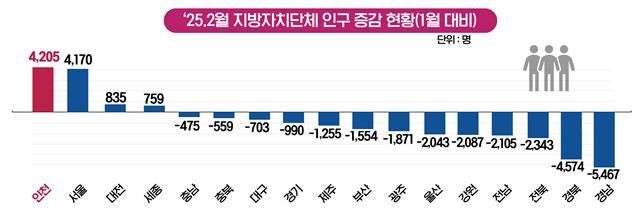 Population Increase and Decrease Status of Local Governments in February 2025. Provided by Incheon City
Currently, in terms of population size, Incheon ranks third after Seoul (9.33 million) and Busan (3.26 million), but it has maintained an unstoppable upward trend since its resident registration population exceeded 3 million in January last year. In particular, population inflow continues due to the development projects of economic free zones such as Songdo, Cheongna, and Yeongjong, as well as new towns like Luwon and Geomdan, leading to forecasts that Incheon will soon surpass Busan.
In fact, as of January, Busan's population decreased by 148,000 compared to five years ago, while Incheon’s population increased by 68,000 during the same period. Most notably, the economically active population?those employed or unemployed aged 15 and over?in Incheon (1,747,000) surpassed Busan (1,721,000) for the first time as of January, which is significant.
Incheon City analyzed that its low birthrate response policies, such as the 'i-Plus 100 Million Dream' program that supports children born in Incheon with a total of 100 million KRW until they turn 18, and the 'Thousand-Won Housing' initiative, are contributing to population growth. Furthermore, Incheon has not recorded a negative net migration rate since 2021, which is one of the indicators of population inflow, indicating continuous population inflow into Incheon.
Incheon has also overtaken Busan in economic growth. Last year, Incheon’s total production scale surpassed Busan for the first time in six years, ranking second among special and metropolitan cities after Seoul. According to Statistics Korea’s provisional regional income estimates for 2023, Incheon’s gross regional domestic product (GRDP) was 116.863 trillion KRW, while Busan’s was 114.165 trillion KRW.
GRDP is an indicator that evaluates all goods and services produced in a region at market value and is used to compare economic scales. Incheon first ranked second among special and metropolitan cities after Seoul in 2017 with a GRDP of 88.5 trillion KRW but fell behind Busan from 2018. However, in 2023, Incheon surpassed Busan again after six years, transforming into the second-largest economic city.
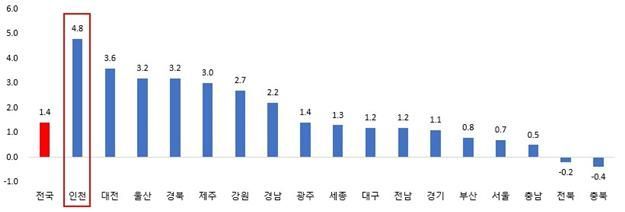
Incheon also recorded a real economic growth rate of 4.8% last year, exceeding the national average of 1.4%, ranking first nationwide for two consecutive years. This is significantly ahead of other cities and provinces such as Busan (0.8%) and Seoul (0.7%). In particular, Incheon’s transportation industry, centered on airports and ports, expanded its logistics network and showed the highest national growth rate of 33.6% last year. Incheon’s manufacturing industry also strengthened its competitiveness based on smart factories and advanced technologies, achieving a high growth rate of 5.7% last year.
An official from Incheon City stated, "Since GRDP first surpassed 100 trillion KRW in 2021, it recorded 113 trillion KRW in 2022 and a provisional 117 trillion KRW in 2023, firmly maintaining second place in economic scale after Seoul. We will continue to focus on creating jobs for young people, supporting businesses, and attracting investment to sustain economic growth."
© The Asia Business Daily(www.asiae.co.kr). All rights reserved.
![Clutching a Stolen Dior Bag, Saying "I Hate Being Poor but Real"... The Grotesque Con of a "Human Knockoff" [Slate]](https://cwcontent.asiae.co.kr/asiaresize/183/2026021902243444107_1771435474.jpg)
















