Legal Review Launched on Sectional Surface Rights for Deep Underground Railways
Government Seeks Alternatives Amid Resident Opposition and Low Compensation Standards
The government has decided to conduct a legal review to establish measures for not setting up sectional surface rights when constructing railways deep underground. Sectional surface rights refer to rights that allow certain facilities to be placed on or under someone else's land, typically applied in tunnel or subway construction.
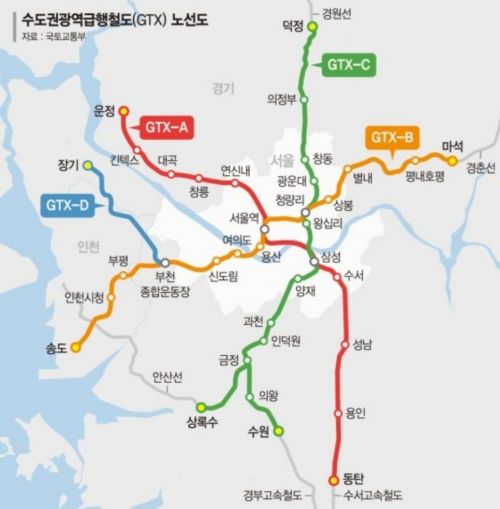
This move comes in response to issues arising from opposition among some local residents over the establishment of sectional surface rights during the construction of the Metropolitan Area Express Railway (GTX). Previously, efforts to address this through special legislation failed due to unresolved conflicts of interest.
According to explanations from related ministries on the 9th, the Ministry of Land, Infrastructure and Transport plans to commission a research project as early as this month to prepare measures for revising current laws related to the application of sectional surface rights and compensation procedures when using deep underground sections. The issue of sectional surface rights has been consistently raised by local residents since the early stages of the GTX project.
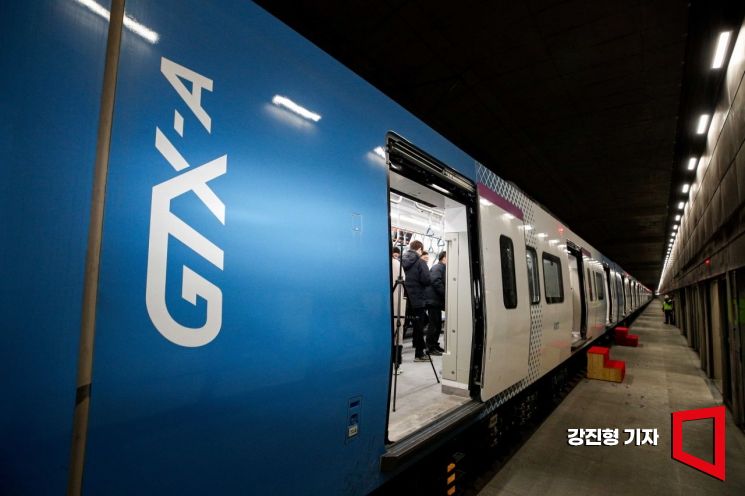 The first GTX-A train unveiled at Dongtan Station platform in Hwaseong, Gyeonggi. Photo by Jinhyung Kang aymsdream@
Under the current Constitution and individual laws, private property rights are recognized, and compensation is mandated when constructing railway facilities underground. Since GTX uses deep underground sections generally below 40 meters, sectional surface rights have been established with compensation varying according to depth. In high-rise urban areas, the limit depth is considered 40 meters, and if deeper areas are used, the compensation rate is set at 0.2% or less.
Local residents have long expressed dissatisfaction with the extremely low compensation standards and infringement of property rights in deep underground construction. At a recent forum held in the National Assembly, a resident of an apartment in Seongdong-gu, Seoul, said, "Part of the GTX facility is located underground, so the railway facility is recorded on the official registry," adding, "The compensation is only about 3,000 won, which infringes on property rights."
The Tenshill 1 and 2 complexes in Wangsimni New Town have deep underground impact areas of only tens to hundreds of square meters, accounting for less than 1% of the entire complex. Although the GTX line only slightly overlaps the edge of the complex, the sectional surface rights are recorded on the registry for about 2,800 households. Jeon Hyun-hee, a member of the Democratic Party, pointed out, "It is necessary to review how to reasonably improve the legal and administrative procedures for establishing sectional surface rights and whether current railway-related laws align with contemporary and environmental changes."
The government maintains that no specific decisions have been made yet. Sectional surface rights are intertwined with various laws including the Constitution, Railway Construction Act, Land Compensation Act, Civil Act, and compensation standards announced by the Ministry of Land, Infrastructure and Transport. It is expected that through expert research and examination of overseas cases and the consistency of proposed amendments, appropriate measures will be considered. Earlier, when local opposition arose over compensation standards in the early stages of the GTX project, the government considered a special law to avoid applying sectional surface rights. Although a bill was proposed, it was not passed by the National Assembly.
Academia suggests various alternatives. These include utilizing underground sections by obtaining residents' land use consent without establishing sectional surface rights, or following the current system but establishing sectional surface rights under a representative name with residents' consent. Experts point out that the most realistic approach is to set sectional surface rights and provide compensation up to a certain depth, excluding deep underground sections below 40 meters. This method ensures legal stability as it does not require re-consent even if land ownership changes.
In Japan, the principle is not to compensate for deep underground sections. However, compensation or claims can be made if relocation of objects is necessary or specific losses occur. Given widespread dissatisfaction with current standards, there is a consensus on the need for legal reform. Professor Kim Jae-sun of Dongguk University said at a previous forum, "Legislation should be proposed that sufficiently protects stakeholders' property rights while overcoming the drawbacks of establishing sectional surface rights," adding, "The basis for possible damage compensation should also be thoroughly discussed."
© The Asia Business Daily(www.asiae.co.kr). All rights reserved.
![Clutching a Stolen Dior Bag, Saying "I Hate Being Poor but Real"... The Grotesque Con of a "Human Knockoff" [Slate]](https://cwcontent.asiae.co.kr/asiaresize/183/2026021902243444107_1771435474.jpg)

















