Despite Criticism Over Tariffs and Fentanyl, Room Left for Talks with the U.S.
"Support for Peace in Ukraine... Taiwan Is Part of China"
Amid tensions with the United States over the tariff policies of the Donald Trump administration, China criticized the U.S., saying it would "strike back firmly" and questioning "what has been gained from the tariff war." However, it also emphasized cooperation and coexistence, leaving the door open for negotiations.
On the 7th, Wang Yi, Director of the Central Foreign Affairs Office of the Chinese Communist Party (also serving as Foreign Minister), spoke at a foreign ministers' press conference held during the major political event, the Two Sessions (Lianghui: the National People's Congress and the Chinese People's Political Consultative Conference). He said, "If (the U.S.) chooses cooperation, mutual benefits and win-win outcomes can be realized, but if it insists on suppression, China will definitely strike back firmly."
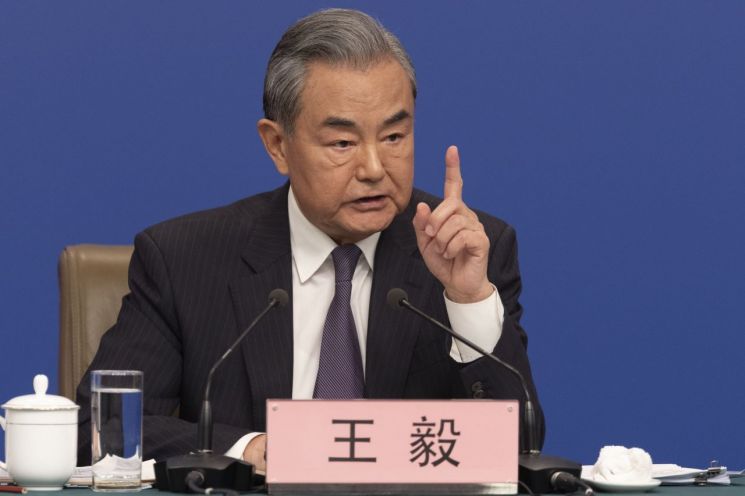 The king is the Director of the Central Foreign Affairs Office of the Communist Party of China (also serving as the Minister of Foreign Affairs). EPA Yonhap News
However, Director Wang stated, "Since China, the world's largest developing country, and the U.S., a developed country, will coexist on this planet for a long time, peaceful coexistence is necessary," and added, "China and the U.S. have broad common interests and space for cooperation," leaving open the possibility of collaboration. He continued, "(The two countries) can be partners, achieve success, and prosper together," and expressed hope that "(the U.S.) will walk the right path of China-U.S. coexistence that benefits both countries and the world."
President Trump raised tariffs on China by 10% last month and imposed an additional 10% tariff on the opening day of the Two Sessions on the 4th, raising the total additional tariff rate on China to 20%. Director Wang questioned, "The U.S. should review what it has gained from years of tariff and trade wars," asking, "Has the trade deficit expanded or shrunk? Has manufacturing competitiveness increased or decreased? Has inflation improved or worsened? Have people's lives gotten better or worse?" He emphasized, "The economic and trade relationship between China and the U.S. is reciprocal and equal."
Regarding the reason President Trump cited for raising tariffs on China?insufficient response to fentanyl?Wang said, "The abuse of fentanyl within the U.S. is a problem the U.S. must face and resolve on its own," adding, "China has provided various forms of support in a humanitarian spirit. The U.S. should not repay kindness with enmity or impose tariffs without reason." He also criticized, "This is not the behavior of a responsible major power."
On President Trump's "America First" policy, Wang stated, "There are about 190 countries in the world, and if every country emphasizes its own priority and falls into a position of power, this world will revert to the law of the jungle."
Wendy Suong, a non-resident fellow at the Atlantic Council's Global China Hub, explained that Director Wang made relatively calm remarks about the U.S. without directly mentioning President Trump, saying, "They want to leave room for easing tensions related to trade."
As China's artificial intelligence (AI) "DeepSeek" has caused a global sensation, questions were also raised about DeepSeek and the U.S.-China advanced technology competition. Director Wang said, "Whether aerospace technology or chip manufacturing, unjust external pressure has never stopped," but added, "Where there is blockade, there is a breakthrough; where there is suppression, there is innovation." He continued, "'A narrow yard and high fence' (U.S. policies blocking the inflow of advanced technology to China) cannot stop innovative thinking, and decoupling and supply chain disruption will ultimately isolate oneself," emphasizing, "Science and technology should not become tools for an iron curtain but should be a benefit shared by all."
President Trump has recently clashed with traditional Western allies and shown a friendly stance toward Russia, shaking the world order. Regarding China-Russia relations, Director Wang said, "No matter how the international environment changes, the historical logic of China-Russia friendship will remain unchanged, and the intrinsic momentum will not weaken."
On Ukraine, he said, "We welcome and support all efforts for peace," and added, "China hopes to play a constructive role together with the international community for the final resolution of the crisis and the realization of sustainable peace according to the will of the parties involved." He also stated, "All countries should learn lessons from the crisis," and emphasized, "Security is mutual and equal. One country's security should not be built on the instability of another." However, he did not answer when asked whether China would dispatch peacekeeping troops.
Regarding China-Japan relations, he emphasized that this year marks the 80th anniversary of the victory in the Anti-Japanese War, saying, "In the face of the test of conscience and trust, Japan must adhere to the spirit of the peace constitution and follow the path of peaceful development." He added that the "One China" principle is the political foundation of China-Japan relations, pointing out, "Although 80 years have passed since Taiwan was returned to China, Japan still does not reflect and secretly communicates with Taiwan independence forces."
On Taiwan, Director Wang emphasized, "Taiwan is an inalienable part of Chinese territory." He asserted, "The only designation for Taiwan in the United Nations is 'Taiwan Province of China,'" and claimed, "Taiwan has never been a country in the past and cannot become a country in the future."
He extended a hand to Europe, emphasizing the achievements of exchanges with Europe, saying, "China still has trust in Europe and believes Europe can be a reliable partner of China." Foreign media analyzed that amid strained U.S.-Europe relations due to support for the Ukraine war and trade conflicts, China is trying to strengthen relations with Europe.
Regarding Middle East issues, he expressed support for the ceasefire proposals of Egypt and Arab countries. He also emphasized the "two-state solution," stating, "Attempts to forcibly change the status of the Gaza Strip will not bring peace but rather trigger new chaos." This was interpreted as a remark targeting President Trump's Gaza plan, which involves U.S. control of Gaza, relocating Palestinian residents, and developing the area.
Meanwhile, he did not express a position on South Korea-China relations or the Korean Peninsula issue.
© The Asia Business Daily(www.asiae.co.kr). All rights reserved.
![Clutching a Stolen Dior Bag, Saying "I Hate Being Poor but Real"... The Grotesque Con of a "Human Knockoff" [Slate]](https://cwcontent.asiae.co.kr/asiaresize/183/2026021902243444107_1771435474.jpg)















