Bank of Korea Reports Smallest Increase in Industrial Loans in Eight Years
Manufacturing Loans Turn Negative; Growth in Service Sector Loans Slows
Industrial Loans Up 72.6 Trillion KRW Last Year, a 3.8% Rise
Slightly Below Pre-COVID-19 Decade Average of 5.4%
In the fourth quarter of last year, industrial loans increased by only 3.3 trillion KRW compared to the previous quarter, marking the smallest increase in eight years. This was due to a decline in manufacturing loans and a reduced increase in service sector loans. Facility fund loans rose by 6.7 trillion KRW, recording the smallest increase since the first quarter of 2013. This was influenced by a base effect from concentrated facility investments centered on semiconductors, secondary batteries, and chemicals, which had seen double-digit growth rates for three years since 2020, as well as deferred facility investments due to trade uncertainties triggered by the Trump administration.
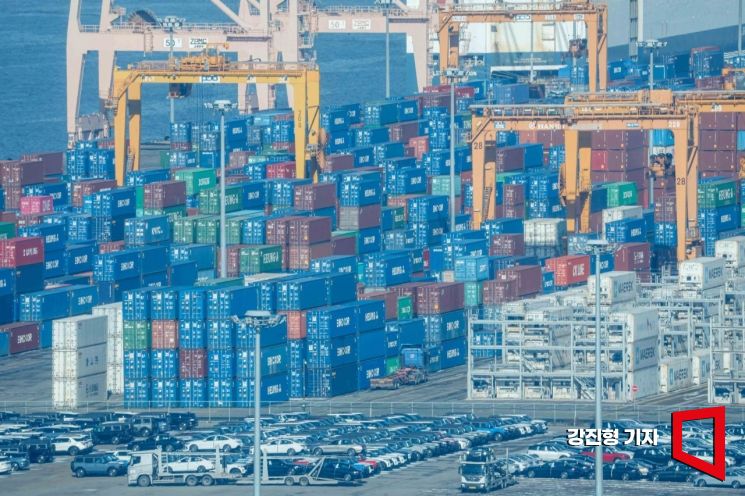 Following President Donald Trump's signing of a proclamation imposing a 25% tariff without exceptions on steel and aluminum products imported into the United States, and his announcement that tariffs on automobiles and semiconductors are also under consideration, containers were piled up at Pyeongtaek Port in Gyeonggi Province on the 13th of last month.
According to the "2024 Fourth Quarter Depository Institutions' Industrial Loans by Industry" released by the Bank of Korea on the 7th, the balance of industrial loans by depository institutions at the end of the fourth quarter of last year was 1,962.2 trillion KRW, an increase of 3.3 trillion KRW from the end of the previous quarter. This increase was smaller compared to the 17.4 trillion KRW rise in the previous quarter, marking the smallest increase since a 900 billion KRW decrease in the fourth quarter of 2016.
By industry, the manufacturing loan balance was 483.4 trillion KRW, decreasing by 1.6 trillion KRW from the previous quarter, turning negative. This was due to companies temporarily repaying their credit lines at year-end to manage financial ratios, resulting in a 2.1 trillion KRW decrease in working capital loans, and facility fund demand increasing by only 500 billion KRW amid expanding domestic and international economic uncertainties. Kim Min-su, head of the Financial Statistics Team at the Bank of Korea's Economic Statistics Department 1, said, "Facility fund loans have slowed in growth due to a base effect from heavy facility investments in semiconductors, secondary batteries, and chemicals over the past two years," adding, "The rapidly changing external environment, including tariff policies under the Trump administration, also led to deferred year-end investments." By sector, decreases were centered on chemicals and medical products (-1 trillion KRW), electronic components, computers, video, audio, and telecommunications (-1.3 trillion KRW). The construction industry saw a 1.2 trillion KRW decrease due to a continued decline in construction performance.
The service sector loan balance was 1,253.7 trillion KRW, increasing by 3.9 trillion KRW. Compared to a 7.5 trillion KRW increase in the previous quarter, the growth rate narrowed. Real estate increased by 1 trillion KRW, and accommodation and food services by 300 billion KRW, leading to the reduced increase. Real estate loans saw a contraction in growth mainly in real estate rental due to a continued slump in the commercial real estate market, including rising vacancy rates in local shopping centers, and year-end loan management by banks. According to the Korea Real Estate Board, the vacancy rate for medium to large shopping centers rose by 0.3 percentage points from 12.7% in the third quarter of last year to 13.0% in the fourth quarter, while small-scale centers increased by 0.2 percentage points from 6.5% to 6.7%. Loans for accommodation and food services saw a reduced increase due to sluggish domestic demand, poor business conditions, and closures.
By financial institution type, loans from deposit banks increased by 1.7 trillion KRW from the end of the previous quarter, with a reduced growth rate. Loans from non-bank depository institutions turned positive, increasing by 1.6 trillion KRW after a 2.3 trillion KRW decrease in the previous quarter. By company size within deposit banks, loans to large corporations decreased by 1.1 trillion KRW, while loans to small and medium enterprises (SMEs) increased by 4.1 trillion KRW, though with a reduced growth rate. Loans to individual business owners, included in SMEs, decreased by 500 billion KRW.
Industrial loans increased by 72.6 trillion KRW last year, a 3.8% rise. The annual growth rates of industrial loans over the past three years were 13.4% in 2021, 13.7% in 2022, and 5.1% in 2023. Kim said, "The annual growth rate of industrial loans averaged 5.4% over the 10 years before COVID-19," adding, "After double-digit growth for three years since 2020, the current rate slightly underperforms the 10-year average, so it is not considered an unstable trend."
© The Asia Business Daily(www.asiae.co.kr). All rights reserved.
![Clutching a Stolen Dior Bag, Saying "I Hate Being Poor but Real"... The Grotesque Con of a "Human Knockoff" [Slate]](https://cwcontent.asiae.co.kr/asiaresize/183/2026021902243444107_1771435474.jpg)















