Pension 'Parameter Reform' to Be Addressed First
Lee Jaemyung: "Expecting Swift Bipartisan Consultations"
Supplementary Budget Stalemate... Opposition Urges Submission of Proposal
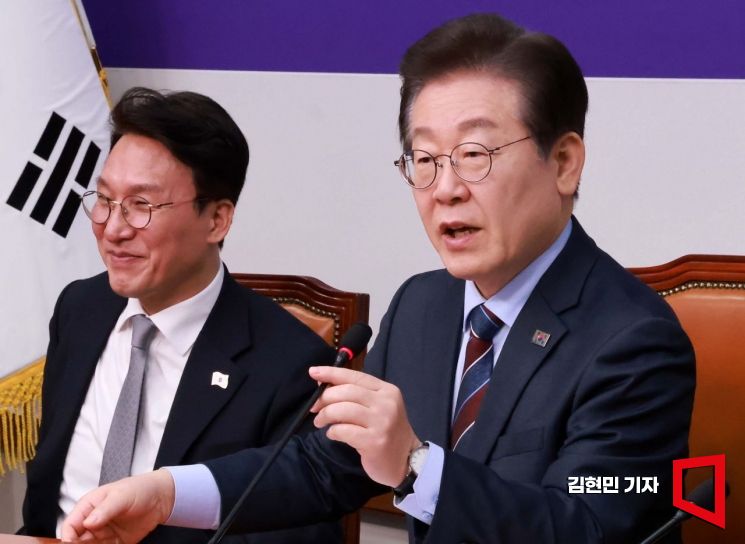 Lee Jae-myung, leader of the Democratic Party of Korea, is speaking at the Supreme Council meeting held at the National Assembly on the 7th. 2025.3.7 Photo by Kim Hyun-min
The ruling and opposition parties have agreed to first address parameter reforms (changes to insurance premium rates and income replacement rates) regarding pension reform, which had been at an impasse until now. Accordingly, there is talk of a sudden possibility of reaching an agreement on pension reform at the third National Policy Council meeting scheduled for the 10th. However, with the early presidential election approaching and tensions between the ruling and opposition parties intensifying, as well as persistent differences over the '1% income replacement rate' gap, there remains a possibility that the talks could fail at the last minute.
On the morning of the 6th, Lee Jae-myung, leader of the Democratic Party of Korea, said at the party's Supreme Council meeting, "At yesterday's National Policy Council, it was decided to prioritize discussions on parameter reforms related to pensions," adding, "I hope that swift bipartisan consultations on pension reform will take place." Kim Sang-hoon, chairman of the Policy Committee of the People Power Party, also said at the morning floor negotiation meeting, "Considering the urgency of parameter reforms, the People Power Party proposed a pre-agreed handling of a 13% insurance premium rate and a 43% income replacement rate, along with discussions on the future introduction of an automatic adjustment mechanism," adding, "We expect some degree of progress."
Previously, the ruling and opposition parties agreed on raising the insurance premium rate, which is the 'money paid,' to 13%, but clashed over the income replacement rate, which is the 'money received.' The People Power Party insisted on 42-43%, while the Democratic Party maintained 44-45%. The People Power Party expressed willingness to accept up to 44% if an automatic adjustment mechanism that adjusts pension amounts based on the number of subscribers and life expectancy is introduced, but the Democratic Party maintained a 'no' stance citing labor union opposition, resulting in a stalemate.
However, at the National Policy Council meeting held the previous day, it was agreed that the automatic adjustment mechanism would be discussed later in the National Assembly's Special Committee on Pensions along with structural reforms, and that parameter reforms would be handled first, breaking the deadlock. After the meeting, Chairman Kim told reporters, "We proposed a 13% insurance premium rate and a 43% income replacement rate, and the Democratic Party said they would review it." If the People Power Party concedes on introducing the automatic adjustment mechanism and the Democratic Party agrees to lower the income replacement rate by 1 percentage point, parameter reforms could be agreed upon.
It is also known that Lee Jae-myung's determination was reflected in the ruling and opposition parties' agreement to prioritize parameter reforms. Since the opposition party has effectively begun preparations for an early presidential election, there is a need to achieve results on issues of high social interest. The government is advocating structural reforms in the direction of 'paying more and receiving less,' but it welcomes any agreement on parameter reforms between the ruling and opposition parties for now.
Other issues besides pension reform show significant differences between the ruling and opposition parties. In particular, there was no progress on the supplementary budget (Chugyeong) formation as Choi Sang-mok, acting Deputy Prime Minister and Minister of Strategy and Finance, was excluded from discussions the previous day. The Democratic Party is pushing for a 35 trillion won 'super supplementary budget,' while the People Power Party is advocating for a 15 trillion won supplementary budget focused on 'targeted support' for vulnerable groups.
Park Chan-dae, floor leader of the Democratic Party, criticized at the Supreme Council meeting that day, "It's been a long time since talks about the supplementary budget started, yet neither the government nor the People Power Party has presented a supplementary budget plan or held consultations," adding, "Choi Sang-mok, who bears the greatest responsibility, is playing the president, and the People Power Party is already rehearsing as the opposition." He continued, "Politics should actively solve the difficulties of the people; ignoring them is to betray one's own reason for existence," urging, "I hope a concrete supplementary budget plan will be brought by next Monday."
© The Asia Business Daily(www.asiae.co.kr). All rights reserved.
![Clutching a Stolen Dior Bag, Saying "I Hate Being Poor but Real"... The Grotesque Con of a "Human Knockoff" [Slate]](https://cwcontent.asiae.co.kr/asiaresize/183/2026021902243444107_1771435474.jpg)















