Proportion of Female Employees in Companies Reaches 28.5%...
Women Hold Only 8.8% of Board Seats
Length of Service Gap Between Men and Women Exceeds Two Years
Men Earn Over 30% More Than Women
Although gender equality indicators are improving, such as an increase in companies with female executives, substantial issues remain regarding pay gaps and length of service between men and women within companies. The imbalance continues, with a difference of about two years in length of service and approximately a 30% gap in salaries.
KCGI Asset Management, which operates the KCGI The Women Fund, analyzed gender equality indicators of 370 major publicly listed companies in Korea from 2021 to 2023 in a time-series manner, in collaboration with ESG rating agency Sustainvest, to mark 'International Women's Day' on the 8th.
A KCGI Asset Management official stated, "Fostering female talent and their participation in management is important for corporate competitiveness," adding, "The KCGI The Women Fund will continue to promote sustainable female economic participation and invest in companies with related competitive advantages."
In November 2018, KCGI Asset Management launched the 'KCGI The Women Securities Investment Company,' the first domestic fund to select and invest in fundamentally strong companies with relatively well-established gender diversity and equity. As of the 6th, it recorded net assets of 17.5 billion KRW.
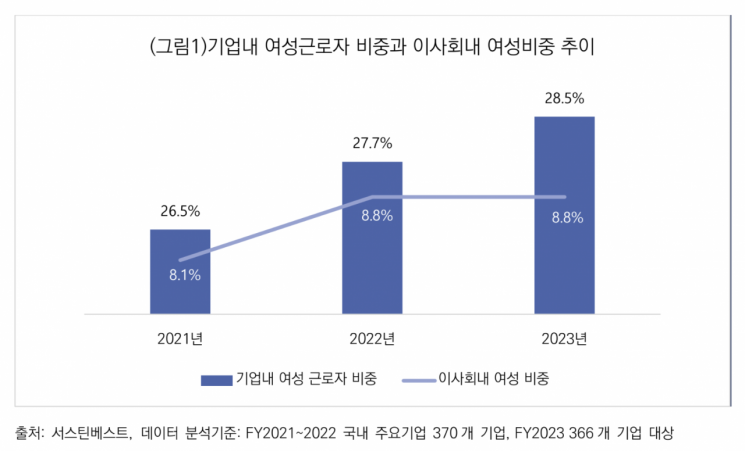
The proportion of female employees within companies is 28.5%, and the proportion of women on boards of directors is 8.8%. While the share of female workers in companies is increasing annually, the proportion of women on boards remains relatively low.
The proportion of female employees rose from 26.5% in 2021 to 28.5% in 2023. The proportion of women on decision-making bodies such as boards of directors remained steady at 8.8% in 2023, the same as in 2022.
The situation is similar when looking at the ratio of female executives to female employees. The average number of female workers in the surveyed companies was 681, while the average number of female executives was 2.7. Only 0.4% of female workers hold executive positions, indicating that a glass ceiling still exists.
The proportion of male executives relative to male workers is 1.6%, which is four times higher than that of females. However, the trend of increasing female workforce participation each year is positive in terms of expanding women's economic activity.
Sustainvest researcher Jang Myung-joo commented, "While the improvement in indicators is positive, a closer look reveals that most female registered executives are appointed as outside directors," adding, "There is some disappointment regarding the appointment of executives through the development of female talent within companies."
The difference in length of service between male and female workers has not changed significantly. The length of service gap is calculated as ‘average male length of service minus average female length of service’ and serves as an indicator reflecting pay differences and the proportion of non-regular workers.
For large companies with assets exceeding 2 trillion KRW, the average length of service gap decreased from 3.1 years in 2021 to 2.7 years in 2023. By industry, in large companies, the consumer goods and services sector saw an increase from 2.4 years in 2020 to 2.6 years in 2023, a 0.2-year rise.
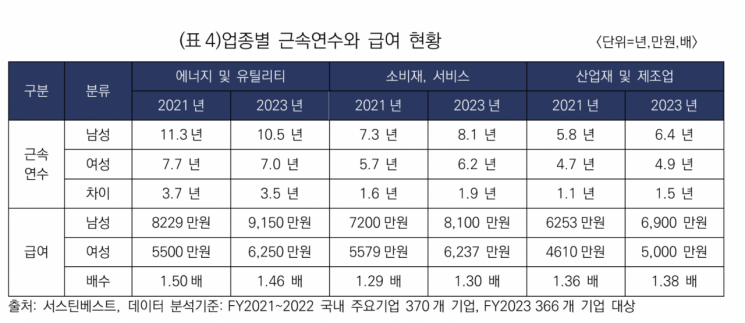
The pay gap between men and women remains significant. Salary differences are influenced by factors such as productivity and length of service, as well as job difficulty and employment type, making it an important gender equality indicator.
Comparing length of service and salary multiples by industry, in the 'industrial goods and manufacturing' sector, women’s length of service is 4.9 years, only about 1.5 years less than men’s, but men’s salaries are 38% higher. In the 'consumer goods and services' sector, the length of service gap is 1.9 years, yet the salary difference is about 30%.
A KCGI Asset Management official said, "Active utilization of female talent can promote diversity and creative ideas within organizations, contributing to corporate sustainability and competitiveness." They added, "The KCGI The Women Fund will continue to promote female economic participation and invest in companies with related competitive advantages," emphasizing, "We will devote ourselves to social responsibility and enhancing investor returns."
© The Asia Business Daily(www.asiae.co.kr). All rights reserved.
![Clutching a Stolen Dior Bag, Saying "I Hate Being Poor but Real"... The Grotesque Con of a "Human Knockoff" [Slate]](https://cwcontent.asiae.co.kr/asiaresize/183/2026021902243444107_1771435474.jpg)
















