About 500 South Korean and U.S. Troops, 150 Ground Vehicles, and 13 Fighter Jets Participate
The South Korean and U.S. militaries conducted the first combined joint integrated fire live-fire exercise of the year, linked to the '2025 Freedom Shield (FS)' exercise.
According to the military on the 6th, the South Korean and U.S. forces conducted the combined joint integrated fire live-fire exercise at the Seungjin Science Training Center in Pocheon, Gyeonggi Province. During the exercise, General Kim Myung-soo, Chairman of the Joint Chiefs of Staff (Navy Admiral), General J.B. Brunson, Commander of the ROK-U.S. Combined Forces Command (U.S. Army General), and General Kang Shin-chul, Deputy Commander of the ROK-U.S. Combined Forces Command (Army General), encouraged the troops through on-site guidance.
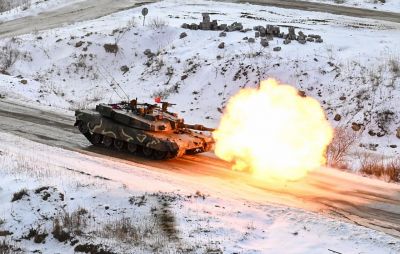
About 500 troops participated in this integrated fire exercise, including the Army's Capital Mechanized Infantry Division Tank Battalion Task Force (TF), Ground Operations Command Special Mobility Support Brigade (one platoon), Dronebot Combat Unit (one platoon), Air Force Operations Command subordinate fighter wings and squadrons, and the U.S. 2nd Infantry Division/ROK-U.S. Combined Division 5-17 Battalion intelligence operation team. Ground forces equipment included approximately 150 units such as South Korean Army K2 tanks, K1A2 tanks, K21 infantry fighting vehicles, K55A1 self-propelled howitzers, 120mm self-propelled mortars, Apache attack helicopters, and Biho Combined Air Defense System, as well as U.S. reconnaissance drones. Air Force equipment included 13 4th and 5th generation fighter aircraft such as F-35A, F-15K, KF-16, and FA-50 under the Air Force Operations Command.
In particular, the military explained that this exercise is significant as it was the first combined joint exercise conducted in connection with this year's FS exercise, during which the procedures for combined joint integrated fire operations to enhance wartime combined operational capabilities were practiced. Additionally, South Korean and U.S. Army troops conducted live-fire training with various infantry weapons such as the Panzerfaust-III (anti-tank rocket), K14 sniper rifle, and K201 grenade launcher while receiving fire support from Army aviation and the Air Force.
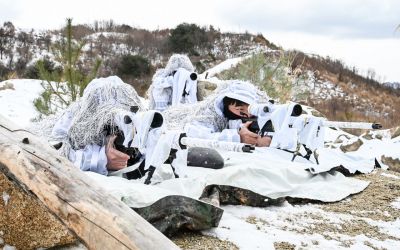
The exercise intensified as the friendly forces, initially on defensive operations, were assigned counterattack missions. The Dronebot Combat Unit's Swid drone and U.S. Skydio X2D drones identified and relayed enemy movements, while K55A1 self-propelled howitzers and 120mm self-propelled mortars supported the mechanized unit's maneuver with preparatory fire. Subsequently, the mechanized unit composed of K1A2 tanks and K21 infantry fighting vehicles crossed the attack start line, marking the start of full-scale combat.
When enemy fighters and drones attempted to attack friendly tanks and armored vehicles, the Biho Combined Air Defense System shot them down. The K1A2 tanks and Apache attack helicopters, encountering complex obstacle zones, eliminated nearby enemies. Infantry riding in K21 infantry fighting vehicles secured the surroundings and covered friendly forces using anti-tank rockets and sniper rifles. The K600 obstacle-clearing tank removed mines and cleared paths using MICLIC (Mine Clearing Line Charge), allowing the following K2 tanks and armored vehicles to conduct maneuver fire and charge forward. Soon after, infantry dismounted from armored vehicles and seized the objectives.
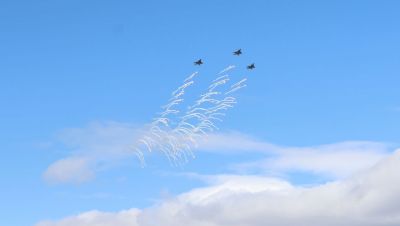
Upon receiving signals of enemy counterattack, the Air Force dispatched F-35A, F-15K, KF-16, and FA-50 fighter aircraft armed with air-to-ground bombs. First, the F-35A, receiving target information from the Joint Terminal Attack Controller (JTAC), neutralized enemy mobile surface-to-air missiles and anti-aircraft guns with simulated air-to-ground bombs, then evaded the danger zone using flare deployment and evasive maneuvers.
Subsequently, the F-15K, KF-16, and FA-50 accurately dropped about 30 live bombs on the target during close air support, completely annihilating the enemy units involved in the counterattack. The MK-84 bomb dropped by the F-15K is a bomb suitable for attacking hardened targets such as bunkers and reinforced shelters, capable of penetrating 60 cm of concrete. One bomb can create an explosion crater 15 meters in diameter and 4 meters deep, with a lethal radius equivalent to 16 soccer fields.
Colonel Cho Seung-jae, commander of the Tank Battalion TF who integrated command of the combined ground forces on site, said, “Through the operation of combined intelligence assets and live-fire exercises with battalion-level weaponry, we were able to significantly enhance our combined operational capabilities,” adding, “We will continue to cultivate a strong battalion that wins when it fights through practical combat-focused training.” Colonel Shin Won-jong, head of the Air Force Operations Command's operational training division who planned the integrated fire exercise, stated, “This live-fire exercise confirmed the overwhelming power and precision of the Air Force,” and added, “We will continue to develop realistic strike capabilities and strengthen ROK-U.S. combined and joint forces through various combined joint exercises.”
Meanwhile, after the exercise concluded, the Chairman of the Joint Chiefs of Staff, the Commander of the ROK-U.S. Combined Forces Command, the Deputy Commander of the ROK-U.S. Combined Forces Command, and participating troops had a session to display and introduce the weapon systems of the South Korean mechanized units. Observers and participants toured domestic premium weapon systems such as the K2 tank, K9A1 self-propelled howitzer, K21 infantry fighting vehicle, Suryong, and K600 obstacle-clearing tank.
© The Asia Business Daily(www.asiae.co.kr). All rights reserved.
![Clutching a Stolen Dior Bag, Saying "I Hate Being Poor but Real"... The Grotesque Con of a "Human Knockoff" [Slate]](https://cwcontent.asiae.co.kr/asiaresize/183/2026021902243444107_1771435474.jpg)

















