"President Accepts Automakers' Request"
One-Month Tariff Exemption Based on USMCA
One day after the United States imposed a 25% tariff on Mexico and Canada, on the 5th (local time), it decided to suspend the tariff on the automobile industry for one month. With the White House leaving open the possibility of additional tariff exemptions, attention is focused on whether the tariff conflict can be partially resolved.
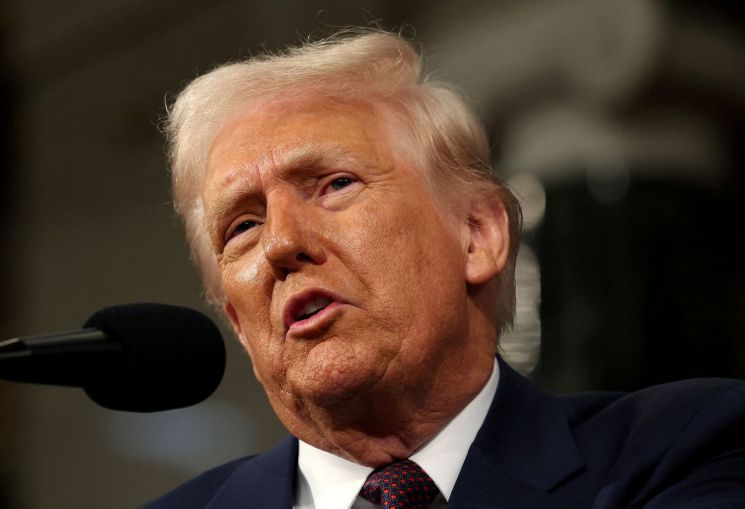
White House spokesperson Caroline Levitt said, "We will provide a one-month (tariff) exemption on all automobiles coming through the United States-Mexico-Canada Agreement (USMCA)."
She added, "We spoke with the Big Three automakers," and "At the request of companies related to USMCA, the (Trump) president gave them a one-month exemption so they would not be economically disadvantaged."
President Trump made the tariff suspension decision after speaking with representatives of the U.S. Big Three automakers, General Motors (GM), Ford, and Stellantis. From Ford, Chairman Bill Ford and CEO Jim Farley, from GM, Chairwoman and CEO Mary Barra, and from Stellantis, Chairman John Elkann spoke with President Trump.
The United States enforced the previously suspended 25% tariff on Canada and Mexico starting at midnight on the 4th. These countries have mostly applied zero tariffs on traded goods under the North American Free Trade Agreement (NAFTA) and its successor, USMCA. The U.S. automakers with production bases in Mexico and Canada expressed concerns that the 25% tariff would cause a sharp increase in vehicle production costs and supply chain disruptions, resulting in significant damage. It was also forecasted that the tariff measure could raise pickup truck prices in the U.S. by $3,000 to $10,000. John Bozzella, chairman of the Alliance for Automotive Innovation (AAI), warned the day before, "All automakers will be affected by tariffs on Canada and Mexico," and "Most people will see prices of some vehicle models rise by as much as 25%."
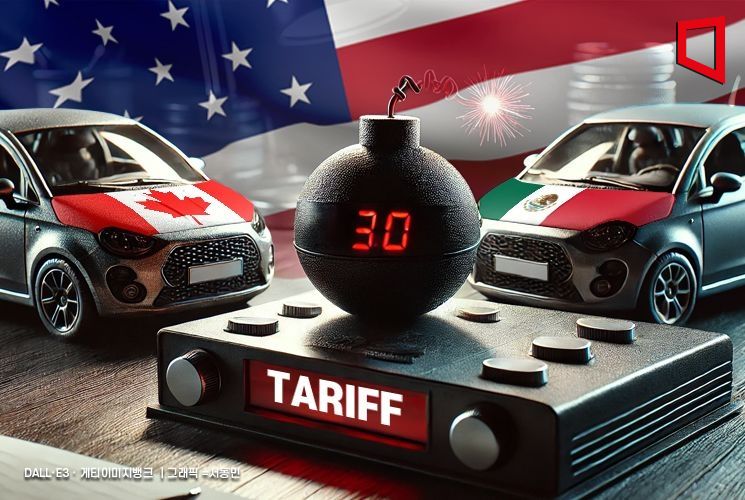
By accepting the automobile industry's request and suspending the 25% tariff on vehicles from Mexico and Canada just one day after the tariff was enforced, U.S. automakers have gained time to avoid the 25% tariff bomb for one month. The U.S. has so far exempted a 2.5% tariff on cars exported to the U.S. by automakers if the vehicles include a certain percentage of North American parts based on USMCA origin rules. Regarding this, Levitt said that President Trump told U.S. automaker executives to start investing in the U.S. to relocate production facilities.
Levitt also hinted at the possibility of additional tariff exemptions, drawing attention to follow-up relief measures that the Trump administration may announce. Earlier, U.S. Secretary of Commerce Wilbur Ross also said in an interview with Bloomberg News that tariff relief measures, including the suspension of tariffs on the automobile sector, could be announced.
Currently, President Trump is discussing tariff issues through calls with the leaders of Canada and Mexico. On the afternoon of the same day, he spoke for 50 minutes with Canadian Prime Minister Justin Trudeau, discussing tariffs and the crackdown on fentanyl, a narcotic painkiller. A call with Mexican President Claudia Sheinbaum is also scheduled.
However, the White House reiterated that the reciprocal tariffs scheduled for April 2 will be enforced as planned. Reciprocal tariffs are based on the tariffs and non-tariff barriers that foreign countries impose on U.S. imports, and the U.S. imposes tariffs on foreign imports accordingly.
Levitt explained, "Reciprocal tariffs are still scheduled to take effect on April 2," and "He (President Trump) has a strong belief that, no matter what happens, they must be enforced without exception."
© The Asia Business Daily(www.asiae.co.kr). All rights reserved.
![Clutching a Stolen Dior Bag, Saying "I Hate Being Poor but Real"... The Grotesque Con of a "Human Knockoff" [Slate]](https://cwcontent.asiae.co.kr/asiaresize/183/2026021902243444107_1771435474.jpg)
















