Farewell Stage at Sejong Center for the Performing Arts Next Month
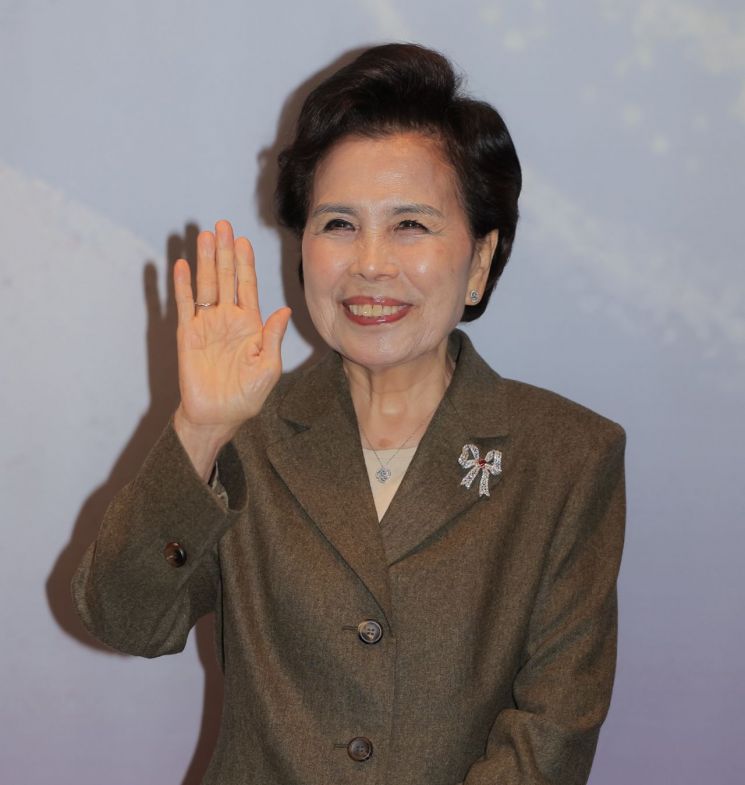 Singer Lee Mi-ja is greeting at the press conference for the traditional song tribute performance "Continuing the Legacy," held on the afternoon of the 5th at the Stanford Hotel in Mapo-gu, Seoul. Photo by Showdang ENT
"As a celebrity, I never liked the word 'retirement,' but now the time has come to firmly say that this is the end."
Lee Mi-ja (84), known as the 'Queen of Elegy,' will hold her farewell stage in April, concluding her 66-year career as a singer. She has been loved by the public for preserving the authenticity of Korean traditional songs with emotional lyrics and profound vocal techniques. With numerous hits such as Dongbaek Agassi (1964), Heuksando Agassi (1965), Seommaeul Seonsaengnim (1966), and Assi (1970), she has released over 2,600 songs in 66 years, making her one of the singers with the largest number of original songs in the Korean music industry. Her farewell stage will be a moment that will be remembered in the history of Korean popular music.
On the 5th, Lee Mi-ja held a press conference at the Stanford Hotel in Sangam-dong, Mapo-gu, Seoul, and hinted at her retirement by stating, "After this performance, I will no longer hold singing performances or release albums." She expressed, "I am happy and grateful to be able to pass on traditional songs to the younger generation."
The final stage is expected to be the 'Lee Mi-ja Traditional Song Tribute Performance ? Connecting the Pulse (맥)' held on the 26th and 27th of next month at the Grand Theater of Sejong Center for the Performing Arts in Jongno-gu, Seoul. She recalled, "Sejong Center is a place I am attached to," mentioning that in 1989, she held her 30th debut anniversary concert there as the first popular singer to do so. Although the venue was initially denied once, she was able to perform with the help of then Seoul Mayor Go Geon. Subsequently, her 40th, 45th, 50th, 55th, and 60th anniversary concerts were all held at Sejong Center, and her final performance will also be on the same stage.
 From the left, singers Jo Hang-jo, Lee Mi-ja, and Joo Hyun-mi attended the traditional Korean music tribute performance "Continuing the Legacy" press conference held on the afternoon of the 5th at the Stanford Hotel in Mapo-gu, Seoul. Photo by Showdang ENT
This performance will be a tribute to traditional songs. Ju Hyun-mi and Jo Hang-jo, whom she has designated as her successors, will join the stage. Lee Mi-ja said, "I want my reliable juniors to carry on the pulse of traditional songs." She described traditional songs as "the pride that has supported me like roots on stage," emphasizing, "Traditional songs are songs we listened to and sang during difficult times, containing both sorrow and joy. Trot developed later with a faster tempo. Although there is a trot boom as times change, traditional songs and trot should be distinguished."
Lee Mi-ja debuted in 1959 at the age of nineteen with pure innocence and gained popular fame in 1964 with Dongbaek Agassi. This song held the number one spot for 34 weeks and sold over 250,000 albums, becoming a huge hit. However, in 1965, it was banned from broadcasting due to its strong Japanese-style influence but was lifted in 1987. It is also known as a favorite song of former President Park Chung-hee. She recalled, "At that time, my songs were overshadowed by Western-style music and considered songs for the working class," adding, "I felt a sense of alienation."
She also participated in Korean military entertainment performances during the Vietnam War and in Germany for dispatched miners and nurses. Lee Mi-ja said, "Our parents' generation lived through difficult times. They left for Vietnam and Germany for their children," and added, "Seeing our people comforted by my songs during the entertainment performances made me feel proud. Although time has passed, traditional songs still make us laugh and cry and represent the era."
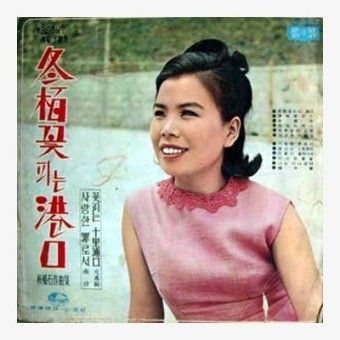
Lee Mi-ja is a singer who has represented the turbulent modern history through her songs and is a history of traditional songs. She was listed in the Guinness Book of Records in 1990 for releasing a total of 560 albums and 2,069 songs, and in 2023, she became the first popular musician to receive the Geumgwan Cultural Medal. She said, "Our music has reached its 100-year history. Amid continuous hardships such as the sorrow of the Japanese colonial period, the joy of liberation, and the pain of the Korean War, our music played a significant role," adding, "Songs that informed us of changes in the times and comforted us will never be forgotten."
© The Asia Business Daily(www.asiae.co.kr). All rights reserved.
![Clutching a Stolen Dior Bag, Saying "I Hate Being Poor but Real"... The Grotesque Con of a "Human Knockoff" [Slate]](https://cwcontent.asiae.co.kr/asiaresize/183/2026021902243444107_1771435474.jpg)

















