Despite escalating trade tensions with the United States, China has set its economic growth target for this year at "around 5%." This is the same target as the year before last and last year, interpreted as an effort to overcome the trade war through boosting domestic demand and additional economic stimulus.
On the 5th, Li Chang, Premier of the State Council of China, expressed confidence in his work report to the National People's Congress (NPC), stating, "The long-term positive trend of the Chinese economy will not change." Xian Danyang, Director of the State Council Research Office, also emphasized the feasibility of achieving the target based on a 5.4% growth rate in the fourth quarter of last year, improvement in the manufacturing Purchasing Managers' Index (PMI) in February, and active cultural tourism consumption.
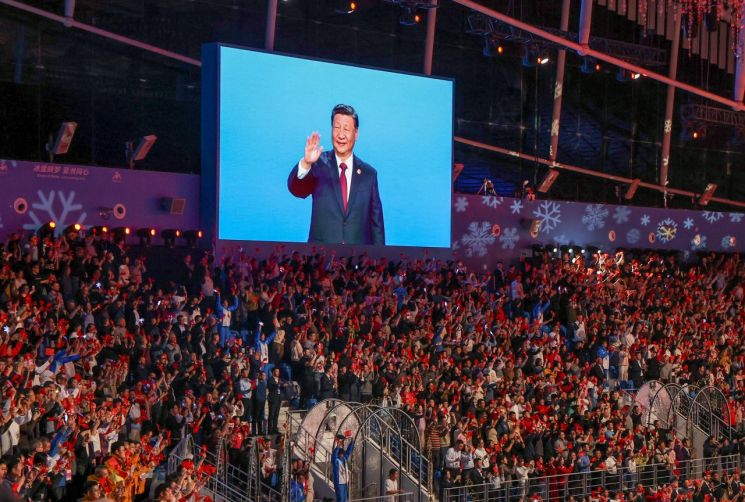 A video showing Chinese President Xi Jinping waving his hand is being played at the opening ceremony of the 9th Harbin Winter Asian Games held on the 7th of last month at the Harbin International Convention and Exhibition Sports Center in China. Photo by Yonhap News
U.S. President Donald Trump recently imposed an additional 20% tariff on Chinese products, and major global institutions forecast China's growth rate at 4.5?4.6%. The Chinese government also set this year’s Consumer Price Index (CPI) target at 2%, the lowest in about 20 years, indicating awareness of deflationary pressures.
China plans to respond with proactive fiscal policies. The fiscal deficit ratio will be expanded to 4% of Gross Domestic Product (GDP), and ultra-long-term special government bonds worth 1.3 trillion yuan and separate special government bonds worth 500 billion yuan will be issued. Local government special-purpose bonds will also be increased to 4.4 trillion yuan.
In particular, boosting domestic demand is set as the top priority, with 300 billion yuan allocated to support the replacement of old products and plans to optimize vacation systems to unlock consumption potential. The word "consumption" was mentioned 31 times in the work report, up from 21 times last year.
Additionally, innovation in artificial intelligence (AI) technology and promotion of the private economy were emphasized. The "AI+ Action" will continue to be promoted, and future industries such as quantum technology, embodied intelligence, and 6G will be nurtured. To protect private enterprises and expand foreign investment, accessibility for overseas investment in telecommunications, healthcare, and education sectors will also be expanded.
© The Asia Business Daily(www.asiae.co.kr). All rights reserved.
![Clutching a Stolen Dior Bag, Saying "I Hate Being Poor but Real"... The Grotesque Con of a "Human Knockoff" [Slate]](https://cwcontent.asiae.co.kr/asiaresize/183/2026021902243444107_1771435474.jpg)















