"Energy Industry Accounts for 59.1% of Emissions...
Urgent Need for Decarbonized Energy Transition"
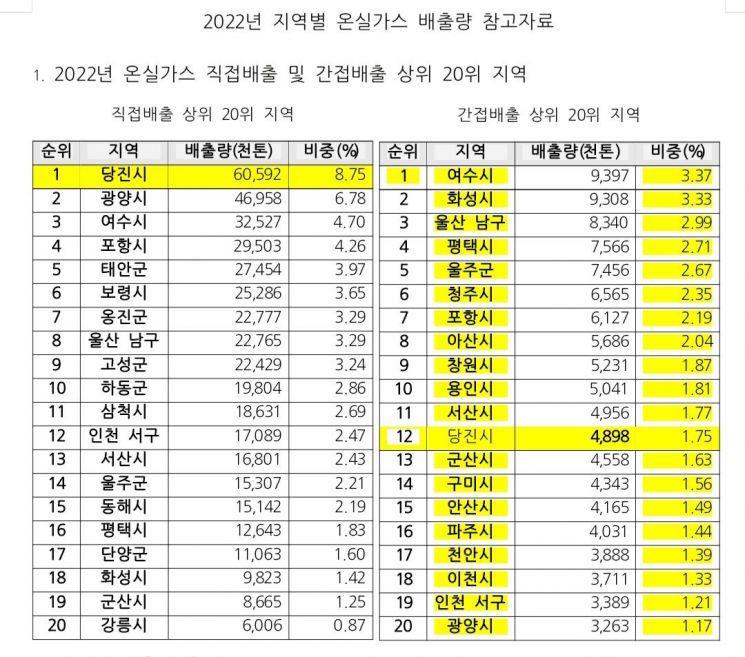
According to an analysis of regional greenhouse gas emissions data by the Dangjin Environmental Movement Federation in Chungnam, as of 2022, Dangjin City's direct greenhouse gas emissions amounted to 60,592,000 tons, ranking first nationwide. Its indirect greenhouse gas emissions were 4,898,000 tons, placing it 12th nationwide.
Of Dangjin City's direct greenhouse gas emissions, emissions from the energy industry accounted for 35,814,000 tons, representing 59.1% of the city's total emissions. This indicates that a transition to decarbonized energy is urgently needed for Dangjin City to achieve carbon neutrality.
The Greenhouse Gas Inventory and Research Center released the "2024 Regional Greenhouse Gas Emissions (2010-2022) Pilot Estimation Results" on its website at the end of January.
The published data is the result of a pilot estimation of direct and indirect greenhouse gas emissions by region for all basic local governments nationwide over the 13 years from 2010 to 2022.
In 2022, Dangjin City's direct greenhouse gas emissions (based on VKT) were 60,592,000 tons, accounting for 8.75% of the total direct emissions of 692,251,000 tons from all cities, counties, and districts nationwide, ranking first among 229 regions.
Indirect greenhouse gas emissions from electricity and heat use, as well as waste, were 4,898,000 tons, placing Dangjin 12th nationwide.
According to the greenhouse gas inventory, Dangjin City's direct emissions are concentrated in the energy sector and in industrial processes and product manufacturing.
The energy sector accounted for 51,343,000 tons, or 84.7%, while industrial processes and product manufacturing accounted for 8,612,000 tons, or 14.2%. Together, these two sectors made up 98.9% of Dangjin City's total direct emissions.
Breaking down the energy sector emissions, the energy industry was responsible for 35,814,000 tons, manufacturing and construction for 14,910,000 tons, and transportation for 422,000 tons.
Dangjin City's direct emissions increased steadily from 46,857,000 tons in 2010 due to the operation of Hyundai Steel's blast furnace and the expansion of Dangjin Thermal Power Plant, then decreased in 2015 and 2016. Emissions rose again, peaking at 67,239,000 tons in 2018, and have shown little fluctuation since 2020.
Dangjin City's indirect emissions are concentrated in electricity use. Emissions from electricity use were 4,797,000 tons, accounting for 97.9% of indirect emissions, with manufacturing and construction accounting for 3,511,000 tons, or 73.2% of total electricity use emissions.
Emissions from heat use were 2,000 tons, and emissions from waste were 98,000 tons.
Meanwhile, among metropolitan governments, Chungnam's direct greenhouse gas emissions in 2022 were 145,555,000 tons, accounting for 21.03% of the total national emissions, ranking first. This was 53,414,000 tons more than Jeonnam, which ranked second with 92,141,000 tons.
In the ranking of direct emissions by region, Dangjin City ranked first, Taean County fifth, Boryeong City sixth, and Seosan City thirteenth, placing four cities and counties in Chungnam among the top 15 nationwide.
Kim Jungjin, Secretary General of the Dangjin Environmental Movement Federation, said, "The reason Dangjin continues to rank first in direct greenhouse gas emissions nationwide is due to the fossil fuel-based economic structure, including the Dangjin Thermal Power Plant and Hyundai Steel, which use coal, and the GSEPS LNG Power Plant." He added, "For Dangjin City to achieve carbon neutrality, it is urgent to transition from fossil fuels such as coal and LNG to renewable energy."
© The Asia Business Daily(www.asiae.co.kr). All rights reserved.
![Clutching a Stolen Dior Bag, Saying "I Hate Being Poor but Real"... The Grotesque Con of a "Human Knockoff" [Slate]](https://cwcontent.asiae.co.kr/asiaresize/183/2026021902243444107_1771435474.jpg)















