Nearly Half of Tax Reduction Benefits: A Profitable Deal
Trump's Second Term Shakes the "CHIPS Support Act"
The Beginning of a Mass Exodus? ... Samsung's Dilemma
The day after TSMC announced a massive investment of $100 billion (approximately 145 trillion KRW) in the United States, President Donald Trump hinted at repealing the 'CHIPS Support Act (CSA),' putting the domestic semiconductor industry on high alert.
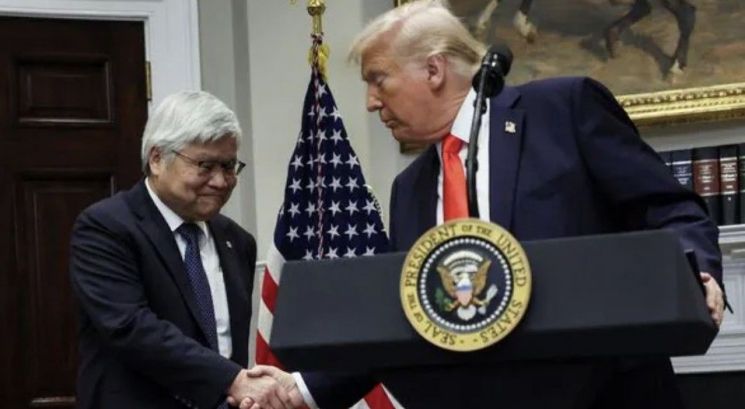 Chairman Wei Zhaojia of TSMC is shaking hands with President Donald Trump ahead of announcing the investment plan in the United States on the 4th (Korean time).
Nearly Half Tax Reduction Benefits: A Profitable Deal
On the 6th, Kyung Hee-kwon, a researcher at the Korea Institute for Industrial Economics and Trade, said in a phone interview with Asia Economy, "TSMC's large-scale investment announcement in the U.S. still demonstrates the strong influence the U.S. holds in determining the global semiconductor market's division of labor," adding, "By expanding production facilities in the U.S., they can reduce tariff burdens and are highly likely to leverage various upcoming U.S. tax reduction laws to cut costs."
The recent announcement by TSMC regarding investment in the U.S. is being interpreted as a move to shift their main production base for customer chips from Taiwan to the U.S. Initially, TSMC planned to operate three factories in Arizona, but now they have stated plans to build two additional production plants, two advanced packaging plants, and a research and development (R&D) center. This indicates their intention to strengthen production capabilities in the U.S.
The tax reduction benefits are pointed out as a key profit TSMC can gain from this change. Considering the various laws currently implemented or soon to be implemented by the U.S. government targeting companies operating semiconductor businesses domestically, it is estimated that TSMC could reduce nearly half of the taxes they would otherwise have to pay for semiconductor manufacturing in the U.S.
Trump's Second Term Shakes the 'CHIPS Support Act'
The CSA, which provides subsidies, low-interest loans, and tax credits of about 10-15% of facility investment, is facing an existential crisis. President Donald Trump argued for the repeal of the CSA during a joint session of Congress the day before. He criticized the CSA as a "terrible bill," pointing out that the subsidy support amounting to hundreds of billions of dollars is ineffective. He emphasized that instead of subsidies, high tariffs should be used to naturally induce companies to invest in the U.S. The semiconductor industry is concerned that if U.S. government investment support disappears, strategies for building production facilities and restructuring supply chains could be disrupted.
However, there is also a forecast that the impact of repealing the CSA may not be significant because the Semiconductor Industry Association (SIA) announced a policy recommendation on January 31 focusing on expanding facility investment tax credits, which could complement the CSA. The recommendation reportedly includes provisions for 25% tax credits on various expenses such as design, software purchases, and outsourcing, providing financial support comparable to the CSA for companies producing semiconductors domestically. If this policy recommendation materializes, TSMC is expected to immediately benefit.
Additionally, there is the 'Trump Tax Cuts and Jobs Act (TCJA),' which reduces corporate tax rates to as low as 15% for U.S. manufacturers and provides 100% tax credits on R&D expenses. Although its official name is the 'Tax Cuts and Jobs Act,' it is more commonly known as the 'Trump Tax Cuts' since it was first promised by President Donald Trump in 2017. This law is set to expire at the end of this year unless Congress decides to extend or revise it, which has not yet happened. Currently, the Republican Party holds the majority in both the Senate and the House, making passage likely. Considering this law as well, it is calculated that TSMC could receive tax credits amounting to approximately 40-55% or more in the U.S. However, since Taiwan plans to implement a 'global minimum tax' starting this year, if the effective tax rate in the U.S. falls below 15%, the scale of tax benefits may decrease. The key issue is whether the U.S. will impose taxes on TSMC at the 15% minimum rate, but there is a significant possibility that the U.S. and Taiwan will offset this through institutional support for TSMC.
The Beginning of a Mass Exodus? ... Samsung's Dilemma

As such, if TSMC actually receives large-scale tax benefits and this information becomes known to the industry, insiders agree that a 'mass exodus' could begin, with global semiconductor companies moving their production facilities en masse from their home countries to the U.S., using TSMC as a signal.
It seems difficult for Korean companies to avoid the market impact following TSMC's announcement. Securing practical benefits has become crucial in deciding which direction to take, with particular attention on Samsung Electronics, which needs to attract U.S. customers in the foundry (semiconductor contract manufacturing) sector. Previously, Samsung Electronics agreed in December last year to receive up to $4.745 billion (approximately 6.8778 trillion KRW) in subsidies from the U.S. government and committed to investing a total of $37 billion by 2030.
Depending on the impact of TSMC's announcement and future market trends, there is speculation that Samsung may accelerate this investment period or increase the scale. Researcher Kyung said, "Samsung's decision to build a foundry plant in Taylor was due to Texas's economic development law, which provides huge tax credits," adding, "Influenced by TSMC's announcement, Samsung may also announce new U.S. investments sooner."
SK Hynix is also investing about 5.2 trillion KRW ($3.87 billion) in West Lafayette, Indiana, to build semiconductor back-end (packaging) production facilities and an R&D center, with potential for additional investments.
© The Asia Business Daily(www.asiae.co.kr). All rights reserved.
![Clutching a Stolen Dior Bag, Saying "I Hate Being Poor but Real"... The Grotesque Con of a "Human Knockoff" [Slate]](https://cwcontent.asiae.co.kr/asiaresize/183/2026021902243444107_1771435474.jpg)
















