Veteran Test Pilots Verify Helicopter Performance
Firing the Cheonggeom at a Virtual Enemy
Automatic Flight Enables Focus on Enemy Detection and Firing
Various aircraft were roaring through the skies above KAI. Along with the KT-1 basic trainer, the Korean Utility Helicopter (KUH-1) Surion and the police version of the Surion, the ‘Chamsuri’ helicopter, were also in flight. To hear explanations about the flight, I entered the pilots' briefing room.
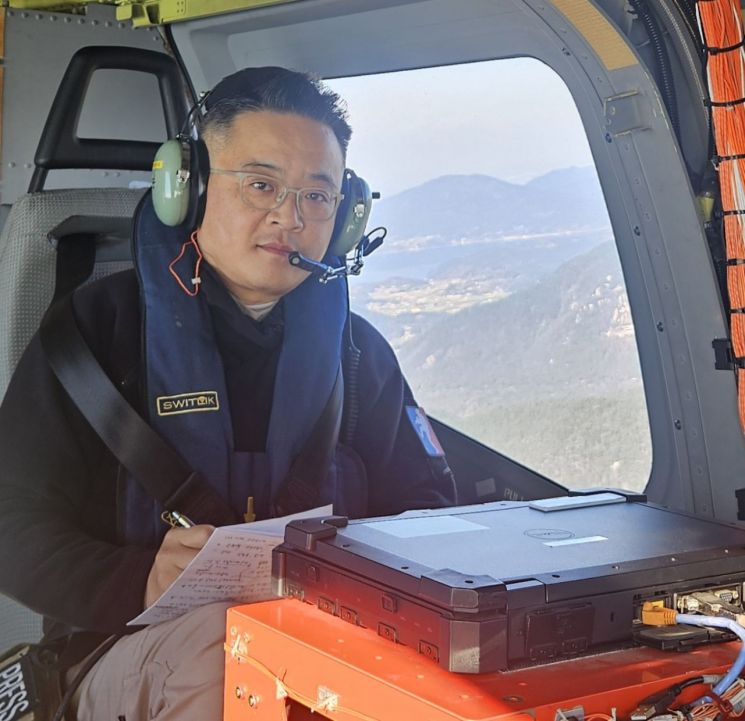 The reporter who boarded the LAH for the first time in the media rode along with two pilots. (Photo by Korea Aerospace Industries)
As if to ease the tension, two test pilots greeted me with bright smiles. Chief Pilot Jo Jeong-hyeok and Chief Pilot Kim Jin-su. The mission of a test pilot is to secure the data engineers need through flight tests of the developed aircraft. They also establish the performance and safe operating limits of the aircraft. Chief Pilot Kim is a veteran who tested the LAH in northern Canada in 2022 by freezing it for 12 hours at below minus 32 degrees Celsius and then checking if it operated normally.
Veteran Test Pilots Verify Helicopter Performance
The total flight time was one hour. The mission was to fly to Changseon Island in the South Sea and then check the operation of the armaments. After the briefing, we moved to the runway. The third prototype of the LAH was on standby. The interior space was about the size of a large van. On the right wall, a computer server was fixed, and there was some spare space at the rear. Unlike attack helicopters deployed to the army such as the Apache Longbow (AH-64D) and Cobra (AH-1Z), whose seats are arranged front to back, the two LAH pilots sat side by side.
Chief Pilot Jo explained how to use the headset, seatbelt, and emergency vest, then inspected the exterior of the helicopter. The pilots began preparing for takeoff by pressing monitors and buttons. A mechanical voice said, “Engine Fire,” indicating that the LAH engine’s fire detection system was functioning normally. The pilots responded with “Number one clear, number two clear.”
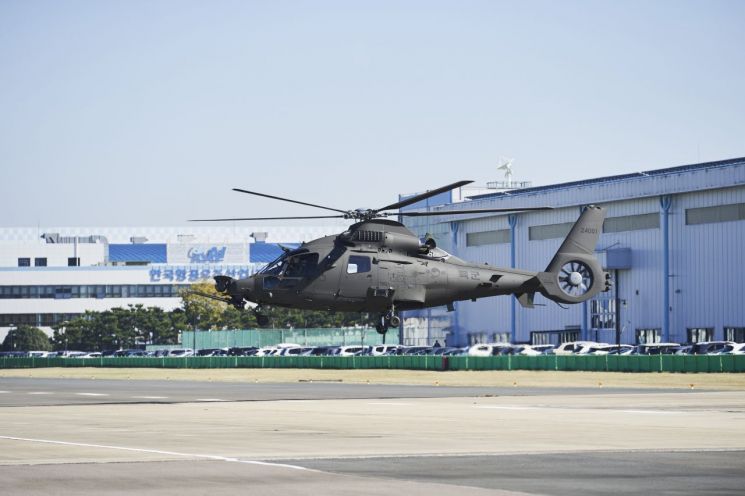 LAH is equipped with a domestically produced 3-barrel 20mm Gatling gun at the front of the fuselage, seven 70mm unguided rockets on the stub wings installed on both sides of the center of the fuselage, and two domestically produced air-to-ground missiles "Cheonggeom" with a range of 8 km each. (Photo by Korea Aerospace Industries)
The helicopter blades began to spin, and a slight movement was felt. My heart started pounding. After seven minutes of preparation, the LAH slowly moved along the runway. Upon reaching the takeoff point, the LAH effortlessly lifted to a height of 2 meters above the ground. It then dipped its nose toward the ground and began flying forward into the air. Reaching an altitude of 300 meters (1000 ft) was instantaneous. Tiny fishing boats, no bigger than fingernails, were visible on the sparkling South Sea. The temporary building of the Aerospace Administration was also in sight.
The LAH accelerated but remained stable without any shaking. When it reached a speed of 180 km/h, the pilots suddenly took their hands off the controls and raised both hands. It was startling. Chief Pilot Jo explained, “Currently, the flight is not being controlled by the pilots but is in automatic flight mode thanks to the autopilot system.” To put it in car terms, it’s autonomous driving. He reassured, “Thanks to this feature, pilots can focus on striking the enemy instead of flying.”
Firing the Cheonggeom at a Virtual Enemy
We simulated encountering enemy tanks. The LAH hid behind a mountain ridge and began automatic hovering in place, like a predator stalking its prey. The pilots closely monitored the electronic optical (EO) and infrared (IR) monitors. EO is used during the day, IR at night. After confirming the enemy tanks, the pilots fired the Cheonggeom missile at the virtual targets.
The LAH is equipped with a domestically produced 3-barrel 20mm Gatling gun at the front of the fuselage, and on stub wings located on both sides of the fuselage center, it carries seven 70mm unguided rockets and two domestically produced air-to-ground missiles called ‘Cheonggeom,’ each with an 8 km range. The Cheonggeom’s range is more than twice that of the Cobra attack helicopter’s missiles, which have a maximum range of 3.75 km. The Cheonggeom is equipped with a dual-mode seeker that uses both visible light and infrared imaging to enhance detection performance. Compared to the Apache’s Hellfire air-to-ground missile, the Cheonggeom has superior guidance capabilities and similar range and penetration power. This superior armament capability compared to similar foreign models is why the LAH is called the ‘Korean Apache.’
Automatic Flight Enables Focus on Enemy Detection and Firing
After completing the mission, the pilots accelerated to let me feel the LAH’s maneuverability. It began a rapid descent over the middle of the sea. Sweat broke out all over my body. Automatically, my hands gripped the seat, and my eyes squeezed shut. The helicopter flew weaving left and right along the mountain ridges. Looking out the window, individual trees below were clearly visible. The pilots continued flying without concern.
A warning sound rang out: “Torque (TQ), Torque (TQ).” This is an automatic warning voice that sounds during rapid maneuvers. The LAH began firing at the virtual enemy in the air. The 20mm Gatling gun mounted at the front of the helicopter turned toward the direction the pilot was looking. The helmet linked to the Target Acquisition and Designation System (TADS) moves the gun in sync with the pilot’s head movements. On the way back, the Boriam temple on the cliff of Geumsan Peak (681m above sea level) came into view. The German Village and the fishing villages of Namhae were also visible. Before landing at the KAI airfield, the pilots checked the landing checklist on the monitor and prepared for landing. After touching down on the runway, they shut down the engine and all systems. When all five blades stopped spinning, a sigh of relief was possible.
Chief Pilot Jo said, “The LAH maintains stability even when firing without the pilot holding the controls,” adding, “During flight at speed, it meets level 1 to 2 maneuverability requirements according to U.S. military standards.”
© The Asia Business Daily(www.asiae.co.kr). All rights reserved.
![Clutching a Stolen Dior Bag, Saying "I Hate Being Poor but Real"... The Grotesque Con of a "Human Knockoff" [Slate]](https://cwcontent.asiae.co.kr/asiaresize/183/2026021902243444107_1771435474.jpg)
















