Ministry of Agriculture, Food and Rural Affairs Announces "Mid- to Long-term Livestock Quarantine Development Plan"
Transition from Government-led to Region- and Private Sector-centered Approach
Promoting "Smart Quarantine" Using Big Data to Identify High-risk Areas and Farms
The government-led livestock quarantine system aimed at blocking major livestock infectious diseases such as foot-and-mouth disease and highly pathogenic avian influenza (AI) will shift to a region- and private sector-centered approach. Although the government's quarantine rules and facility enhancements have so far succeeded in preventing large-scale outbreaks of livestock infectious diseases, it has been determined that without voluntary participation, there are clear limitations, as some farms still violate basic quarantine rules.
The Ministry of Agriculture, Food and Rural Affairs announced the "Mid- to Long-term Livestock Quarantine Development Plan" containing these details at the National Policy Issues Ministerial Meeting held on the 5th.
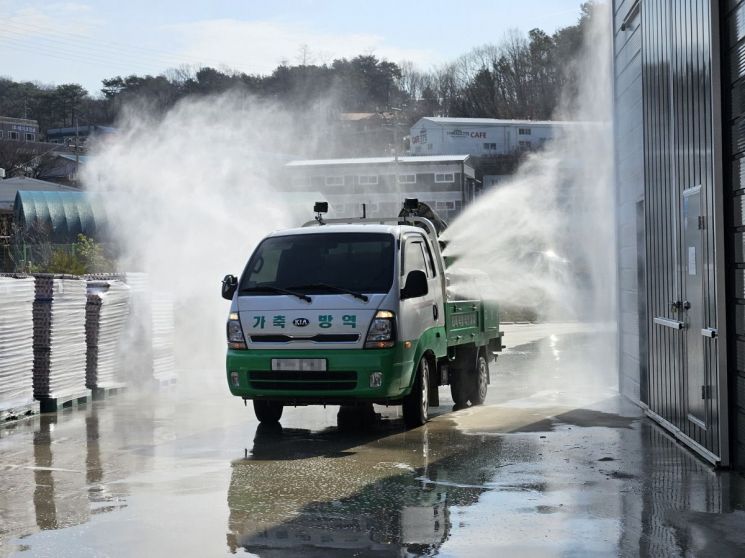
An official from the Ministry of Agriculture, Food and Rural Affairs explained, "Until now, we have implemented a regulatory approach led by the government, including quarantine rules and facility enhancements to block foot-and-mouth disease and AI. The final stage is for farms to disinfect and quarantine themselves, but this part is insufficient, and farms raise the issue that there are too many regulations, making compliance difficult. We judge that without voluntary awareness changes from farms and regions, there are limits to blocking infectious diseases. Therefore, local governments will establish quarantine rules that farms can follow, and incentives will be strengthened to encourage participation by providing rewards when these are implemented."
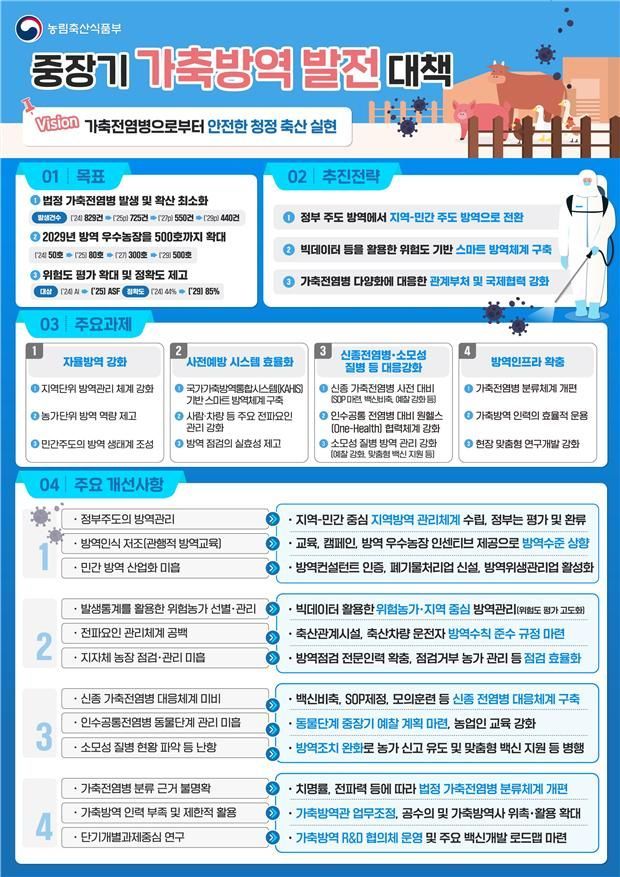
The main tasks of this plan are ▲ strengthening autonomous quarantine ▲ streamlining the preemptive prevention system ▲ enhancing response to new infectious and consumptive diseases ▲ expanding quarantine infrastructure.
◆Quarantine system shifts from government-led to region- and private sector-centered= Local governments will establish customized quarantine management plans based on regional conditions, and the government will manage and support the implementation of these plans, establishing a region-led autonomous quarantine system. Specifically, metropolitan local governments will formulate livestock infectious disease prevention and management measures every three years, and basic local governments will annually establish quarantine plans such as managing high-risk farms and livestock-related facilities, quarantining dense livestock complexes, and managing key quarantine control zones, considering past livestock infectious disease occurrences.
The Ministry of Agriculture, Food and Rural Affairs will evaluate local governments' quarantine measures and prioritize support for quarantine-related projects for excellent local governments starting in 2026. Incentives such as exemption from culling and quarantine inspections and priority support for livestock businesses will be expanded and strengthened for farms with excellent quarantine performance.
Farms violating quarantine rules will be required to undergo additional mandatory education. Furthermore, the scope of mandatory quarantine education will be expanded beyond existing farm owners to include workers who actually manage livestock and drivers of manure and feed vehicles entering farms. A farm autonomous quarantine campaign, tentatively titled "I Protect My Farm," will also be continuously promoted in collaboration with producer organizations.
Efforts will also be made to foster a private industrial ecosystem related to livestock infectious disease prevention and management. To activate quarantine hygiene management businesses specializing in farm disinfection and pest control, standard manuals for disinfection and pest control will be produced and distributed. From 2026, a certification system for excellent consultants will be introduced to nurture the private consulting industry. Additionally, the participation of private disease diagnostic institutions in regular surveillance of livestock infectious diseases, currently led by city and provincial livestock quarantine agencies, will be continuously expanded. A new livestock waste disposal business specializing in culling and carcass disposal will be established to promote industrialization in related fields while strengthening the management of quarantine vulnerabilities during the culling process.
◆Strengthening the preemptive prevention function of livestock infectious diseases= Efforts will be made to minimize social costs such as livestock culling and price increases caused by outbreaks through strengthening preemptive prevention functions.
First, smart quarantine will be promoted by efficiently allocating quarantine resources such as surveillance and disinfection through big data analysis of farm facilities, breeding status, surrounding terrain, vehicle entry frequency, and vector distribution to select high-risk areas and farms. The artificial intelligence-based risk assessment, which has been piloted for highly pathogenic avian influenza since the end of last year, will be expanded to African swine fever (ASF) this year. The risk assessment indicators will be diversified and advanced to increase the evaluation accuracy from 44% last year to 85% by 2029.
Additionally, from 2026, quarantine information within the National Animal Health Integrated System (KAHIS), such as livestock vehicle traffic volume and infectious disease occurrence data, will be disclosed to the private sector. A "Next-generation KAHIS Transition Roadmap" will be prepared to advance disease analysis and prediction.
◆Strengthening response to new diseases such as caprine foot-and-mouth disease and African horse sickness= The government plans to proactively establish preparedness systems for caprine foot-and-mouth disease and African horse sickness, which have occurred in neighboring countries such as China and Thailand and have a high possibility of entering the country. From this year, surveillance of major vectors for caprine foot-and-mouth disease (wild gorani, etc.) and African horse sickness (flies, mosquitoes, etc.) will be conducted to determine whether the viruses have entered the country. Vaccines for caprine foot-and-mouth disease and African horse sickness will be stockpiled for 160,000 heads (30% of all goats) and 28,000 heads (one dose for all horses nationwide), respectively, and emergency standard operating procedures (SOPs) will be prepared for each disease.
Management of zoonotic livestock infectious diseases transmissible to humans will be further strengthened. Due to recent continuous cases in the United States where highly pathogenic avian influenza has infected humans via dairy cattle, influenza testing for mammals such as dairy cattle will be enhanced. To establish a rapid response system in case of domestic occurrence, the emergency action guidelines for mammalian AI will be supplemented, and virtual quarantine drills will be conducted.
For consumptive diseases such as porcine epidemic diarrhea (PED) and porcine reproductive and respiratory syndrome (PRRS), which are difficult to monitor and manage due to farmers' reluctance to report outbreaks, quarantine measures such as movement restrictions on affected farms will be relaxed to encourage reporting. Regular testing for consumptive diseases will be conducted targeting 500 pig farms by 2025.
In addition, the Ministry of Agriculture, Food and Rural Affairs plans to specify and reclassify statutory livestock infectious diseases, which are currently simply categorized from Type 1 to Type 3 without clear criteria, based on fatality rates and transmissibility. Major quarantine measures such as temporary movement bans and culling will also be systematized to be applied differentially by disease type according to the new classification criteria and disease risk levels.
Minister Song Mi-ryeong of the Ministry of Agriculture, Food and Rural Affairs said, "This plan is significant in that it addresses quarantine policies encompassing prevention, outbreak response, and post-management, not just specific livestock infectious diseases. The government will faithfully implement this plan to minimize the occurrence and damage of livestock infectious diseases, and we ask local governments and the private sector to also strive for the transition to region- and private sector-led autonomous quarantine."
© The Asia Business Daily(www.asiae.co.kr). All rights reserved.
![Clutching a Stolen Dior Bag, Saying "I Hate Being Poor but Real"... The Grotesque Con of a "Human Knockoff" [Slate]](https://cwcontent.asiae.co.kr/asiaresize/183/2026021902243444107_1771435474.jpg)
















