Asian NATO: "Not Opposed, but Skeptical"
"Taiwan's Fall Would Be a Disaster for the U.S.... Must Do Its Part Like South Korea"
Elbridge Colby, nominee for the U.S. Department of Defense Policy Deputy Secretary, raised doubts about the sustainability of trilateral security cooperation among South Korea, the U.S., and Japan, citing South Korea's political situation on the 4th (local time).
Colby, who served in the first term of President Donald Trump's administration, appeared before the Senate Armed Services Committee hearing that day and, when asked about his views on an "Asian version of NATO," said, "Given South Korea's political situation over the past 6 to 8 months, it is unclear whether it can continue," expressing his concerns.
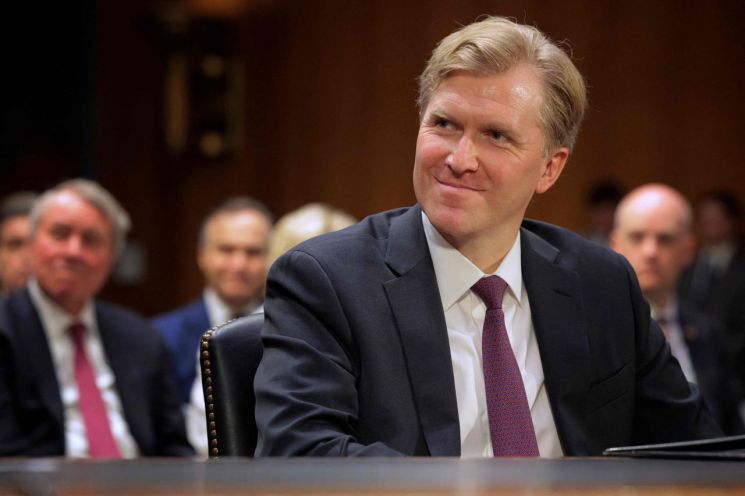 Elbridge Colby, Nominee for U.S. Department of Defense Deputy Secretary of Policy. Photo by Getty Images Yonhap News
Regarding the Asian NATO, he said, "Theoretically, I am not opposed to it, but I am skeptical," adding, "Foundational work and political capital are being invested for a multilateral (security) organization, and something multilateral could be established in the region, but it is not an ambition as grand as an Asian NATO."
He cited the reason that Japan, India, and Australia are in different positions, adding, "Their environments are also quite different."
When asked about his past statement that "nothing threatens the U.S. more than China's invasion of Taiwan," and his changed stance last November that "the U.S. has strong interests in defending Taiwan, but the U.S. can survive without Taiwan," he replied, "My value regarding Taiwan is consistent. Defeat and fall of Taiwan would be a disaster for U.S. interests." He also said, "What I am concerned about is that the (U.S.-China) military balance has weakened," and "Taiwan is very important to the U.S., but it is not an existential interest."
He argued that Taiwan's current defense budget is less than 3% of its Gross Domestic Product (GDP) and should be raised to 10%.
Colby expressed his opinion on the recent reduction of Taiwan's defense budget by the Legislative Yuan, saying, "I am quite disturbed," and added, "In policy dialogues and recommendations with Taiwan, we have tried by all possible means to encourage them to be similar to South Korea, for example." He also mentioned Taiwan's TSMC investment plans in the U.S., saying, "It is an incredibly wealthy country, so I do not understand why they are not spending at a level commensurate with the threat."
Regarding South Korea, he said, "It is a reliable model with a much stronger military," and added, "If the alliance does not do its part, it is not only unfair to demand pain from the U.S. military but also unfeasible."
Colby described the NATO alliance as "very successful," but pointed out, "However, for it to continue, it must move in the direction led by President Trump. The post-Cold War NATO model is too heavily focused on U.S. responsibility." He also argued that NATO member countries' defense levels should be expanded to Cold War levels.
Regarding the recent close cooperation among North Korea, China, Russia, and Iran, he said it causes confusion as a kind of counter-coalition against the West, pointing out, "The cornerstone of that coalition is China." Colby said, "China has the largest economy, and through China's exports, Russia can continue the war in Ukraine." He added, "Russia is helping Iran and North Korea," and said, "Therefore, from a defense perspective, we must work with allies to fill the gaps around us."
On allied defense contributions, he criticized, "Israel, South Korea, and Poland are really doing their part, but the large economies in the alliance network are not doing their share."
He also said, "I do not want to give up on the Middle East, nor do I want a nuclear-armed Iran. I do not want Russia to ruthlessly trample Europe or North Korea to occupy South Korea," while also emphasizing the importance of setting strategic priorities, saying multiple major issues cannot be addressed simultaneously. However, he did not specify what he considers strategic priorities. He also claimed that Iran's nuclear armament would pose an 'existential risk' to the U.S.
Additionally, regarding questions about who started the Russia-Ukraine war, Colby drew a line, saying he does not want to undermine President Trump's efforts for a ceasefire agreement.
© The Asia Business Daily(www.asiae.co.kr). All rights reserved.
![Clutching a Stolen Dior Bag, Saying "I Hate Being Poor but Real"... The Grotesque Con of a "Human Knockoff" [Slate]](https://cwcontent.asiae.co.kr/asiaresize/183/2026021902243444107_1771435474.jpg)















