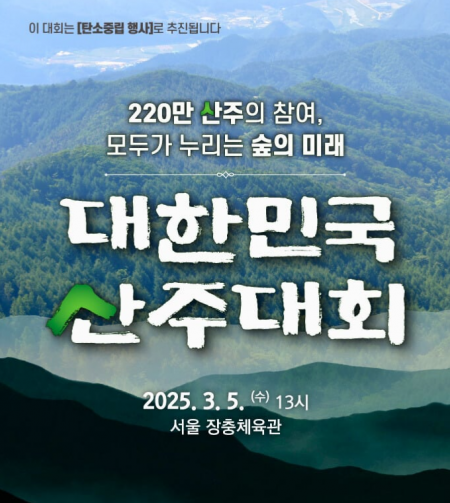
The "Republic of Korea Forest Owner Conference" was held again in Seoul after 45 years since 1980. The Forest Owner Conference was organized to explain the changed forest paradigm to forest owners and to encourage their direct and indirect participation in forest management.
On the 5th, the Korea Forest Service held the Forest Owner Conference at Jangchung Gymnasium in Seoul together with the Korea Federation of Forest Cooperatives. The Forest Owner Conference is a gathering where forest owners from across the country share their forest management experiences, attracting a crowd close to 4,000 people. Previously, 3,659 forest owners participated in the pre-registration conducted by the Korea Forest Service, showing high interest in forest management.
Under the slogan "Participation of 2.2 million forest owners, a future forest enjoyed by all," the event was filled with sessions introducing forest management support systems such as the forest pension-type private forest purchase and forestry direct payment system, as well as income increase plans utilizing forest resources like forest products and timber production.
On-site, forest owners who achieved results in complex management combining forests and forestry, forest management experience forests operating experiential programs using forests, and landscaping tree cultivation gathered in one place to share their skills and experiences, receiving positive responses from participants.
Broadly speaking, forest policy shifted paradigms from national land greening in the 1970s and 1980s to resource circulation since the 1990s.
For example, at the time of establishing the "1st Erosion Control and Afforestation Plan" in 1972, South Korea had 830,000 hectares (12.5%) of its total forest area of 6.67 million hectares without trees, and the growing stock volume was only 10.6 cubic meters per hectare. Reflecting this, past Forest Owner Conferences focused on "national land greening." It was a venue strongly reflecting the government's will to achieve national land greening by encouraging forest owners' participation.
However, after succeeding in national land greening, South Korea's forest growing stock volume increased to 172.4 cubic meters per hectare (15.6 times compared to 1972), and the timber self-sufficiency rate rose to 17.4% as of 2023. This marks the background of the shift in forest policy from national land greening to forest resource utilization.
The value of forests has also increased. Unlike the past, which focused simply on producing forest products and timber, today more weight is added to intangible public values such as carbon absorption and storage, air purification, and water source replenishment (estimated at 259 trillion KRW annually).
However, the ownership structure of private forests has become fragmented, and the phenomenon where absentee forest owners?whose residences do not coincide with the forest location?outnumber resident forest owners has become more pronounced, worsening the conditions for private forest management.
For example, the number of private forest parcels increased from 3.84 million in 2005 to 4.92 million in 2023 (fragmentation), and during the same period, the proportion of forest owners owning less than 3 hectares rose from 83.1% to 88.6%. This is interpreted as a phenomenon caused by parcel division during inheritance of private forests from elderly forest owners to their children.
The problem is that the more this phenomenon continues, the more difficult decision-making in forest (private forest) management may become. This leads to concerns that the fragmentation process (dispersal of ownership) lowers the economic viability of forests, causing forest owners to lose interest in forest management as in the past, which may increase the amount of neglected forests.
The Korea Forest Service’s decision to revive the Forest Owner Conference after 45 years this year is explained in connection with this. The Korea Forest Service’s plan is to revive the experience of successfully leading national land greening through the participation of forest owners in the past and to promote regional economic revitalization based on forests by encouraging forest owners’ participation in forest management through the conference.
Im Sang-seop, Administrator of the Korea Forest Service, said, “I hope the Forest Owner Conference has become an opportunity to further activate forest owner-centered forest management,” and added, “The Korea Forest Service will continue to do its best to promote the rights and interests of 2.2 million forest owners and to revitalize forest management.”
© The Asia Business Daily(www.asiae.co.kr). All rights reserved.
![Clutching a Stolen Dior Bag, Saying "I Hate Being Poor but Real"... The Grotesque Con of a "Human Knockoff" [Slate]](https://cwcontent.asiae.co.kr/asiaresize/183/2026021902243444107_1771435474.jpg)















