January 2025 Housing Statistics by the Ministry of Land, Infrastructure and Transport
1,352 Unsold Homes in Seoul, Up 41% in One Month
Seoul Metropolitan Area Leads Unsold Home Surge... Overlapping Supply and Transaction Cliffs
Malignant Unsold Homes Nationwide Reach 22,872 Units... 18 Consecutive Months of Increase
Even Seoul, where housing preference is the highest nationwide, has fallen into the swamp of unsold homes. In just one month, the number of unsold houses in the Seoul area increased by more than 40% compared to the previous month. The number of units surpassed 1,000, marking the largest scale in 10 years. While the provinces, which had been driving the nationwide increase in unsold homes, have slowed down, unsold homes in Seoul and the greater metropolitan area suddenly surged. Moreover, with the 'transaction cliff' and 'supply cliff' coinciding, the housing market is on a path of continuous deterioration.
Even Seoul Sees Sharp Increase in Unsold Homes... Over 40% Rise in One Month
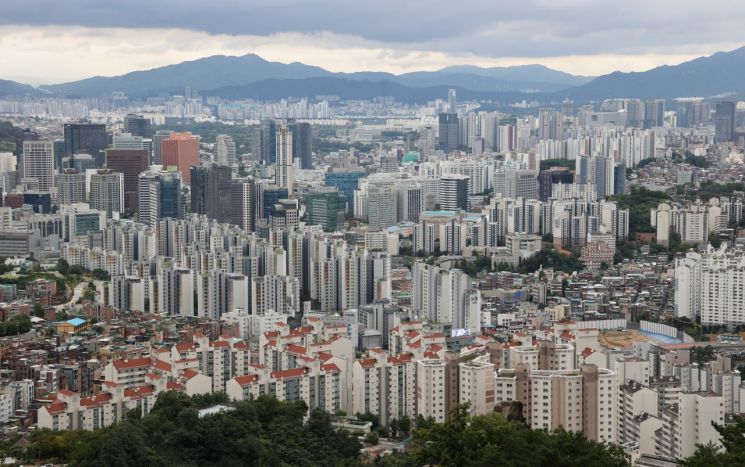
According to the 'January 2025 Housing Statistics' released by the Ministry of Land, Infrastructure and Transport on the 27th, the number of unsold homes in Seoul totaled 1,352 units. This is a 41.3% surge compared to the previous month (957 units). It is the first time since June 2023 (1,181 units) that Seoul's unsold homes have exceeded four digits. It is also the largest scale in 10 years since January 2015 (1,497 units). Leading the trend of 'one smart home' and 'Eoljuksin (newly built no matter how cold)', Seoul, which has the highest housing preference nationwide, is rapidly experiencing a spread of unsold homes. Industry insiders say that the actual number of unsold homes in Seoul may have exceeded 2,000 units. Since unsold statistics are based on voluntary reports by project owners, there is a tendency to 'underreport' due to fear of revealing unsold inventory.
Yang Ji-young, senior asset management consultant at Shinhan Investment Corp., said, "Last year, the supply volume in Seoul increased by nearly 50% compared to the previous year, centered on Gangdong-gu and Dongdaemun-gu, so supply temporarily exceeded demand. Since polarization is progressing by district in Seoul as well, it may take some time to resolve unsold homes." She also added, "Because this is a sudden surge, we need to observe further to determine whether it is a temporary phenomenon."
The construction industry maintains confidence in the Seoul market. The scale of housing starts in Seoul increased by 56.5%, from 1,306 units to 2,044 units in January. Nationwide, the number was 10,178 units, a 55.7% decrease compared to 22,975 units a year ago. The proportion of Seoul in total housing starts also rose sharply from 5.7% to 20%. This reflects the belief that despite the sudden occurrence of unsold homes, demand in Seoul remains strong. The impact of changes in housing starts will begin to affect supply in earnest 2 to 3 years later.
'Empty New Homes' Accumulate... Worst in Over 11 Years
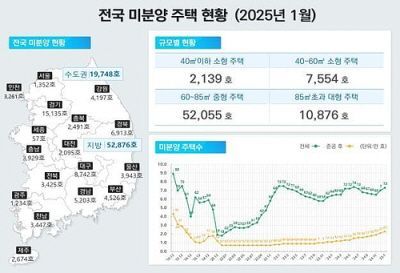
The greater metropolitan area, including Seoul, also saw an increase in unsold homes to 19,748 units, up 16.2% from 16,997 units the previous month. Compared to December last year, Gyeonggi Province increased from 12,954 units to 15,135 units (16.8%), and Incheon rose from 3,086 units to 3,261 units (5.7%). Even though there were no new housing supply volumes in the metropolitan area in January, the rise in unsold homes was significant. Meanwhile, the provinces, which had been driving the increase in unsold homes, decreased slightly by 0.6%, from 53,176 units to 52,876 units. The total nationwide unsold homes, combining the metropolitan area and provinces, continued to rise for the second consecutive month to 72,624 units.
The so-called 'malignant unsold homes,' referring to unsold homes after completion, are also not decreasing easily. Nationwide, the number increased by 4.6%, from 21,480 units in December 2024 to 22,872 units in January. This marks the 18th consecutive month of increase and is the largest scale since October 2013, when there were 23,306 units. The number of 'empty homes after construction completion' increased across all regions, including Seoul and Incheon (10.4%), Gyeonggi (0.8%), and provinces (6.9%), with Seoul rising 2.8% compared to the previous month.
The housing market is also overshadowed by other dark clouds called the 'supply cliff' and 'transaction cliff.' In January, the number of sales transactions was 38,322, down 16.5% from 45,921 in the previous month. The decline was more severe in the provinces (-20.3%) than in the metropolitan area (-11.8%). The supply volume in January also decreased sharply, with the metropolitan area at 3,617 units, down 54.2% compared to the same period last year. The provinces saw a 35.5% decrease to 3,823 units.
© The Asia Business Daily(www.asiae.co.kr). All rights reserved.
![Clutching a Stolen Dior Bag, Saying "I Hate Being Poor but Real"... The Grotesque Con of a "Human Knockoff" [Slate]](https://cwcontent.asiae.co.kr/asiaresize/183/2026021902243444107_1771435474.jpg)
















