"The Constitutional Right of the National Assembly to Form the Constitutional Court Rendered Hollow"
Petition to Immediately Recognize Ma as Justice Dismissed
Attention Focused on Timing of Acting Prime Minister Choi's Appointment of Ma
On the 27th, the Constitutional Court unanimously decided with all eight justices that Acting Prime Minister and Minister of Economy and Finance Choi Sang-mok infringed upon the National Assembly's authority in the case filed by Speaker Woo Won-sik against him regarding the 'non-appointment' of Ma Eun-hyuk as a Constitutional Court justice candidate.
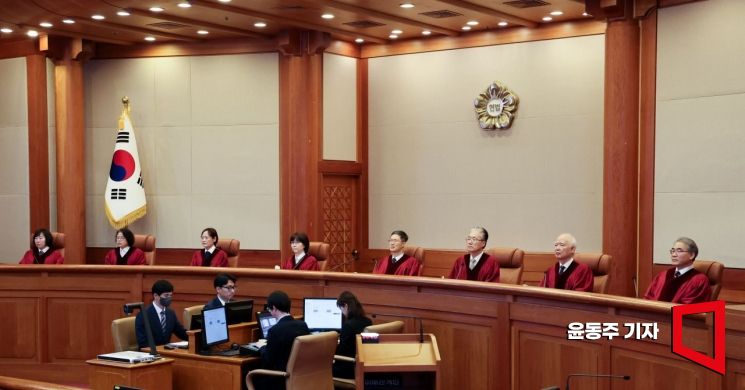 Acting Chief Justice Moon Hyung-bae and other Constitutional Court justices are seated at the Constitutional Court in Jongno-gu, Seoul, on the 27th, attending the case regarding the dispute over authority related to the appointment suspension of candidate Ma Eun-hyuk, filed by National Assembly Speaker Woo Won-sik against Acting President Choi Sang-mok. Photo by Yoon Dong-joo
The Constitutional Court stated, "Acting Prime Minister Choi, as Acting President, not appointing Ma Eun-hyuk, who was elected by the National Assembly, as a justice constitutes an infringement on the National Assembly's constitutional right to form the Constitutional Court through the selection of justices." The Court further said, "It is impermissible for the President or Acting President to refuse to appoint a person elected by the National Assembly without justifiable reasons, citing their own appointment authority, as this nullifies the Constitutional Court formation rights granted to the National Assembly, the representative body of the people."
The Constitutional Court is composed of nine justices: three appointed directly by the President, three nominated by the Chief Justice of the Supreme Court and appointed by the President, and the remaining three elected by the National Assembly and appointed by the President. Thus, the executive, legislative, and judicial branches each exercise appointment rights over three justices. This decision confirms that Acting Prime Minister Choi infringed upon the National Assembly's substantive appointment rights.
The Constitutional Court's decisions generally carry binding force, meaning state agencies and individuals are obligated to act according to the Court's rulings. However, there are no penalties or sanctions for non-compliance, indicating a lack of coercive power. Moreover, the Court did not specify when Acting Prime Minister Choi must appoint Ma Eun-hyuk, so his judgment may influence the schedule of President Yoon's impeachment trial and other related matters.
If Acting Prime Minister Choi appoints Ma Eun-hyuk early, the Constitutional Court will have a full bench of nine justices, potentially allowing the resumption of the impeachment trial for President Yoon, which concluded its hearings on the 25th. This is because the Court could issue a ruling with a full nine-member panel to dispel controversies surrounding the 'eight-member system.' To do so, the trial would need to be reopened and renewed, likely delaying the verdict.
Even if Ma Eun-hyuk is appointed as a justice, he may choose to recuse himself from participating in President Yoon's impeachment trial. In that case, the final decision would be made by the remaining eight justices without a renewed hearing process, with the verdict expected around mid-March.
Meanwhile, the Court dismissed the petition requesting confirmation of Ma Eun-hyuk's status as a justice, deeming it inappropriate. The Court explained, "This petition asks the Court to issue a decision granting Ma Eun-hyuk the legal status of a justice, which goes beyond confirming an infringement of authority and lacks a basis in the Constitution and the Constitutional Court Act, thus it is inadmissible." Regarding the legality of Speaker Woo's petition without going through a plenary session, the Court concluded that "there is no problem."
The Constitutional Court reportedly holds daily deliberations on President Yoon's impeachment case. These deliberations involve all justices, with the presiding justice summarizing issues for discussion, followed by individual opinions from each justice. According to legal experts, the deliberations are expected to last about two weeks, following precedent.
In addition to President Yoon, the Constitutional Court is preparing rulings on impeachment trials for five officials from the current administration. These include Prime Minister Han Duck-soo, Board of Audit and Inspection Chairman Choi Jae-hae, and three prosecutors: Lee Chang-soo, Chief of the Seoul Central District Prosecutors' Office; Cho Sang-won, Fourth Deputy Chief of the Central District Prosecutors' Office; and Choi Jae-hoon, Head of the Anti-Corruption Division 2 of the Central District Prosecutors' Office. Prime Minister Han concluded his hearing on the 19th, Chairman Choi on the 12th, and the three prosecutors on the 24th.
© The Asia Business Daily(www.asiae.co.kr). All rights reserved.
![Clutching a Stolen Dior Bag, Saying "I Hate Being Poor but Real"... The Grotesque Con of a "Human Knockoff" [Slate]](https://cwcontent.asiae.co.kr/asiaresize/183/2026021902243444107_1771435474.jpg)















