Breaking Down by Item: Inflation Rises 0.35%p When Exchange Rate Jumps 10%
During Recent 'Rapid Exchange Rate Surge' Periods, Inflation Exceeds 0.35%p Increase
Even If Exchange Rate Stabilizes After a Surge, Long-Term Sensitive Items Like Chicken and Domestic Airfare
Remain Inflationary Factors in the Second Half... Variables Threatening 'Price Stability' This Year
At the end of last year, a sharp rise in the exchange rate was analyzed to pose a greater threat to price stability this year than previously expected. This conclusion was drawn by examining the impact of exchange rate fluctuations on individual items separately. Even if the exchange rate stabilizes after a period of rapid increase, long-term sensitive items, mainly services with relatively high price persistence such as chicken and domestic airfare, are expected to be potential inflationary factors in the second half of this year. According to this analysis, inflation this year could exceed the Bank of Korea's forecast of 1.9% presented the day before.
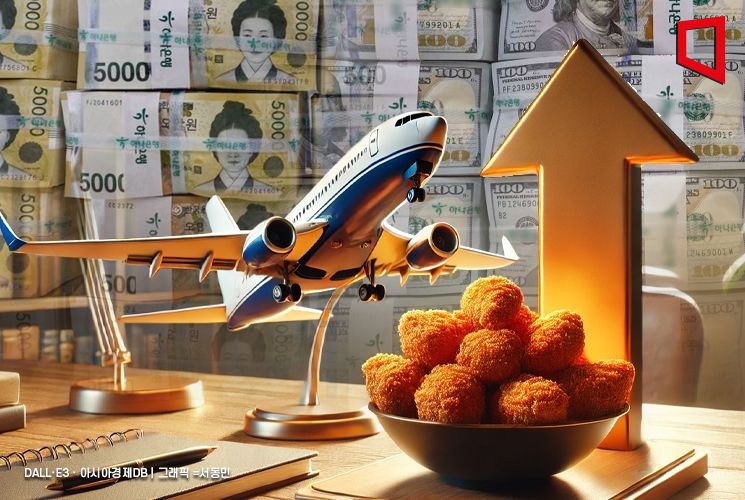
Breaking Down the Impact by Item...When Exchange Rate Rises 10%, Inflation Increases by 0.35%P
On the 27th, the Bank of Korea announced in its report titled 'Analysis of the Short- and Long-term Pass-through Effects of Exchange Rates on Inflation: Focusing on Transmission Channels through Individual Items' that when the annual average KRW-USD exchange rate rises by 10%, the annual consumer price inflation rate increases by 0.35 percentage points. This result was obtained by examining the impact of exchange rate fluctuations on inflation through individual items, concluding that the effect is greater than the previously known '0.2 to 0.3 percentage points increase in inflation when the exchange rate rises by 10%'. In particular, even if the exchange rate stabilizes afterward, the previously high exchange rate level will continue to affect inflation over a longer period, especially for core items, remaining a potential inflationary factor in the second half of this year.

Jang Gang-cheol, Deputy Head of the Price Trends Team at the Bank of Korea's Research Department, stated, "Considering the exchange rate effects appearing over both short and long terms, the pass-through effect of the KRW-USD exchange rate on inflation is estimated at 0.28 percentage points for the short-term effect and 0.19 percentage points for the long-term effect when the exchange rate changes by 10 percentage points." This corresponds to the previously mentioned '0.35 percentage points increase in annual consumer price inflation when the annual average exchange rate rises by 10%'. The pass-through effect is divided into a 60:40 ratio between short-term and long-term effects. The pass-through of exchange rates to consumer prices peaks nine months after the exchange rate change and then gradually decreases.
Especially when focusing on periods like recently, where the exchange rate rose sharply and remained elevated for more than three months, both the short-term effect (0.31 percentage points) and the long-term effect (1.30 percentage points) increased, with the long-term effect rising much more significantly. Deputy Head Jang explained, "Companies that had delayed price increases may join in raising prices if the exchange rate rise prolongs, thereby expanding the pass-through effect of exchange rates on inflation." This suggests that even if the exchange rate falls in the future, the previous sharp rise in exchange rates could remain an inflationary factor in the second half of this year.
"When Exchange Rates Jump... Gasoline and Bananas Rise Immediately, While Kalguksu and Bath Fees Increase Over Time"
Which items were sensitive to exchange rates, and how did they affect inflation in the short and long term? Among 458 consumer price survey items, the Bank of Korea identified 45 items (with a weight of 11.3%) as short-term sensitive items that showed relatively large inflation responses within three months after exchange rate changes. The long-term sensitive items, which showed significant cumulative effects over nine months, numbered 73 (15.1%). Among the 45 short-term sensitive items, about half (22 items) were non-core items. Energy items such as gasoline, diesel, and kerosene accounted for 6 items, and food items such as imported beef, oranges, and bananas accounted for 16 items. The long-term sensitive items had a higher proportion of core items, totaling 55. There were many service items with relatively high price persistence, such as dining out items like beef, kalguksu (hand-cut noodle soup), and chicken (19 items), and personal services like domestic airfare, bath fees, and car rental fees (17 items).

Matching detailed price items with industry input-output tables, the analysis showed that these exchange rate sensitive items tend to have a high input of imported intermediate goods in their production processes compared to non-sensitive items. In particular, the proportion of imported intermediate inputs in short-term sensitive items was 37.4%, significantly higher than the 14.2% for non-sensitive items. Long-term sensitive items (16.3%) also had a higher proportion than non-sensitive items. Deputy Head Jang said, "Items whose price increases respond strongly to exchange rate fluctuations tend to have a higher dependence on imported intermediate inputs."
By weighting and summing the prices of short- and long-term exchange rate sensitive items separately, the Bank of Korea explained that short-term sensitive prices exhibited greater volatility compared to long-term sensitive prices. During recent periods of rapid exchange rate increases, short-term sensitive prices showed rapid fluctuations, while long-term sensitive prices fluctuated less but showed prolonged effects of exchange rate changes with a time lag. Non-sensitive items showed less volatility in price increases compared to sensitive items.
© The Asia Business Daily(www.asiae.co.kr). All rights reserved.
![Clutching a Stolen Dior Bag, Saying "I Hate Being Poor but Real"... The Grotesque Con of a "Human Knockoff" [Slate]](https://cwcontent.asiae.co.kr/asiaresize/183/2026021902243444107_1771435474.jpg)

















