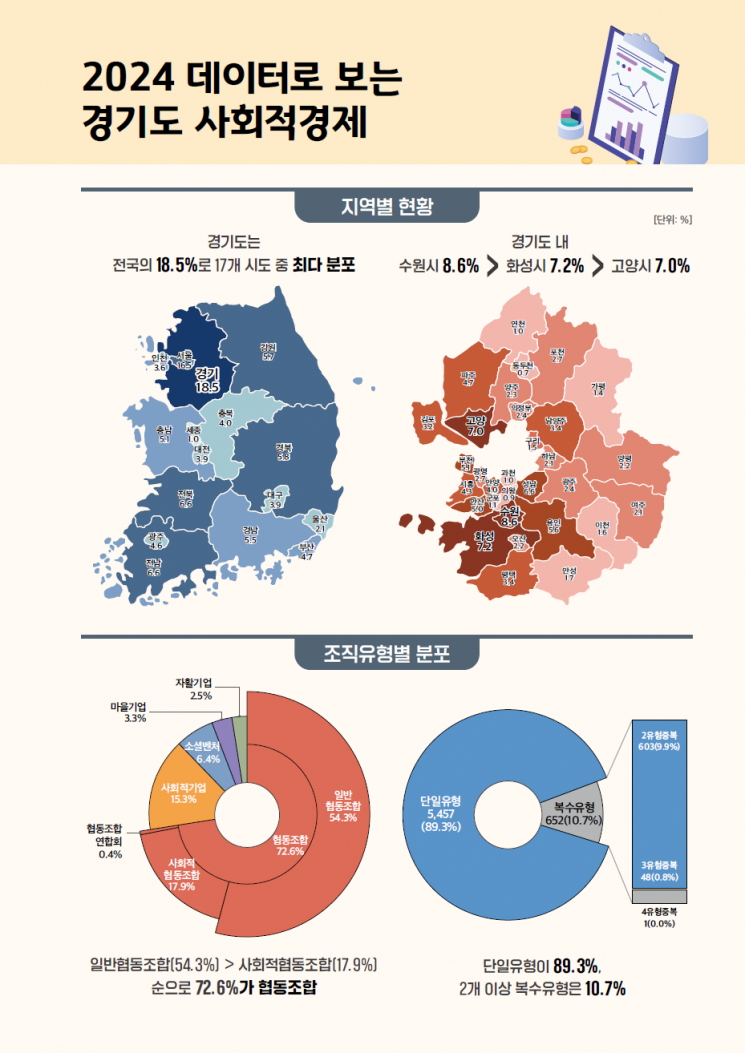
The average sales revenue of ‘social economy organizations’ such as cooperatives in Gyeonggi Province was 1.1 billion KRW, with each enterprise employing about 10 people. Additionally, it was found that 6,926 social economy organizations, accounting for 18.5% of the nationwide total, are located in Gyeonggi Province.
The Gyeonggi Social Economy Institute announced on the 26th that, based on a survey conducted from January to December 2024 targeting (preliminary) social enterprises, village enterprises, (social) cooperatives, and social ventures, there were a total of 6,926 social economy organizations in the province as of the end of last year. This represents 18.5% of the national total, making it the largest scale among the 17 metropolitan cities and provinces.
Among these, organizations that maintained corporate registration status or were confirmed not to have suspended or closed operations through business registration and the survey accounted for 71.3% of the total.
By region, Suwon City (8.6%), Hwaseong City (7.2%), and Goyang City (7.0%) ranked highest. By organization type, cooperatives accounted for 72.6% of the total. Cooperatives were composed of general cooperatives (54.3%), social cooperatives (17.9%), and cooperative federations (0.4%).
By industry, social enterprises (22.9%), village enterprises (23.2%), and social ventures (41.6%) all had a high proportion of manufacturing. Other organizations were predominantly in the education services sector (16.5%).
The average sales revenue per social economy enterprise was 1.105 billion KRW, with 26.9% of enterprises falling within the range of 100 million KRW to less than 500 million KRW. The average number of employees was 10.2, and 41.9% of enterprises employed between 1 and fewer than 5 people.
For enterprises that participated consecutively in the Gyeonggi Social Economy Center and Gyeonggi Social Economy Institute surveys over the past three years, sales revenue increased by an average of 10.2% (114 million KRW), and the proportion of enterprises employing between 5 and fewer than 20 people expanded from 25.8% in 2023 to 31% in 2024.
67% of social economy organizations in the province employ vulnerable groups, of which 83.5% work as regular employees. Furthermore, 51.6% of the surveyed enterprises reinvest their profits into the local community, contributing to regional economic revitalization and the creation of social value.
A Gyeonggi Province official stated, "Unlike nationwide social economy organization surveys conducted by ministries every 1 to 5 years, Gyeonggi Province builds systematic data through annual full surveys. Given that the response rate for social economy organization surveys generally remains at 20-30%, naturally formed panel data (data obtained by tracking multiple entities over several years) compensates for the limitations of sample representativeness and serves as key material for practical monitoring."
Meanwhile, the Gyeonggi Social Economy Institute plans to promote the achievements of social economy organizations in the province and utilize the database built over two years for effective policy formulation.
© The Asia Business Daily(www.asiae.co.kr). All rights reserved.
![Clutching a Stolen Dior Bag, Saying "I Hate Being Poor but Real"... The Grotesque Con of a "Human Knockoff" [Slate]](https://cwcontent.asiae.co.kr/asiaresize/183/2026021902243444107_1771435474.jpg)
















