Shell Releases 'LNG Outlook' Report
"Driven by Asian Economic Growth, Decarbonization, and AI"
Global liquefied natural gas (LNG) demand is projected to grow by approximately 60% by 2040. As demand for LNG carriers increases, domestic shipbuilders are expected to benefit.
On the 25th (local time), global energy company Shell released the 'LNG Outlook' report, forecasting that LNG demand will reach 630 million to 718 million tons annually by 2040, representing a 60% increase from current levels. This is an upward revision from last year's forecast of 625 million to 685 million tons. The increase in demand is attributed to economic growth in the Asia region, decarbonization efforts in heavy industry and transportation sectors, and the impact of artificial intelligence (AI).
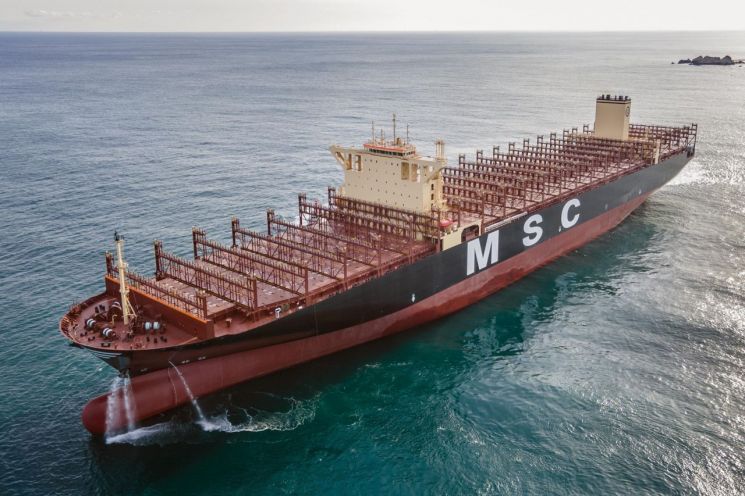 Test sailing of the ultra-large LNG dual-fuel container carrier built and delivered by HD Hyundai Heavy Industries last year. (Photo by HD Hyundai Heavy Industries)
Tom Summers, Senior Vice President of LNG Marketing and Trading at Shell, stated, "The world will need more gas in power generation, heating and cooling, industry, and transportation sectors to achieve development and decarbonization goals. LNG will continue to be the preferred fuel because it can meet the growing global energy demand in a stable, flexible, and adaptable manner."
Last year, global LNG trade volume totaled 407 million tons, with new supply development limited, resulting in the smallest annual increase (2 million tons) in a decade. By 2030, over 170 million tons of new LNG supply is expected to become available, particularly to meet rising demand in Asia; however, the operational timelines of new LNG projects remain uncertain.
On the other hand, demand is increasing worldwide. China is significantly expanding its LNG import capacity and plans to add pipeline gas connections by 2030. India is also accelerating the expansion of its natural gas infrastructure, aiming to connect gas pipelines to a population of 30 million over the next five years. Shell predicts that Europe’s LNG demand will increase by 2030 to complement the intermittency of renewable energy and ensure energy security.
With new orders for LNG-powered vessels rising, the related market demand is expected to exceed 16 million tons annually by 2030. This figure represents a 60% upward revision compared to last year’s forecast.
In particular, domestic shipbuilders such as HD Hyundai Heavy Industries, Hanwha Ocean, and Samsung Heavy Industries, which hold a dominant technological edge in LNG carriers, are highly likely to benefit from additional orders. Last year, Korean companies secured 70% of global LNG carrier orders. Last month, HD Korea Shipbuilding & Offshore Engineering signed a contract worth 3.716 trillion KRW to build 12 LNG dual-fuel container ships for a French shipping company, and Samsung Heavy Industries secured an order for one LNG carrier worth 379.6 billion KRW. Riding this momentum, Korea accounted for 62% of global ship orders last month, surpassing China to rank first.
© The Asia Business Daily(www.asiae.co.kr). All rights reserved.
![Clutching a Stolen Dior Bag, Saying "I Hate Being Poor but Real"... The Grotesque Con of a "Human Knockoff" [Slate]](https://cwcontent.asiae.co.kr/asiaresize/183/2026021902243444107_1771435474.jpg)















