A wearable platform has been developed that consumes 30,000 times less power than a smartwatch while integrating sensor detection, computation, and display output into a single functional unit.
The National Research Foundation of Korea announced on the 26th that a joint research team led by Professor Park Cheol-min of Yonsei University and Professor Wang Geon-uk of Korea University developed an ultra-low-power neuromorphic (a computing technology that mimics the human brain to perform large-scale memory and computation) integrated artificial intelligence (AI) display device platform.
Recently, healthcare devices that can monitor biometric information such as body movement and heart rate have gained popularity due to the increasing demand for personalized health management.
However, currently commercialized wearable devices operate sensor, computation, and display functions separately, resulting in complex systems and high power consumption. Additionally, the low intuitiveness of digital numeric displays and vulnerability to changes such as bending and pressure cause discomfort in wearing, which has been pointed out as a limitation.
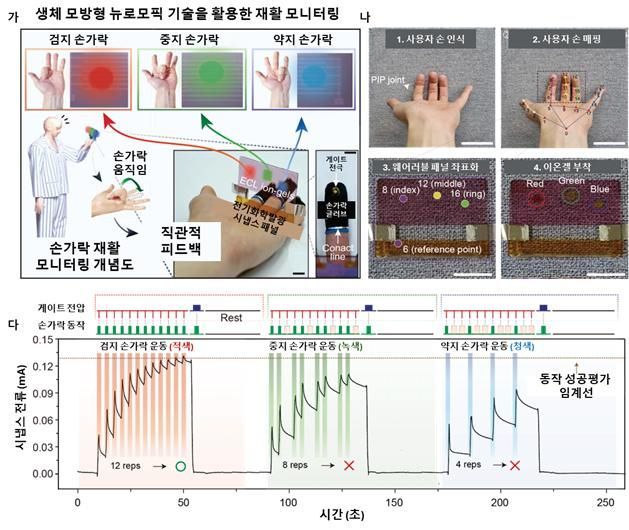 Concept and operation results of finger rehabilitation monitoring based on neuromorphic technology. Provided by Professor Cheolmin Park, Department of Materials Science and Engineering, Yonsei University.
To overcome these limitations, the joint research team applied neuromorphic technology that mimics biological neural networks and edge computing, which processes data in real-time on the device, and developed an ultra-low-power AI display that integrates sensor-synapse-display functions into a single device.
Edge computing is a concept opposite to cloud computing, processing data in real-time on the device without data transmission, offering advantages such as faster response times, reduced network load, and lower power consumption.
During the research process, the joint team first implemented the AI display device by combining electrochemical luminescent ion gel (an electrolyte material with both ion mobility and mechanical flexibility) and organic electrochemical transistors (transistors combining electrolytes and organic semiconductors, mainly used in biosensors and wearable devices).
This is a neuromorphic-based device integrating sensor-synapse-display functions, acting as an AI device that learns input stimuli in real-time through artificial neural networks and outputs results as light intensity and color.
In particular, the integrated AI display developed by the joint research team shows power consumption approximately 30,000 times lower than that of a smartwatch (around 1W), which is expected to be a breakthrough solution to the power consumption problem.
The joint research team successfully advanced this technology into a wearable platform to monitor users’ joint rehabilitation and abnormal heart rates.
Each time the user performs joint rehabilitation movements, red, green, and blue lights gradually brighten to motivate the user’s rehabilitation, and abnormal heart rate patterns are analyzed and displayed with red for normal, green for mild abnormalities, and blue for severe abnormalities, allowing users to check for anomalies through the display.
Professor Park Cheol-min said, “Through this research, the joint team overcame the high power consumption and complex structural limitations of existing wearable systems. The developed technology can be used not only for monitoring users’ health status but also in various fields such as robotic sensory feedback, smart sensors, and AI devices based on the Internet of Things (IoT) in the future.”
Meanwhile, this research was conducted with support from the Nano and Materials Technology Development Project and Mid-Career Research Project promoted by the Ministry of Science and ICT and the National Research Foundation of Korea. The research results were also published on the 24th in the international materials science journal Nature Materials.
© The Asia Business Daily(www.asiae.co.kr). All rights reserved.
![Clutching a Stolen Dior Bag, Saying "I Hate Being Poor but Real"... The Grotesque Con of a "Human Knockoff" [Slate]](https://cwcontent.asiae.co.kr/asiaresize/183/2026021902243444107_1771435474.jpg)















