Seoul Hosts Urban Space Conference
International Examples from New York and Tokyo
Priority Consideration for Areas Near Cultural Heritage Sites
The 'Floor Area Ratio (FAR) Transfer System,' which allows buildings to be constructed at higher FARs in commercial areas by transferring unused FAR from regions where development is difficult, will begin in Seoul in the second half of this year. It is expected to resolve property rights infringements in areas restricted by height limits, such as near the Pungnap Toseong fortress or around Gimpo Airport, where proper FAR could not be utilized. Cases of constructing landmarks by acquiring FAR, similar to New York and Tokyo, are also expected to increase.
On the 25th, the Seoul Metropolitan Government held an urban space conference titled "Innovation of Space, Evolution of the City: Seoul-type FAR Transfer System" at the Seosomun Government Complex's main conference room.
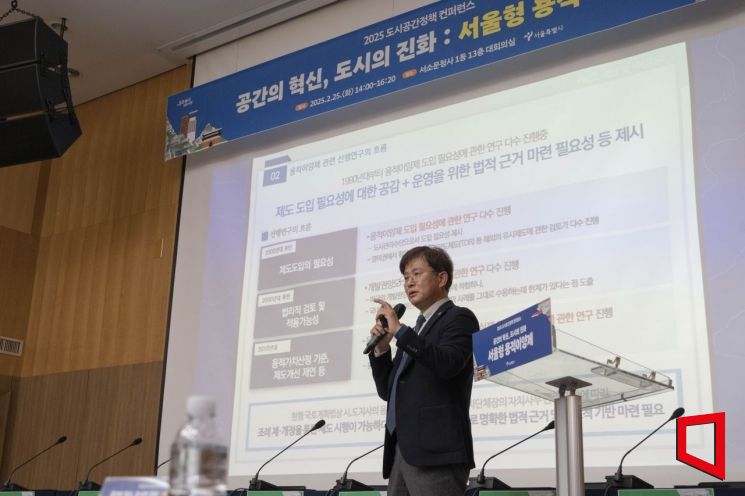 On the 25th, Professor Nam Jin of the University of Seoul is presenting at the '2025 Urban Space Policy Conference' held at Seoul City Hall Seosomun Building 1 in Jung-gu, Seoul.
Introduction of the 'FAR Transfer System' from the Second Half of This Year
The floor area ratio (FAR) is the ratio of a building's total floor area (sum of all floor areas) to the site area, and the legally permitted FAR varies according to the designated land use under the National Land Planning Act. In Seoul, the maximum FAR for general commercial areas is 1300%. Some areas cannot fully utilize their FAR due to cultural heritage preservation or height restrictions. In such cases, the 'Seoul-type FAR Transfer System' acts as a public intermediary to transfer FAR between different areas.
The city is promoting the introduction of the FAR transfer system to minimize property losses in overlapping regulated areas. This system can stimulate growth in areas needing development and serve as a sustainable management tool in regions where asset preservation, such as cultural heritage, is important. The total restricted floor area in Seoul due to regulations amounts to approximately 1.52 million square meters. Currently, the areas around cultural heritage sites cover 524,000 square meters, obstacle surface restriction zones 786,000 square meters, and the vicinity of Pungnap Toseong fortress 211,000 square meters.
This system is already established overseas. The One Vanderbilt building in New York was developed as a 93-story skyscraper by acquiring FAR from the nearby Grand Central Terminal. In Tokyo, six buildings including the Shin-Marunouchi Building and GranTokyo (43 floors) purchased FAR from the culturally designated Tokyo Station to build taller structures.
The United States' Transfer of Development Rights (TDR) system designates specific transfer and receiving areas within special purpose districts and includes public registration methods for recording FAR transfers. Japan operates a system called the 'Special FAR Application District,' which, unlike the U.S., applies only in specific districts. Unused FAR is sold to private companies and used to fund public projects.
 On the 25th, Professor Kim Ji-yeop from the Department of Architecture at Sungkyunkwan University is presenting at the '2025 Urban Space Policy Conference' held at Seoul City Hall Seosomun Building 1 in Jung-gu, Seoul. Photo by Seoul City
"Should Apply First to Areas Where Regulation Easing Is Difficult"
To introduce the FAR transfer system, Seoul plans to enact the 'Seoul Metropolitan FAR Transfer System Operation Ordinance (tentative name)' in the first half of this year. Additionally, a test of the actual FAR transfer process will be conducted in the Gangdong-gu Gupun-dari Station area revitalization project, which will serve as a basis for completing an implementation model.
Professor Nam Jin of the University of Seoul, who presented at the conference, stated, "The transfer areas could include places necessary for maintaining Seoul's identity, such as around Pungnap Toseong, Bukchon Hanok Village, and Namdaemun. Priority should be given to areas where regulatory easing is difficult and property losses are significant." He added, "The receiving areas for FAR transfers should be selected based on criteria that require strategic development, such as urban redevelopment, while having restrictions on urban planning regulation easing like additional land use zone upgrades." He further noted, "The scope of FAR transfer should be pursued within the legal maximum FAR to increase feasibility." The maximum FAR for general commercial areas is 1300%.
Professor Kim Ji-yeop of Sungkyunkwan University's Department of Architecture, in a presentation titled 'Legal Issues and Institutionalization Plans for Introducing the FAR Transfer System,' analyzed, "Regarding whether local governments can permit private transactions conditioned on FAR increases, the Enforcement Decree of the National Land Planning Act states that building coverage ratio and FAR can be eased conditioned on public facility donations, but since this is not a mandatory provision, it is possible." He also explained, "A change in FAR under district unit plans is not interpreted as requiring public facility donations, unlike changes in land use zones."
Professor Kim emphasized the need to amend the National Land Planning Act and its Enforcement Decree for stable system introduction and operation. He explained, "While Seoul's FAR transfer system operation is possible through ordinance enactment, for long-term stable operation, amendments to the Enforcement Decree are necessary. Since laws allow easing FAR and height restrictions in district unit plan areas as stipulated by the Enforcement Decree, new provisions for FAR and height restriction easing can be established in the decree, enabling the enactment of ordinances for Seoul's FAR transfer system based on the decree."
Kim Se-shin, Senior Urban Planning Officer at Seoul City, said, "This is not about reducing rental housing or social mix but creating tools to raise or lower FAR, and the approach may vary depending on policy and local circumstances." He added, "Since this is a newly created system without basic ordinances or grounds, explanations will be provided through briefings if necessary during the pilot site selection process regarding where and how it will be applied."
© The Asia Business Daily(www.asiae.co.kr). All rights reserved.
![Clutching a Stolen Dior Bag, Saying "I Hate Being Poor but Real"... The Grotesque Con of a "Human Knockoff" [Slate]](https://cwcontent.asiae.co.kr/asiaresize/183/2026021902243444107_1771435474.jpg)
















