Korea Customs Service Announces Export-Import Status for February 1-20
Export Value Reaches 35.3 Billion Dollars, Import Value 34.5 Billion Dollars
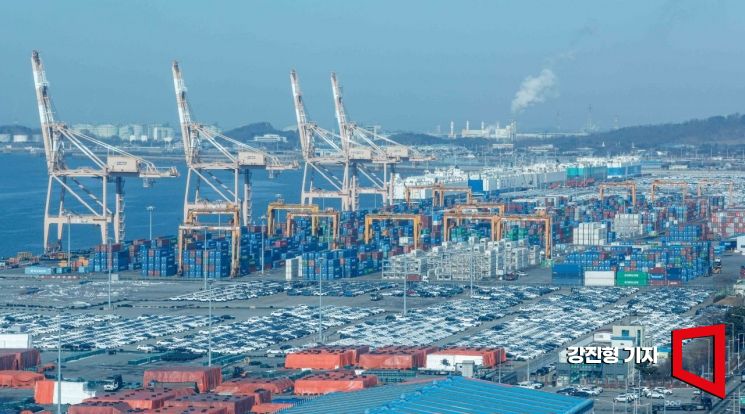 President Donald Trump signed a proclamation imposing a 25% tariff without exceptions on steel and aluminum products imported into the United States, and stated that tariffs on automobiles and semiconductors are also under consideration. Meanwhile, export vehicles are waiting to be loaded at Pyeongtaek Port, Gyeonggi Province on February 13, 2025. Photo by Kang Jin-hyung
From the 1st to the 20th of this month, export value increased by 16% compared to the same period last year. The rise in exports of key items such as semiconductors, automobiles, and ships drove the overall increase in export value. During the same period, the trade balance recorded a surplus of 800 million dollars.
Although export value in January, the previous month, decreased by 10.3% due to a reduction in working days caused by the Lunar New Year holiday, marking the first decline in 16 months, an upward trend is expected this month. The trade balance, which recorded a deficit of 1.9 billion dollars in January, is also expected to turn into a surplus this month.
According to the export-import status announced by the Korea Customs Service on the 21st for February 1?20, export value was 35.3 billion dollars, a 16% increase compared to the same period last year.
The number of working days until the 20th of this month was 15.5 days, 2.5 days more than the 13 days in the same period last year. Considering this, the average daily export value was 2.28 billion dollars, a 2.7% decrease.
Among the top 10 major export items, eight items increased: ▲semiconductors (22.1%), ▲passenger cars (40.3%), ▲steel products (11.4%), ▲auto parts (9.1%), ▲ships (23.5%), ▲wireless communication devices (8.7%), ▲precision instruments (26.8%), and ▲computer peripherals (44.8%). Petroleum products and home appliances decreased by 9.7% and 15.0%, respectively. By country, export value increased to ▲China (13.6%), ▲the United States (16%), ▲the European Union (8%), and ▲Vietnam (32.7%).
Import value was recorded at 34.5 billion dollars, a 7.7% increase compared to the same period last year. Imports increased in items such as semiconductors (16.9%) and machinery (19.9%), while crude oil (-19.2%) and gas (-13.7%) decreased. By country, imports increased from ▲the United States (13.8%), ▲the European Union (17.7%), ▲Japan (22.7%), and ▲Taiwan (21.5%), while imports from China (-1.7%) decreased.
Cho Ik-no, Trade Policy Officer at the Ministry of Trade, Industry and Energy, stated, "Exports until the 20th recorded double-digit growth driven by strong performance in key items such as semiconductors, automobiles, and ships," and added, "Overall in February, IT items such as semiconductors and computers, as well as automobile exports, are expected to show favorable trends, leading to a positive export rebound and a trade balance surplus."
However, since the inauguration of the new U.S. administration, trade policies focusing on tariffs, such as the imposition of a 25% tariff on steel and aluminum, have been announced one after another, increasing uncertainty in our export environment.
Our government plans to minimize the burden on domestic companies and diversify export markets to global South regions such as Asia, Africa, and South America through the 'Pan-Ministerial Emergency Export Measures' announced on the 18th.
Policy Officer Cho said, "We will actively respond to external trade risks such as the U.S. new administration's tariff policies by promptly implementing the Pan-Ministerial Emergency Export Measures announced on the 18th."
© The Asia Business Daily(www.asiae.co.kr). All rights reserved.
![Clutching a Stolen Dior Bag, Saying "I Hate Being Poor but Real"... The Grotesque Con of a "Human Knockoff" [Slate]](https://cwcontent.asiae.co.kr/asiaresize/183/2026021902243444107_1771435474.jpg)















