Apple Equips iPhone 16e with In-House Designed Communication Modem
Previously Used Qualcomm Modems... Disputes Over Royalties
Expected to Expand Distribution of 'Apple Intelligence'... Korean Language Support Coming in Early April
Apple's '?(탈) Qualcomm' has officially begun. The newly released iPhone 16e is equipped with a communication modem developed in-house. As Apple formally parts ways with Qualcomm, which has virtually monopolized the mobile communication modem market, the impact is expected to extend to other manufacturers. It is also expected to play a role in expanding the distribution of Apple's generative artificial intelligence (AI) service, 'Apple Intelligence.'
According to the IT industry on the 20th, Apple equipped the iPhone 16e, unveiled on the 19th (local time) through its website, with the 'Apple C1,' a communication modem designed by Apple itself. This is the first time Apple has applied a self-developed communication modem to the iPhone. While Apple uses its own A-series chipset, designed in-house, as the application processor (AP) for the iPhone, it has used modems from Qualcomm and Intel until now.

The newly released iPhone 16e is an iPhone outside the regular lineup, unveiled for the first time in over three years since the iPhone SE3 launched in 2022. The previously released iPhone SE series was considered a cost-effective (price-to-performance) model among Apple's iPhone lineup. Compared to flagship models, it features lower camera performance and excludes some additional functions but is equipped with the latest AP. It also supports Apple's AI service 'Apple Intelligence,' which is scheduled to support the Korean language starting this April.
Apple has been intensively investing in communication modem development to break away from Qualcomm. This is to reduce the royalties and component costs paid for using Qualcomm's communication modems. All recently released iPhones have been equipped with Qualcomm's communication modems. Communication modems are essential components for smartphones to send and receive data and make phone calls, as smartphones exchange signals with base stations installed by mobile carriers through these modems.
Qualcomm virtually monopolizes the global mobile communication modem market. This is because it holds numerous fundamental patents related to mobile communications, and competitors have virtually disappeared in the 5G era. Apple once equipped Intel's communication modems in iPhones instead of Qualcomm's, amid disputes over royalties paid for modem use. However, after Intel abandoned 5G communication modem development, Apple reached a royalty agreement with Qualcomm and began using Qualcomm modems. Subsequently, Apple acquired Intel's communication modem division and started direct development.
Industry attention is focused on whether the Apple C1 communication modem in the iPhone 16e will deliver proper performance. If the modem's performance is proven, it is expected that Apple will equip its self-designed communication modems in flagship iPhone models released thereafter. In that case, Apple can save costs such as royalties previously paid for using Qualcomm's modems.
There is also a view that Apple's break from Qualcomm will have repercussions for other smartphone manufacturers. Since Qualcomm has lost one of its largest global customers, Apple, it is expected to raise prices for APs and communication modems to maintain profitability. According to major foreign media reports, Apple accounts for more than 20% of Qualcomm's total sales. In fact, Qualcomm is known to have raised the price of its flagship smartphone AP, the 'Snapdragon 8 Elite,' announced at the end of last year. Snapdragon chipsets are widely used in major smartphones running the Android operating system (OS), including Samsung Electronics' Galaxy series.
Meanwhile, Qualcomm has faced sanctions from competition authorities worldwide for monopolistic practices related to communication solutions. South Korea's Fair Trade Commission (FTC) also imposed corrective orders and a fine of approximately 1.0311 trillion won on Qualcomm in 2017 for abusing its monopoly position to hinder the business activities of competing chipset manufacturers and mobile phone makers such as Samsung. This is the largest fine ever imposed by the FTC. Qualcomm filed a lawsuit against this but after going through the final appeal, the Supreme Court dismissed the appeal in 2023, confirming the fine.
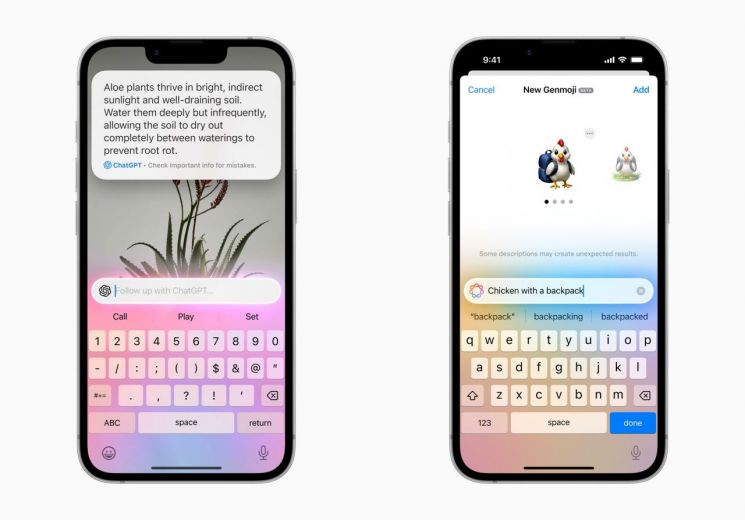
The iPhone 16e is also expected to play a role in expanding the distribution of Apple's generative AI service, Apple Intelligence. Until now, the iPhone models supporting Apple Intelligence have been relatively high-priced latest models. The price of the iPhone 16e (990,000 won) is cheaper than the regular iPhone 16 series models (1,250,000 won), the Pro models (1,550,000 won), and the older iPhone 15 (1,090,000 won).
Currently, the iPhones supporting Apple Intelligence include the iPhone 16 series (16, 16 Plus, 16 Pro, 16 Pro Max) and the iPhone 15 Pro series (15 Pro, 15 Pro Max), all of which are relatively recently released models. Apple Intelligence operates using an 'on-device' method, processing some AI computations directly on the smartphone. Older models are known to have limitations in on-device processing due to smaller RAM capacities.
With the release of the iPhone 16e, Apple announced that it will support the Korean language service for Apple Intelligence in early April. Launched in October last year, Apple Intelligence currently supports only English, limiting its use for domestic users in Korea.
© The Asia Business Daily(www.asiae.co.kr). All rights reserved.
![Clutching a Stolen Dior Bag, Saying "I Hate Being Poor but Real"... The Grotesque Con of a "Human Knockoff" [Slate]](https://cwcontent.asiae.co.kr/asiaresize/183/2026021902243444107_1771435474.jpg)
















