Government to Promote University Autonomy if Estimation Committee Fails to Decide
Medical Community Opposes, Saying "Responsibility for Policy Failure Is Shifted to Universities"
Medical School Association: "Admissions Quota Should Be Frozen at Pre-2026 Levels"
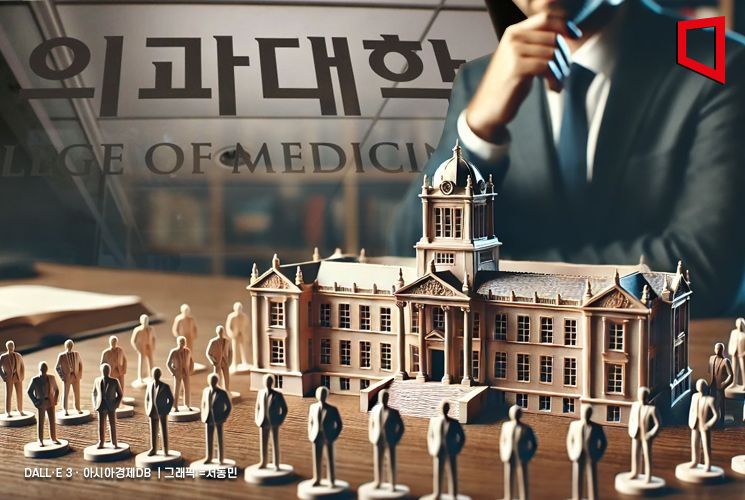
The government is promoting a plan to allow each university to autonomously decide the scale of medical school quota increases for next year, but the medical community has opposed this, saying it is "trying to shift the responsibility for policy failure onto the universities." As interests surrounding the medical school quotas diverge, conflicts between university presidents and medical school deans are intensifying, raising concerns that the conflict between the medical community and the government will be prolonged and that confusion in medical education and admissions will be inevitable.
According to the Ministry of Health and Welfare on the 20th, the National Assembly's Health and Welfare Committee held a bill review subcommittee meeting the day before to review two amendments to the Medical Workforce Support Act specifying matters related to the Medical Workforce Supply and Demand Estimation Committee (Estimation Committee), four amendments to the Framework Act on Health and Medical Services, and the government's revised proposals, but no conclusion was reached. Lawmakers from both ruling and opposition parties plan to gather additional opinions from the medical community and others regarding the composition of the Estimation Committee, discuss further, and conduct a one-point review of the bills within this month to pass them.
It is reported that both ruling and opposition parties agreed on preparing a supplementary provision allowing each university to autonomously decide the medical school quota for the 2026 academic year admissions if the Estimation Committee fails to decide the quota by April. Park Min-su, Vice Minister of Health and Welfare, said, "In principle, medical school quotas are decided by the Estimation Committee through amendments to the Framework Act on Health and Medical Services or the Medical Workforce Support Act," but added, "This is a Plan B prepared in case decisions are not made by the Estimation Committee or the Health and Medical Policy Deliberation Committee (HMPDC)."
The medical community opposed this, saying it effectively shifts the dispute onto universities and medical schools. Kim Seong-geun, spokesperson for the Korea Medical Association (KMA), said, "The government's revised proposal assumes the case where the Estimation Committee cannot reach a conclusion, but it does not specify until when they will wait for the Estimation Committee's decision," and criticized, "It looks like the government is suddenly shifting the quota discussions, which had been conducted with the medical community, onto the universities." Kim added, "In previous discussions for 2023-2024, universities showed a tendency to pursue their own interests rather than the educational conditions of medical schools," expressing concern that "there will be noisy conflicts among university members."
Universities also foresee inevitable internal conflicts if the government pushes for autonomous quota increases. University administrations want to increase as many students as possible to boost tuition revenue and expand the size of medical schools, but medical school faculties are demanding reductions citing realistic educational conditions. Even when the government allowed up to a 50% reduction of the increased quota for national university medical schools last year, some private universities tended to select as many students as possible instead of reducing quotas.
Kim Chang-su, president of the National Association of Medical School Professors (and professor of preventive medicine at Yonsei University College of Medicine), criticized, "The government's directive for each university to autonomously decide the medical school admission quota is just a way to shift policy failure onto universities and for the Ministry of Education to avoid responsibility," adding, "They are neglecting the fundamental responsibility of maintaining a long-term medical workforce supply system or the overall framework of national healthcare and are resorting to an easy trick."
Regarding the government proposal to reflect the opinions of medical school deans when their views differ from those of university presidents, Kim said, "Most universities, including private ones, have a structure where the president appoints the dean, so how could the dean express opinions contrary to the president's will?" and called it "virtually meaningless."
Meanwhile, the Korean Association of Medical Colleges and Medical Schools (KAMC) has requested university presidents of each medical school to freeze the medical school quotas at the 2024 level (3,058 students) before any increase next year and to let the Estimation Committee decide the quotas from 2027 onward. The KAMC emphasized that "if students do not return during the first semester and the delay extends beyond the second semester, it will be impossible to produce doctors for the second consecutive year, and the medical education system will be severely damaged," highlighting that this decision prioritizes preventing class disruptions and normalizing academic affairs.
© The Asia Business Daily(www.asiae.co.kr). All rights reserved.
![Clutching a Stolen Dior Bag, Saying "I Hate Being Poor but Real"... The Grotesque Con of a "Human Knockoff" [Slate]](https://cwcontent.asiae.co.kr/asiaresize/183/2026021902243444107_1771435474.jpg)















