Legislative Forum on Digital Creator Fostering Act Held
Youth Job Creation... Market Grows to 5 Trillion KRW Annually
"Platform Behavior Must Change... Existing Laws Have Limits"
A legislative bill aimed at protecting digital creators who produce and distribute content on platforms such as YouTube, Instagram, and NAVER, and fostering the industry, has entered full-scale discussion. The focus is on resolving blind spots caused by the lack of application of the Labor Standards Act and creating a fair environment where large platforms and creators can coexist.
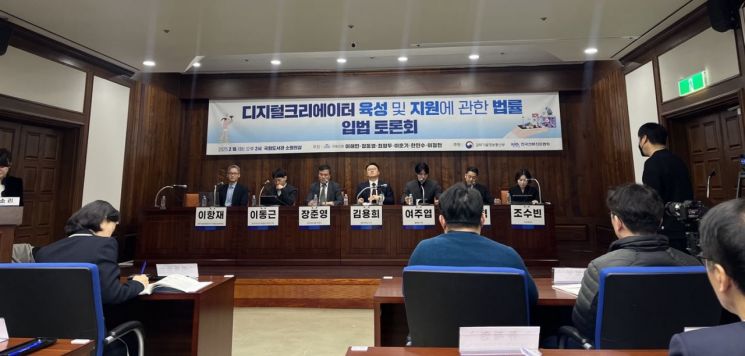
On the 18th, a legislative forum on the "Act on the Fostering and Support of Digital Creators," sponsored by Representative Lee Hae-min of the Innovation Party, was held at the National Assembly Library. Attendees included Ryu Je-myung, Director of the Network Policy Office at the Ministry of Science and ICT, Choi Min-hee, Chairperson of the National Assembly Science, ICT, Broadcasting and Communications Committee (SIBCC), Choi Hyung-doo, Secretary-General, and lawmakers from both ruling and opposition parties such as Jeong Dong-young, Lee Jeong-heon, and Han Min-soo, demonstrating the strong interest of the government and ruling party.
Occupational Instability... Imbalance with Platforms
Digital creators refer to individual or multiple creators or businesses producing and distributing content through networks. According to an SIBCC survey, as of 2023, the digital creator media industry’s revenue reached approximately 5.3 trillion KRW, a 28.9% increase from the previous year. The industry employs about 42,000 people, with more than half being young people under their 30s, making it a key sector for youth employment. However, 83.5% of these businesses are small-scale enterprises with fewer than five employees, which means they are not covered by the Labor Standards Act.
Additionally, creators reportedly feel insecure about their job stability due to the opaque algorithms of large platforms and their dependence on advertising revenue. Creator Jo Soo-bin, who runs the YouTube channel SubingSu TV, said, "The biggest concern for creators right now is whether they can continue this work." He added, "It is true that it is difficult to predict revenue based on views, algorithms, and advertising, which causes anxiety." He supported the enactment of the law, stating, "Since the creator industry has created a new business model, an institutional foundation is needed to establish a stable and clear occupational culture."
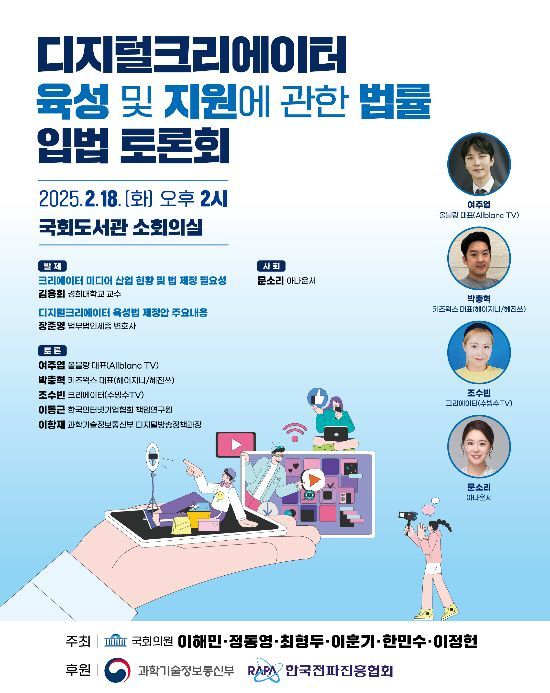
Yeo Ju-yeop, CEO of Allblanc, said, "Creator businesses are perceived merely as creators rather than companies, and thus are excluded from various government support projects such as overseas expansion support." He emphasized, "Various supports for business operations such as commercialization, marketing, and labor costs need to be prepared." Park Chung-hyuk, CEO of Kidsworks, proposed that the government establish a consultative body to facilitate communication between creators and platforms. He said, "It will resolve various disputes between platforms and creators and produce a win-win effect."
Insufficient under Current Law... Rights Protection Including Fair Contracts
While existing media and content industry laws have focused on supporting 'content,' the proposed Digital Creator Fostering and Support Act is characterized by its focus on 'people.' The purpose is to create fair contracts and a healthy market environment in the creator market, generate new jobs, and target the global market with K-content.
The bill includes provisions for establishing a fair environment among platform operators such as YouTube and Instagram, creators, and production companies, including ▲establishing codes of conduct and guidelines ▲preparing win-win cooperation policies and forming consultative bodies ▲concluding and implementing fair contracts ▲recommending the use of standard contracts, as well as ▲personnel training, overseas expansion, and financial support.
Jang Jun-young, a lawyer at Sejong Law Firm, said, "This bill was submitted to the National Assembly in August last year and is under review. There is a demand to promptly legislate to correct legal imbalances in the field," emphasizing, "It is important to induce voluntary cooperation among global platform operators and private businesses such as MCNs."
"Excessive Burden from Surveys... Is Using the Broadcasting Development Fund Appropriate?"
At the forum, opinions were also raised that the bill could impose excessive burdens on stakeholders in the creator industry. Lee Dong-geun, senior researcher at the Korea Internet Corporations Association, said, "There is a provision requiring creators and service providers to compulsorily submit data necessary for surveys," adding, "If sensitive information such as sales by sector is requested, it could be an excessive burden." He also opposed using the Broadcasting and Communications Development Fund (Bangbal Fund) as a resource for implementing the law. He stated, "This year, the Bangbal Fund is about 870 billion KRW, which is 30% less than last year and 15% less than the previous year," and argued, "When the scale of public resources decreases, priorities must be set based on policy goals and institutional consistency."
In response, Lee Hang-jae, Director of the Digital Broadcasting Policy Division at the Ministry of Science and ICT, emphasized, "Platforms deleting creators' channels or blocking content is an infringement of our citizens' property rights," and added, "It is necessary to change the behavior of big tech companies through brand image rather than regulation and to promote win-win cooperation between platforms and creators." He said, "We plan to eliminate blind spots so that youth employment can increase steadily in a healthy environment, base it on government budgets, and use the Bangbal Fund only for items grounded in law."
Representative Lee Hae-min, who proposed the bill, said, "The enactment law has a long way to go. From today, we will walk a difficult and thorny path," appealing, "Please support creators who are not protected by existing legislation to work in a safe creative environment and to build a healthy industrial ecosystem."
© The Asia Business Daily(www.asiae.co.kr). All rights reserved.
![Clutching a Stolen Dior Bag, Saying "I Hate Being Poor but Real"... The Grotesque Con of a "Human Knockoff" [Slate]](https://cwcontent.asiae.co.kr/asiaresize/183/2026021902243444107_1771435474.jpg)
















