National Health Insurance Service Research Institute Survey
Only About 14% of Elderly Die at Home
About 68% of long-term care elderly wish to die at home, but in reality, less than 15% die at home, while approximately 70% die in hospitals.
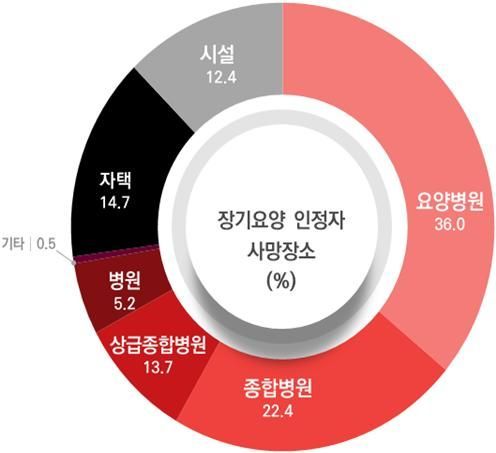
On the 17th, the National Health Insurance Service Health Insurance Research Institute announced the results of the "2023 Analysis of Benefit Usage in the Year Before Death of Long-term Care Decedents," which included this information. The institute analyzed the characteristics of 169,943 long-term care grade recipients who died in 2023, based on their health insurance and long-term care benefit data from the year prior to death. As a result, the place of death was medical institutions such as nursing hospitals at 36.0% and general hospitals at 22.4%, totaling 72.9%. Home accounted for 14.7%, and facilities for 12.4%.
This phenomenon is contrary to the wishes of the elderly. According to the institute’s analysis based on the "Korean Long-term Care Elderly Cohort" baseline survey and the 2023 Elderly Status Survey data, 67.5% of 3,032 care-receiving elderly wished to die at home.
Among the long-term care elderly who died in 2023, 99.6% used health insurance benefits, and 75.8% used long-term care benefits. Their average benefit costs were approximately 25 million KRW for health insurance and 15 million KRW for long-term care. The cause of death for 15.1% of long-term care decedents was cancer. Benefit costs increased as the month of death approached, with the highest costs in the month immediately before death. The average benefit cost in the month before death was 4.08 million KRW.
More than half of the decedents, 59.7%, received life-sustaining medical treatment before death. By type of life-sustaining treatment, the use of vasopressors was 48.7%, followed by artificial nutrition supply such as nasal tubes or injections at 38.0%, blood transfusions at 15.1%, and artificial respiration and cardiopulmonary resuscitation each at 9.6%. Among these, vasopressor use and artificial nutrition supply were performed in nursing hospitals for 45.0% and 55.6% of cases, respectively.
Thirteen point one percent of decedents had prepared a life-sustaining treatment discontinuation plan, with more than half (56.5%) of these plans made within one month before death. Additionally, 7.6% of all decedents and 58.2% of those who prepared a life-sustaining treatment discontinuation plan implemented the decision to discontinue life-sustaining treatment within one month before death. However, as age increased, the rates of planning and implementing life-sustaining treatment discontinuation generally tended to decrease.
The average period from the initial long-term care grade assessment to death was 2.06 years for cancer patients and 4.16 years for non-cancer patients. The proportion of deaths in medical institutions was higher for cancer patients at 84.7% compared to 70.8% for non-cancer patients.
The institute explained the overall analysis results by stating, "The subjects faced end-of-life care and death that differed from their own or their families’ preferences." They suggested as alternatives ▲activating systems to confirm life-sustaining treatment intentions of long-term care elderly ▲establishing an end-of-life care provision system within the elderly long-term care insurance system ▲and resolving medical blind spots before death for long-term care recipients.
© The Asia Business Daily(www.asiae.co.kr). All rights reserved.
![Clutching a Stolen Dior Bag, Saying "I Hate Being Poor but Real"... The Grotesque Con of a "Human Knockoff" [Slate]](https://cwcontent.asiae.co.kr/asiaresize/183/2026021902243444107_1771435474.jpg)















