Diagnosis of Difficulties Faced by Busan Export Companies Due to the Trump-Initiated Tariff War
and Presentation of Response Strategies
On the 17th, the Busan Institute published the BDI Policy Focus titled "Trade Impact and Exit Strategies for Export Companies to the United States," analyzing the effects of the U.S.'s high tariff policies on export companies in the Busan region and presenting five key countermeasures.
This study is a follow-up to Policy Focus No. 435, published last January, titled "Policy Impact Outlook and Challenges for Busan Following the Inauguration of the Second Trump Administration (Ⅰ)," and includes content related to the tariff war initiated by Trump.
Trade is a driving force behind the dynamic economic growth of countries (regions), but recent changes in the global trade environment, such as the imposition of high tariffs by the United States, raise concerns about the weakening of regional economic growth driven by exports. Busan's exports to the U.S. in 2024 are expected to reach $2.7 billion, marking a recovery phase after a decline since 2015; however, due to Trump's ultra-hardline policies, there is a risk of entering another export recession.
The main contents include the background of the U.S.'s high tariff policy, responses from neighboring countries (China, Japan, Taiwan), and survey results from Busan-based companies exporting to the U.S.
The survey was conducted over 19 days from January 6 to January 24, 2025, targeting 247 Busan-based companies exporting to the U.S. Among them, 73 valid samples were obtained. Responses were received in the following order: machinery (19 companies), steel (13 companies), auto parts (9 companies), electrical and agricultural & marine products (6 companies each), textiles & apparel (5 companies), and chemicals & cosmetics (4 companies each).
The main reasons cited for the U.S. initiating the tariff war include the decline of domestic manufacturing and job recovery, offsetting the trade deficit with China, using trade issues as leverage in foreign negotiations, and intensified competition for technological supremacy.
In response to the Trump administration's tariff pressure, China chose an ultra-hardline approach by filing a complaint with the World Trade Organization (WTO), arguing that the U.S.'s unilateral tariff imposition is a serious violation of rules. Japan adopted a strategy of securing a foothold in the U.S. domestic market through large-scale investments instead of acquiring or owning US Steel, thereby gaining access to the South American market. Taiwan aims to reduce its dependence on the Chinese market and early conclude a friendly trade agreement with the U.S.
According to the survey, the expected tariff increase rate by industry was highest for electrical and electronic products at 13.0%, followed by steel and non-ferrous metal products at 12.1%, and agricultural & marine products and processed foods at 11.7%. Companies' own countermeasures included exploring and collaborating with international business partners (23.5%), developing alternative markets in third countries (21.4%), and strengthening domestic sales (17.4%).
Major difficulties faced by export companies included logistics cost burdens, exchange rate volatility uncertainty, profitability decline due to tariff burdens, lack of opportunities to use trade finance, challenges in pioneering new markets and connecting with buyers, and insufficient capacity to respond to changes in the trade environment.
The five key countermeasures proposed were: the publication of the tentatively named "Busan International Trade Weekly"; preparation against the influx of Chinese products blocking export routes; strengthening export marketing of regional intermediate and industrial goods targeting the revival of U.S. manufacturing; establishment of a tentatively named "Trade Promotion Division" and strengthening domestic and international economic ties; and securing product competitiveness through expanded policy support funds.
Through the "Busan International Trade Weekly," it was proposed to deliver real-time trade issues and policy support information to companies as they change moment by moment. Additionally, to prepare for China's accelerated targeting of the Korean market, it was suggested to strengthen market monitoring of major export items such as steel and home appliances and actively discover new export opportunities arising from the U.S. manufacturing revival policy.
Due to increasing trade uncertainties and the growing importance of export support tasks and exit strategy formulation, the establishment of a "Trade Promotion Division" was proposed. Furthermore, strengthening networks with buyers in the Americas, assisting Busan companies in connecting with buyers by utilizing global networks of large and medium-sized enterprises, and pioneering new markets were suggested. In addition, to enhance the competitiveness of export companies, it was proposed to expand practical support measures such as R&D support, logistics cost support voucher projects, and support for hiring foreign professionals.
Jang Jeong-jae, Senior Research Fellow at the Busan Institute, emphasized, "In the rapidly changing global trade environment, strengthening the competitiveness of Busan's export companies and establishing a stable export base require the establishment and deployment of multifaceted support systems and proactive responses through analysis of various possible scenarios."
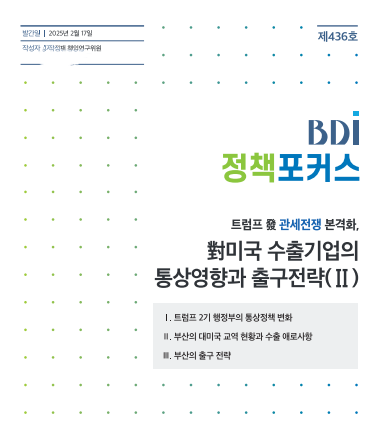 Cover of Busan Development Institute BDI Policy Focus 'Trade Impact and Exit Strategy II for Export Companies to the United States'.
© The Asia Business Daily(www.asiae.co.kr). All rights reserved.
![Clutching a Stolen Dior Bag, Saying "I Hate Being Poor but Real"... The Grotesque Con of a "Human Knockoff" [Slate]](https://cwcontent.asiae.co.kr/asiaresize/183/2026021902243444107_1771435474.jpg)















