Trump Signals Review of Semiconductor Tariffs... Possibility Suggested
Semiconductor Industry Structured Around 'Divided Manufacturing Process'
Tariffs Expected to Apply to Final Country of Manufacturing
Analysis: Negative Impact on Major U.S. Tech Firms Unavoidable
"Exceptions or Reductions Possible for Advanced Semiconductors"
High Likelihood Tariffs Will Be Used as a Negotiation Tool
Tension is mounting in South Korea's semiconductor industry on the 12th as President Donald Trump and the U.S. administration express their intention to impose tariffs on semiconductors, just as they have on other items.
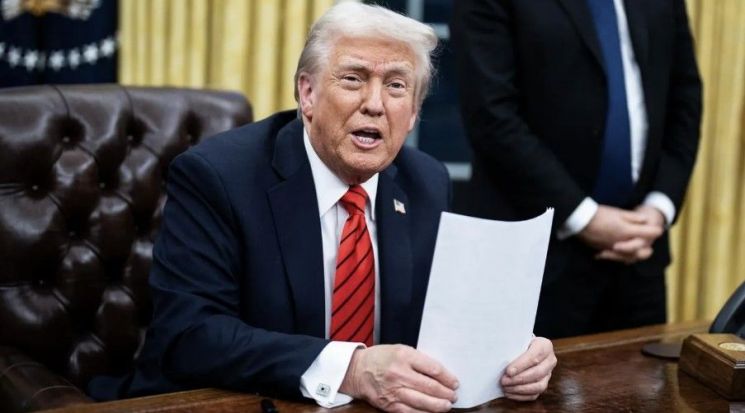
Amid uncertainty over the pace of the 'semiconductor subsidies' promised and finalized under the previous administration, the announcement that the U.S. government is considering imposing tariffs has amplified the shockwaves. Consequently, with both subsidies and tariffs at stake, South Korea's semiconductor industry finds itself held hostage over a critical issue that could influence its market power in the U.S., increasing the likelihood of strong pressure from the Trump administration. Considering that the Trump administration is focusing on strengthening the U.S.'s dominant position in semiconductor manufacturing and revitalizing American workers in manufacturing, industry analysts suggest that the administration may demand additional investments and new factory establishments from Korean companies through subsidy and tariff pressures.
First Application of 'Semiconductor Tariffs'?... "Likely a Negotiation Tactic"
Although President Trump has recently imposed tariffs on various countries and products, the semiconductor industry reportedly had little concern about a tariff bomb dropping on semiconductors. This is because semiconductors are covered under the Information Technology Agreement (ITA) signed by World Trade Organization (WTO) members in 1997, agreeing not to impose tariffs between countries, fostering a strong perception that tariffs were irrelevant. Additionally, given the nature of semiconductors, where materials, parts, and equipment (so-bu-jang) needed to make a single product are supplied by multinational companies, imposing tariffs could cause prices to soar, making tariff imposition impractical and thus unlikely.
However, recent moves by the Trump administration have changed the situation. With the possibility of withdrawing from the WTO looming, the administration's 'tariff barrage' seemingly disregards the WTO, raising industry concerns that semiconductor tariffs could indeed become a reality. Jang Sang-sik, Director of the Korea International Trade Association's International Trade and Commerce Research Institute, said, "Theoretically, semiconductor tariffs are possible just like other products." He added, "Semiconductor manufacturing is divided by country and company, and Trump's statement about imposing tariffs can be understood as applying tariffs to the final country of semiconductor manufacturing. Since the topic has been raised, it seems likely that tariffs will be imposed in some form."
If tariffs are imposed on semiconductors, companies like SK Hynix and Samsung Electronics, which have secured dominance in the high-bandwidth memory (HBM) market and recorded significant sales in the U.S., as well as their suppliers of materials, parts, and equipment, are expected to face some impact. The prices of HBM, which are sold at high prices, could rise further due to additional tariffs, potentially affecting price negotiations with customers. According to the corporate analysis firm Leaders Index, SK Hynix recorded cumulative U.S. sales of 27.3058 trillion won (58.8% of total sales) in the third quarter of last year, nearly tripling from 9.7357 trillion won in the same period the previous year. The proportion of sales from the U.S. region also increased by 13.4 percentage points. During the same period, Samsung Electronics' sales in the Americas increased by 24.0%, from 68.2784 trillion won to 84.6771 trillion won.
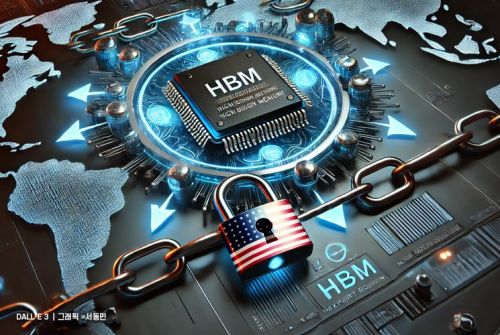
However, there remains room for exceptions regarding South Korea. This is because U.S. big tech companies extensively use South Korea's advanced memory products such as HBM. Director Jang said, "The Trump administration will, in principle, impose semiconductor tariffs but is expected to grant exceptions or reductions for advanced semiconductors to allied or investing countries." He also emphasized, "It seems highly likely that the Trump administration will use this as leverage to negotiate by presenting demands it has sought from various countries."
Request to Congress to Withdraw Subsidies?
Concerns are emerging that the future of the 'semiconductor subsidies,' which still have some time before final decisions, has become uncertain amid President Trump's relentless decisions.
On the 29th of last month, Howard Lutnick, the nominee for Secretary of Commerce, expressed at a Senate confirmation hearing his intention to reconsider semiconductor subsidies promised under the previous administration's 'U.S. CHIPS and Science Act.' There is cautious speculation that President Trump might directly request Congress to withdraw these subsidies.
Under U.S. law, the sitting president's authority is limited to overturning policy matters agreed upon by Congress during the previous administration, as stipulated by the 1974 'Congressional Budget and Impoundment Control Act.' However, if the president reasonably believes that a policy could harm the nation, even if passed by Congress, they can request Congress to reconsider it. Given that the Republican Party, the ruling party, currently holds a majority in Congress, analysts suggest that President Trump has a considerable chance to exercise this request authority at least once.
The total semiconductor subsidies that South Korean companies are set to receive from the U.S. government amount to approximately 8 trillion won. Samsung Electronics has finalized subsidy contracts worth $4.745 billion (about 6.88 trillion won), and SK Hynix has signed for $458 million (about 660 billion won). SK Hynix's agreement also includes a government loan of $500 million (about 724.8 billion won). The semiconductor subsidies are not paid as a lump sum but are disbursed in stages upon completion of promised factory and facility investments.
© The Asia Business Daily(www.asiae.co.kr). All rights reserved.
![Clutching a Stolen Dior Bag, Saying "I Hate Being Poor but Real"... The Grotesque Con of a "Human Knockoff" [Slate]](https://cwcontent.asiae.co.kr/asiaresize/183/2026021902243444107_1771435474.jpg)

















