Discussion on Solutions for Eight Major Social Issues
Exploring Labor and Regional Development in Gwangju
Need for Multi-Party System and Presidential Runoff Voting
Finalizing the Gwangju Declaration After Collecting Opinions Until the 16th
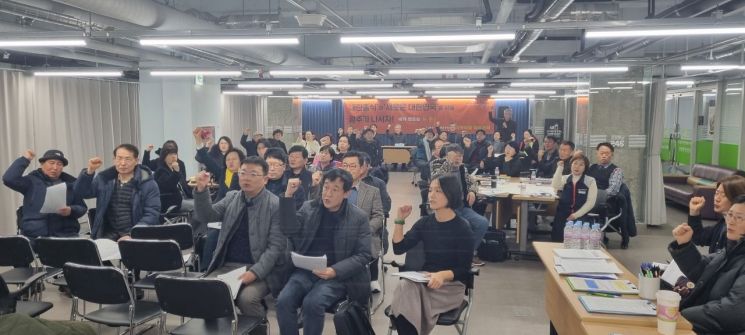 The Yoon Seokyeol Immediate Resignation and Social Reform Gwangju Emergency Action held a large forum for participating organizations in social reform on the afternoon of the 11th at Jeonil Building 245, Dong-gu, Gwangju. Photo by Min Chanki
Civil society organizations in Gwangju held a citizen forum to comprehensively organize and publicize major social reform agendas.
The Gwangju Emergency Action for Immediate Resignation of Yoon Suk-yeol and Major Social Reform held a large forum for participating organizations on the afternoon of the 11th at Jeonil Building 245 in Dong-gu, Gwangju.
The forum proceeded with a presentation on constitutional amendment by Choi Youngtae, honorary professor at Chonnam National University, followed by group presentations on specific topics and agenda discussions.
During the forum, participants discussed solutions to improve social issues in eight areas: labor, basic rights of citizens, eradication of deep-rooted evils, political reform, women and social minorities, regional issues, division and peace, and climate-ecological agriculture.
Professor Choi Youngtae explained the need for constitutional amendment, stating, "Acting President Choi Sangmok once again exercised veto power over the special investigation bill on rebellion passed by the National Assembly. President Yoon Suk-yeol has exercised his veto 25 times in two and a half years," and added, "On the other hand, if politics loses the spirit of compromise and integration, a party with 150 seats in the National Assembly could abuse impeachment against high-ranking officials, paralyzing the administration, and there is currently no proper adjustment mechanism in place."
He continued, "To separate far-right forces from conservatives in our country, a multi-party system is necessary. If a runoff voting system for presidential elections is introduced, it would encourage participation of minor parties and keep far-right and far-left forces in check, thereby establishing a multi-party system."
In the labor agenda, topics such as job security for non-regular workers, guarantee of the three basic labor rights, and a four-day workweek were discussed.
Participants said, "As of 2022, workers in businesses with fewer than five employees account for about 31% of the total," and "Workers in various forms of employment such as special contract workers and freelancers have restricted rights to organize, resulting in poor working conditions."
They added, "As of last year, non-regular workers made up more than half of all workers. They are in a blind spot due to job insecurity, low wages, and weak social insurance coverage," and "There should be a system to restrict the use of non-regular workers only to cases where the need for such employment is objectively recognized."
Regarding regional issues, participants discussed including regional identity in the preamble of the Constitution and achieving balanced regional development.
They said, "The current Constitution states the duty to promote equal improvement of citizens' lives and foster the regional economy, but the terms 'local' and 'region' are used interchangeably, failing to guarantee regional identity," and "For balanced regional development, the value of basic rights and coexistence should be reflected rather than just economic logic."
In the political agenda, there were opinions that introducing a recall system and a citizen initiative system is necessary to strengthen direct democracy.
Participants said, "Through a recall system, residents would be able to monitor and control local government heads and council members," and "A citizen initiative system would encourage active citizen participation in government decision-making, helping to reflect diverse opinions."
The Emergency Action group will collect additional opinions on the agenda until the 16th. From the 19th to the 25th, they will determine the first priorities for agenda selection through a public opinion survey, and on the 1st and 8th of next month, they will combine results from a public square forum and a Gwangju citizen deliberative vote to finalize the major social reform tasks to be included in the Gwangju Declaration.
© The Asia Business Daily(www.asiae.co.kr). All rights reserved.
![Clutching a Stolen Dior Bag, Saying "I Hate Being Poor but Real"... The Grotesque Con of a "Human Knockoff" [Slate]](https://cwcontent.asiae.co.kr/asiaresize/183/2026021902243444107_1771435474.jpg)
















