Korea Zinc announced on the 7th that Lee Je-jung, Vice Chairman and Chief Technology Officer (CTO) of Korea Zinc, along with Jeong Tae-woong, President of the Smelting Business Division, visited the Ulsan Onsan Smelter to conduct an urgent inspection of strategic mineral production volumes and processes. This visit came as concerns over the supply chain of strategic minerals grew following China's recent control over rare metal exports. Korea Zinc is the only company in South Korea that produces rare metals such as antimony, indium, bismuth, and tellurium.
Vice Chairman Lee emphasized to the smelter employees, "Amid rapidly changing international circumstances, the importance of safeguarding resource security is increasing," adding, "We must fulfill our role as a key national industry by ensuring stability to prevent supply chain disruptions and contribute to national interests."
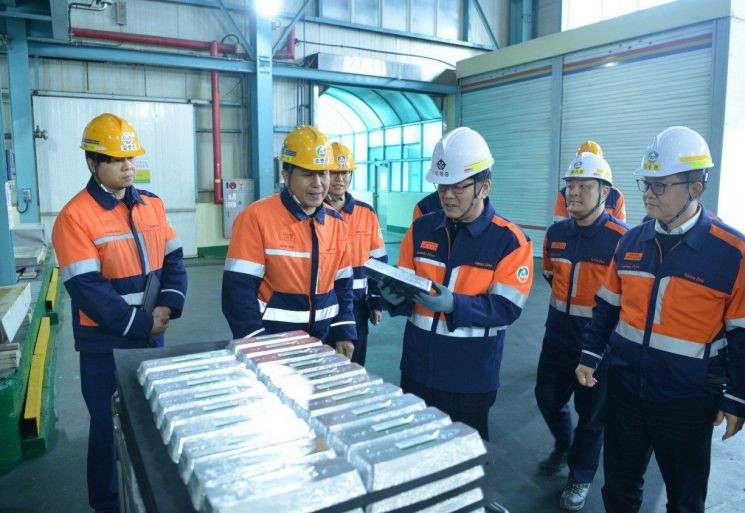 Vice Chairman Lee Je-jung, CTO of Korea Zinc (center), is visiting the indium plant within the Korea Zinc Onsan Smelter to inspect the produced products. (Photo by Korea Zinc)
Korea Zinc produces three of the five items subject to export controls imposed by the Chinese government: indium, bismuth, and tellurium. Regarding indium, known as the "metal vitamin" used in display, touchscreen, and solar panel manufacturing, Korea Zinc supplies about 150 tons annually, accounting for approximately 11% of the global demand of around 1,400 tons.
Bismuth, used in nuclear power plants and defense industries, is also produced exclusively by Korea Zinc domestically, with annual sales of 900 to 1,000 tons both domestically and internationally. Tellurium, widely used in solar cells, thermoelectric devices, capacitors, and vehicle parts, is produced at 100 to 200 tons annually.
Antimony, which saw a worsening supply shortage after China imposed export controls last September, is also produced solely by Korea Zinc in South Korea. Antimony is used in various fields such as military supplies, semiconductors, infrared devices, and lead-acid batteries, and demand is expected to expand further amid ongoing negotiations regarding exports to the United States.
At a meeting with smelter executives and team leaders, Vice Chairman Lee encouraged core technical researchers and workers, urging them to ensure thorough production so that strategic resources can be stably supplied to the industry. He stressed the importance of unwavering efforts to improve rare metal recovery rates and process efficiency, emphasizing that the technology research center must dedicate itself to research and development (R&D) aimed at enhancing rare metal recovery rates.
Korea Zinc plans to increase rare metal recovery rates by more than 20-30% for each item. Operating the world's only integrated zinc, lead, and copper process, the company possesses the capability to extract 12 types of rare metals present in trace amounts in zinc and lead concentrates, aiming to maximize its differentiated technological strengths compared to other smelters.
Vice Chairman Lee also listened to updates on the development of a recycling resource processing process, which involves an investment of 124.1 billion KRW, and encouraged the on-site employees by saying, "Thanks to the dedication and efforts of the Onsan Smelter staff, we have been able to respond swiftly to changes."
© The Asia Business Daily(www.asiae.co.kr). All rights reserved.
![Clutching a Stolen Dior Bag, Saying "I Hate Being Poor but Real"... The Grotesque Con of a "Human Knockoff" [Slate]](https://cwcontent.asiae.co.kr/asiaresize/183/2026021902243444107_1771435474.jpg)















