79% Increase in Patent Applications Over Five Years
Promoting Paper Publication and Patent Applications to Drive Technological Advancement
Rising Applications to Defend Against Patent Infringement Lawsuits
Record-High 35 Trillion Won Invested in R&D
Amid patent competition among companies in sectors such as semiconductors and batteries, Samsung Electronics has been identified as the domestic company with the highest number of patent applications over the past five years. This is attributed to its massive investment in developing technological capabilities and its efforts to secure patents amid frequent patent infringement lawsuits. This has also been analyzed to have influenced the commercialization of actual products.
According to data titled 'Patent Application Status by Top 10 Frequent Applicants by Year (2020?2024)' received on the 10th from the Korean Intellectual Property Office by the office of Kim Han-kyu of the Democratic Party of Korea, Samsung Electronics ranked first among the top 10 companies in patent applications over the past five years. Samsung Electronics, which produces semiconductors, smartphones, and displays, filed 7,447 patent applications in 2020, accounting for the highest proportion (26.5%) among the 28,146 patents filed by the top 10 companies. Since 2021, it has maintained the largest share of patent applications, holding over 30% each year.
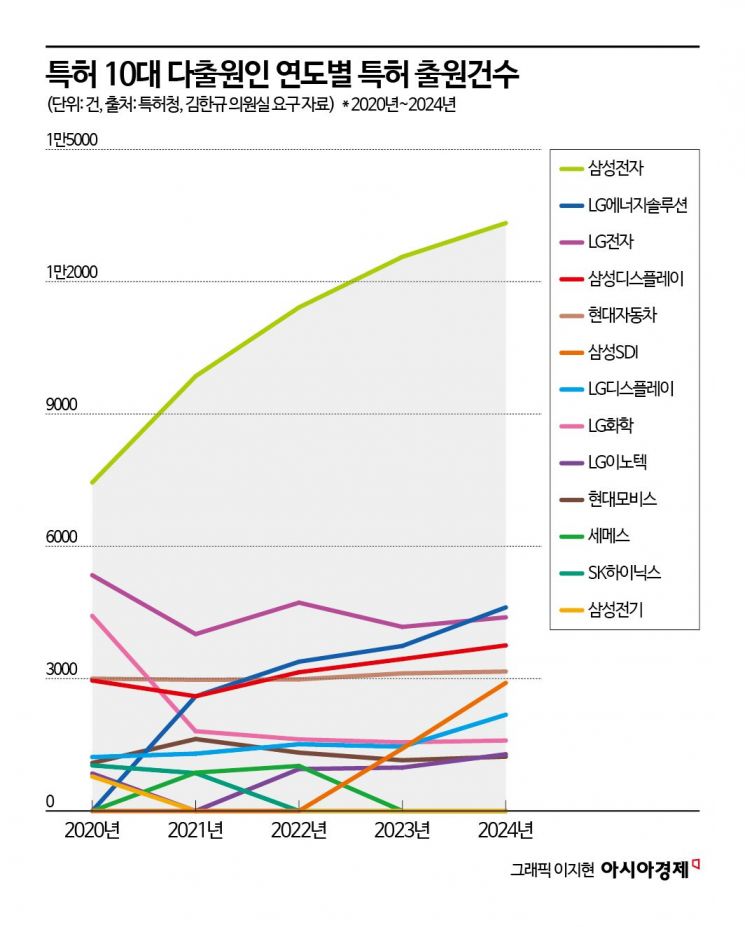
The number of patent applications has also increased annually: ▲7,447 (2020) ▲9,856 (2021) ▲11,417 (2022) ▲12,563 (2023) ▲13,329 (2024), showing a steady rise. Over five years, this represents an approximately 79% increase, ranking first in growth rate as well. Samsung Electronics holds numerous patents in fields such as semiconductors, displays, smartphones, artificial intelligence (AI), 5G and communication equipment, and battery technology, securing global technological competitiveness based on these. Furthermore, leveraging these patents, it has commercialized AI semiconductors, high-performance memory, and server technologies into actual products, recently applying them to new technology products such as the Galaxy Watch's bioelectrical impedance analysis (BIA) measurement device and the wearable robot for walking assistance called 'Botfit.'
Through patents related to bioelectrical impedance analysis (BIA) measurement, Samsung Electronics applied body composition analysis functions to the Galaxy Watch, securing competitiveness in the smart healthcare market. Utilizing patents related to walking assistance technology and robot control algorithms, Samsung developed 'Botfit,' a customized wearable robot intended for commercialization to assist users with rehabilitation and walking difficulties.
Samsung Electronics continues to innovate in the display sector as well. It leads the market by securing numerous patents related to foldable phones. Although it unveiled the world's first foldable phone, the 'Galaxy Fold,' in 2019, the initial model faced a crisis due to display defects. However, Samsung applied various patented technologies such as enhanced hinge durability and extended display protective films, releasing an improved model within five months and regaining market trust. Currently, Samsung Electronics holds over 90% market share in the foldable phone market.
A company's patent portfolio serves as a key indicator of technological capability. It reflects the outcomes of research and development (R&D) investments and provides incentives for technological innovation. Holding patents on core technologies also prevents imitation by competitors and entry by latecomers. Recently, in industries with high patent dependency such as semiconductors, batteries, and automotive components, competition to protect technology among companies has intensified.
As revealed by patent application statistics, Samsung Electronics strategically invests in patent applications. Having a large number of patents offers various advantages in global competition. First, it protects core technologies, preventing imitation by competitors and strengthening market dominance. Additionally, securing patents in multiple countries provides legal protection when entering overseas markets, facilitating global expansion.
Moreover, it can gain an advantage in patent-sharing negotiations between companies and generate revenue through technology licensing using its patent portfolio. Such a frequent application strategy acts as an important factor that creates value beyond simple R&D investment. Samsung Electronics has been known to have raised its technological level by encouraging company-wide publication of papers and patent applications since the 1990s. In 1992, it succeeded in developing the world's first 64Mb DRAM, becoming a technological leader in the semiconductor field. Last year, Samsung Electronics invested a record-high total of 35 trillion won in R&D, focusing on technology development. Over the past five years, Samsung Electronics has invested more than 150 trillion won in R&D, which serves as a core strategy to stay ahead in global technological competition.
In particular, Samsung Electronics has intensified its patent application efforts amid frequent patent infringement lawsuits overseas. In 2011, Apple filed a patent infringement lawsuit against Samsung Electronics regarding iPhone design and screen layout patents, leading to nearly seven years of litigation. In 2020, global telecommunications equipment company Ericsson sued Samsung for infringing patents related to 5G and LTE. Recently, a U.S. patent management firm also filed a lawsuit claiming that Samsung's foldable phone infringed on its translator patent.
Im Hyung-kyu, former president who led the semiconductor industry at Samsung Electronics for over 30 years, stated in his book 'Hidden Heroes' that "To overcome the situation of having to pay large patent fees to advanced companies, great efforts were made to secure valid patents," adding, "Patent applications were emphasized from the early stages of business, and meaningful international patents began to emerge from the mid-1990s." Samsung Electronics encourages the presentation of excellent papers at overseas academic conferences after patent application, which has reportedly increased the rate of publication in global academic journals.
Looking at global statistics, Samsung Electronics ranks among the top in patent counts. Last year, Samsung Electronics filed 3,924 patents, ranking second in the global patent activity statistics announced by the World Intellectual Property Organization (WIPO). Besides Samsung Electronics, LG was the only other Korean company in the global rankings, with Huawei ranking first with 6,494 patents. Regarding this, a Samsung Electronics official explained, "Patents are the source of all technologies, and it is a global trend for companies to proactively secure many patents," adding, "Due to frequent overseas patent disputes, we secure patent rights to respond accordingly."
© The Asia Business Daily(www.asiae.co.kr). All rights reserved.
![Clutching a Stolen Dior Bag, Saying "I Hate Being Poor but Real"... The Grotesque Con of a "Human Knockoff" [Slate]](https://cwcontent.asiae.co.kr/asiaresize/183/2026021902243444107_1771435474.jpg)
















