Domestic researchers have developed a novel fiber-type thermoelectric material and succeeded in implementing a wearable sensor system that mimics human skin sensation.
The National Research Foundation of Korea announced on the 5th that Professor Taeyoon Lee's research team at Yonsei University developed a high-performance stretchable fiber-type thermoelectric device embedded with copper iodide (CuI) nanoparticles, a high-performance inorganic thermoelectric material, and implemented a sensor system that simultaneously detects temperature, tension, and pressure using wearable electronic devices.
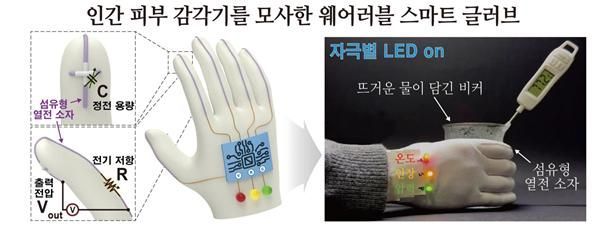 Example material of a wearable smart glove mimicking human skin sensors. Provided by the National Research Foundation of Korea.
Wearable electronic devices have gained attention as the importance of non-face-to-face health management has increased after the COVID-19 pandemic, coinciding with the rising demand for personalized health monitoring systems.
To use health monitoring systems with wearable electronic devices, it is important to utilize sensors based on flexible and stretchable thermoelectric devices that can precisely detect physical data such as user movement and body temperature changes.
However, existing organic thermoelectric material-based devices have low thermoelectric performance, and inorganic thermoelectric material-based devices lack flexibility and stretchability, limiting their use as sensors for wearable electronic devices.
The fiber-type thermoelectric device developed by the research team is significant in that it can overcome these limitations. This device has copper iodide nanoparticles uniformly distributed inside, providing high flexibility and stretchability while delivering excellent thermoelectric performance.
For example, the fiber-type thermoelectric device can stretch up to 835% and achieves a high Seebeck coefficient of 203.6 μV/K (a value representing the voltage generated by a temperature difference, used as an indicator to evaluate thermoelectric device performance), overcoming the previous limits of 350% stretchability and 58 μV/K Seebeck coefficient, according to the research team.
The research team also integrated the fiber-type thermoelectric device into a multimodal sensor form within a wearable smart glove to implement a sensor system that detects various stimuli (mimicking skin sensation). A multimodal sensor refers to a sensor system capable of simultaneously detecting and fusing multiple physical and chemical signals to process data.
The smart glove equipped with multimodal sensor functions can precisely detect changes in the user's temperature, tension, and pressure by measuring changes in different variables such as output voltage, electrical resistance, and capacitance. The research team anticipates that this will enable the implementation of personalized health management systems through wearable electronic devices.
Professor Taeyoon Lee stated, “Our research team has newly proposed a technology that reproduces various human skin sensations with a single fiber,” adding, “This technology will enable personalized health monitoring through wearable electronic devices in the future.”
© The Asia Business Daily(www.asiae.co.kr). All rights reserved.
![Clutching a Stolen Dior Bag, Saying "I Hate Being Poor but Real"... The Grotesque Con of a "Human Knockoff" [Slate]](https://cwcontent.asiae.co.kr/asiaresize/183/2026021902243444107_1771435474.jpg)















