Third Largest Number of Stores Globally After the US and China
Once Seen as a Symbol of Luxury and Excess in 1999
Now, a Tall Americano Costs Less Than Half the Minimum Hourly Wage
Struggling to Improve Profitability as Margins Fall to 5%
It has been reported that the number of Starbucks stores in South Korea has surpassed 2,000. As of the end of last year, there were 2,009 locations. This surpasses Japan, where Starbucks first expanded outside of North America and currently has 1,991 stores, making South Korea the country with the third largest number of Starbucks stores in the world after the United States and China. Given that South Korea's population is about 52 million, the number of stores per capita is even higher than in the United States or China. It's no wonder South Korea is often called the "Republic of Starbucks."
Starbucks first entered the Korean market in July 1999, opening its first store near Ewha Womans University. That was more than 25 years ago. Over that time, Korean consumers' perception of Starbucks has changed significantly, just as the number of stores has increased. Many people may remember the early image of Starbucks. Back then, a certain term was always associated with Starbucks: "Doenjang-nyeo." This derogatory slang was used in the 2000s to criticize women perceived as overly indulgent or extravagant. At that time, Starbucks coffee was more expensive than a meal, so simply visiting Starbucks could earn you the label of "Doenjang-nyeo" or "Doenjang-nam."
It's hard to imagine now, but back then, a cup of Starbucks coffee cost more than a bowl of Jjajangmyeon. In 1999, a tall Americano was priced at 3,000 won, while a bowl of Jjajangmyeon cost just 2,500 won. The minimum hourly wage at the time might surprise you: it was only 1,525 won. So, you had to work almost 1 hour and 58 minutes to afford a single Americano, which naturally led to the perception of Starbucks as a luxury.
Especially at that time, 200-won instant coffee was the norm, while Starbucks popularized brewed coffee. Since spending money on coffee was not yet commonplace, the cultural shock was even greater.
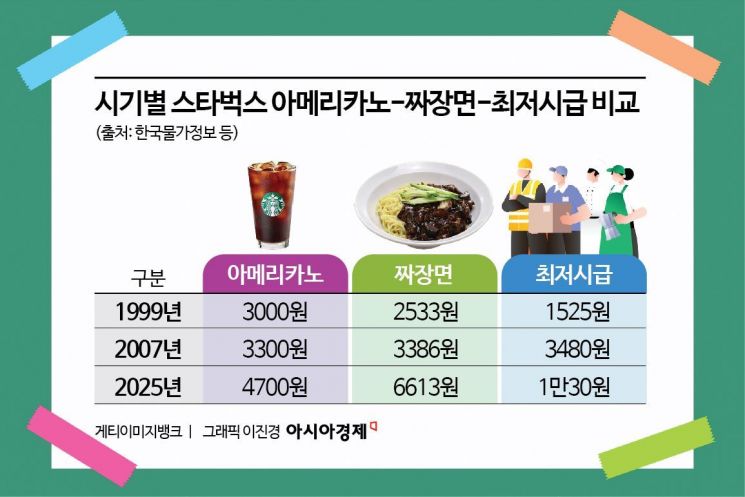
It wasn't until 2007, eight years after Starbucks entered Korea, that you could finally buy a cup of Americano with just one hour's work. The minimum wage rose to 3,480 won in 2007, while a tall Americano cost 3,300 won. Even so, the perception of Starbucks as a luxury persisted.
But now, Starbucks coffee is cheaper than both Jjajangmyeon and the minimum hourly wage. The price of a tall Americano recently increased by 200 won to 4,700 won, which is much cheaper than last year's average price of Jjajangmyeon, 6,613 won, as calculated by the Korea Price Information Center. This year's minimum hourly wage is 10,030 won, so you can buy a cup of coffee without even working half an hour. While the price of brewed coffee has remained relatively stable due to fierce competition among cafes, the cost of dining out and the minimum wage have both risen sharply. Looking back, the change is truly remarkable.
By 2025, not only have relative prices and the number of Starbucks stores changed, but perceptions of Starbucks have also shifted dramatically. These days, almost no one associates visiting Starbucks with the term "Doenjang-nyeo." Instead, Starbucks has become a convenient and approachable caf?. With plenty of charging outlets and no need to worry about being watched by staff, it's now considered a haven for the "Kagong-jok" (caf? study crowd). Many people see it as renting a study space for the price of a cup of coffee in the 4,000-won range. In a way, over the past 25 years, Starbucks has shed its image as a luxury caf? and established itself as a comfortable space.
But there is a twist. The fact that Starbucks is a comfortable place to stay for a long time also means that table turnover is low. SCK Company, which operates Starbucks in Korea, is estimated to have surpassed 3 trillion won in annual sales for the first time last year, thanks to the increased number of stores. However, profits have not grown in proportion to the company's expansion. The operating margin, which was 10% in 2010, dropped sharply to 4.8% in 2023. This is likely due to the high operating costs of large stores with many employees, combined with low turnover rates.
Meanwhile, as coffee bean prices soared, Starbucks announced consecutive price hikes in August and November last year, and again in January this year. While the company claims that the price of its core menu item, the tall Americano, has only been raised once, most consumers feel that "prices have gone up again." In addition, Starbucks is implementing various strategies to improve profitability, such as increasing the number of stores that use buzzers instead of calling customers' names, and launching a subscription service. Perhaps as a result, the operating margin in the first half of last year reportedly recovered to the 5% range.
Having transformed over 25 years from a symbol of luxury to a haven for caf? study groups, Starbucks is now focusing on improving its weakened profitability. It will be interesting to see what the future holds for the company.
© The Asia Business Daily(www.asiae.co.kr). All rights reserved.
![Clutching a Stolen Dior Bag, Saying "I Hate Being Poor but Real"... The Grotesque Con of a "Human Knockoff" [Slate]](https://cwcontent.asiae.co.kr/asiaresize/183/2026021902243444107_1771435474.jpg)
















