'White-collar Exemption' in Semiconductor R&D at the Center of Debate
Lee May Make a Progressive Decision Like the Fintax Abolition
Industry: "This Is a National Issue, R&D Work Must Be Understood"
The attention of semiconductor companies facing a recession has turned to the political sphere. There is speculation that Lee Jae-myung, leader of the Democratic Party of Korea, may make a progressive decision regarding the exemption from the 52-hour workweek. The industry views this not as a special privilege but as a minimum 'necessary condition' to compete in the global market.
According to political circles on the 31st, the Democratic Party will hold a policy forum on the 3rd of next month to discuss the so-called 'white-collar exemption' clause. This is the biggest issue in the Semiconductor Special Act, proposing an exception to the 'maximum 52-hour workweek' stipulated by the Labor Standards Act for research and development (R&D) workers. It has been reported that at this forum, attendees from Samsung Electronics and SK Hynix will be R&D field-level practitioners rather than C-level executives.
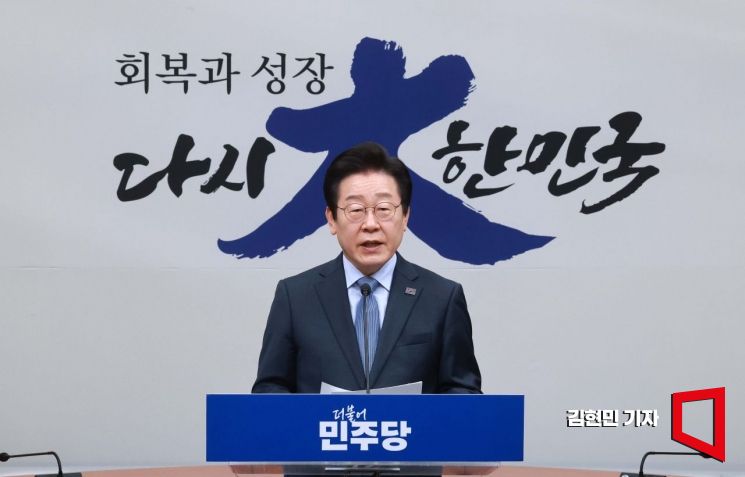 Lee Jae-myung, leader of the Democratic Party of Korea, is holding a New Year's press conference at the National Assembly on the 23rd. Photo by Kim Hyun-min
The white-collar exemption has gained attention as the competition for semiconductor R&D among countries intensifies. The industry demands that R&D workers be able to focus on development without being constrained by working hour limits to avoid falling behind overseas companies. At a press conference on the 23rd, Lee Jae-myung responded to related questions by saying, "My basic stance is to make a practical judgment," showing a relatively open attitude.
An industry insider said, "R&D does not operate on fixed deadlines but on a project basis," adding, "At least in the R&D field, we want to be able to compete equally in the global market." Another industry source pointed out, "If performance improves, the compensation that individual workers can receive also increases," and criticized the notion that employers oppress workers to make them work more as a distorted frame.
Ahn Ki-hyun, Executive Director of the Korea Semiconductor Industry Association, said, "(The white-collar exemption clause) is not a matter of whether to include it or not, but a national issue that must be included," emphasizing, "Opponents consider R&D work as simple labor, but they need to understand how much the 52-hour workweek system damages the industry."

The Democratic Party was the party that put the brakes on whether to include the white-collar exemption. However, within the party, members of the Industry, Trade, Small and Medium Enterprises Committee have an open stance, while members of the Environment and Labor Committee strongly oppose it. They argue that if the working hours system is to be altered, the Labor Standards Act must be amended, which is quite difficult considering the identity of the Democratic Party.
The variable is Lee Jae-myung's 'Muksanism' behavior. Facing the possibility of an early presidential election and needing to expand his appeal to the centrist electorate, Lee has recently been emphasizing keywords such as practicality and growth. Attention is focused on the possibility of a progressive decision similar to when the financial investment income tax (Fintax) was abolished last year. At that time, after a policy forum, Lee overturned the existing party stance and agreed to abolish the Fintax.
A Democratic Party official said, "If Lee Jae-myung makes a decision, all four 'food laws,' including the Semiconductor Special Act, could pass the plenary session by mid-next month," adding, "If labor opposition is severe, there is also the option to adjust the application period of the white-collar exemption clause, granting temporary effect until 2035."
© The Asia Business Daily(www.asiae.co.kr). All rights reserved.
![Clutching a Stolen Dior Bag, Saying "I Hate Being Poor but Real"... The Grotesque Con of a "Human Knockoff" [Slate]](https://cwcontent.asiae.co.kr/asiaresize/183/2026021902243444107_1771435474.jpg)

















