Adjusting Production Volumes Between Factories in Response to Tariffs
LG Electronics "Considering Relocating Factory from Mexico to the U.S."
Hyundai Motor: Building U.S. Production System and Replacing Management
Samsung SDI: Reviewing State-Level Policies in the U.S.
As the second term of the Trump administration begins, Korean companies with factories in low-cost production countries such as Mexico and Vietnam are facing increasing concerns. If the U.S. imposes high tariffs on products manufactured in these countries, companies will need to minimize the impact through measures such as adjusting production volumes. There are also forecasts that, in the long term, relocating factories locally will be considered.

According to the industry on the 31st, major domestic companies in semiconductors, secondary batteries, automobiles, and steel are reviewing plans to reduce production volumes at factories in Vietnam, Mexico, and other countries while expanding production at U.S. factories in preparation for the Trump administration's protectionist trade policies.
Earlier, U.S. President Donald Trump mentioned that starting next month, a 10% tariff would be imposed on imports from China, and a 25% tariff on imports from Canada and Mexico. There are also expectations that tariffs will be imposed on foreign semiconductors, pharmaceuticals, steel, and other products.
Semiconductor Industry "Considering Relocation of Mexico Factory"
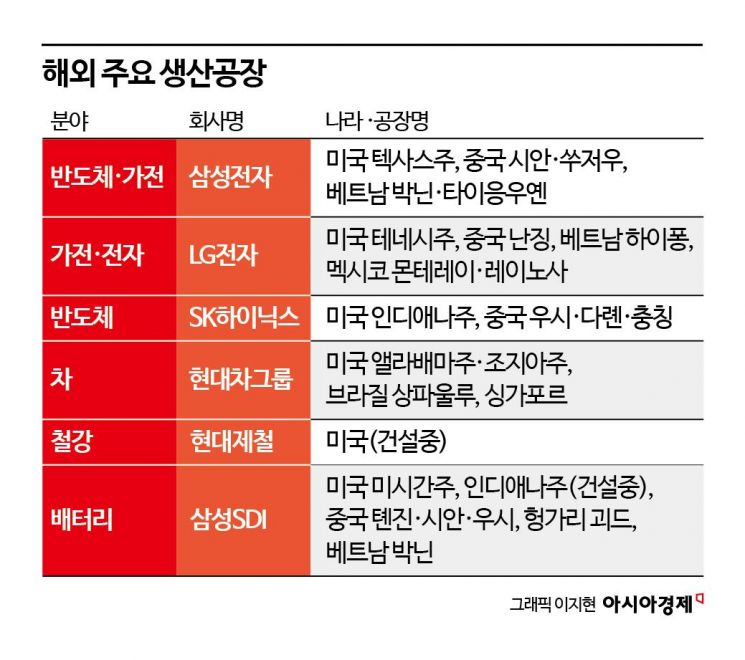
Currently, domestic semiconductor companies operate production bases in various countries including the U.S., China, and Southeast Asia. Samsung Electronics operates factories in Austin, U.S. (foundry semiconductors), Xi'an, China (NAND flash memory production), Suzhou (semiconductor packaging and testing), and Bac Ninh and Thai Nguyen in Vietnam (semiconductor post-processing). Samsung plans to respond to the situation by adjusting production volumes between these factories.
Earlier, Han Jong-hee, Vice Chairman and CEO of Samsung Electronics, stated at the world's largest electronics and IT exhibition 'CES 2025' on the 7th that the tariff burden following the start of Trump's second term would "not be a big problem," adding, "We have quite a few factories and do not concentrate production in one place, so we plan to respond accordingly." Samsung Electronics also decided on an investment scale of over $37 billion to build a foundry (semiconductor contract manufacturing) factory in Taylor, Texas, U.S.
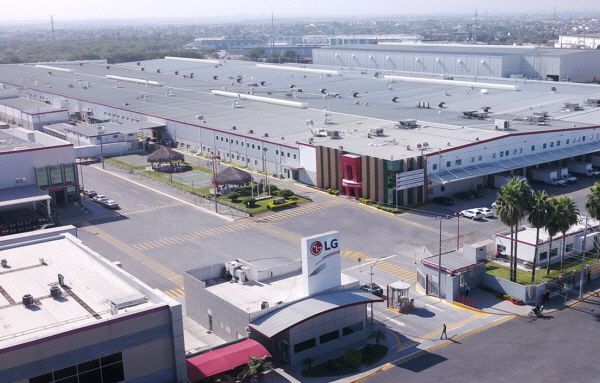
In the case of LG Electronics, in addition to adjusting production volumes between factories, the possibility of relocating the Mexico production plant to the factory in Tennessee, U.S. is also being considered. LG Electronics inevitably faces impact as it has production bases in major U.S. trade deficit partner countries targeted by the U.S. Currently, it operates home appliance production plants in Tennessee, U.S.; Haiphong, Vietnam; Nanjing, China; and Monterrey and Reynosa, Mexico.
Kim Chang-tae, Vice President of LG Electronics, said at the Q4 earnings briefing on the 23rd, "If the U.S. significantly raises tariffs, more aggressive changes in production site strategies, including relocating production sites and adjusting production capacity at existing sites, could be included in the scope of consideration." Regarding this, an LG Electronics official explained, "There is a possibility of expanding the home appliance factory in Tennessee, U.S.," adding, "Some products will be partially relocated to Tennessee through volume expansion and item diversification."
SK Hynix is also considering expanding its local factory in the U.S. Currently, factories are operating in Wuxi (DRAM), Dalian (NAND flash), and Chongqing (post-processing) in China, and the company has announced plans to build an advanced post-processing and R&D-related production plant in Indiana, U.S., with an investment of $3.87 billion, which is expected to be implemented.
Hyundai Motor: Changing U.S. Production System and U.S. Experts
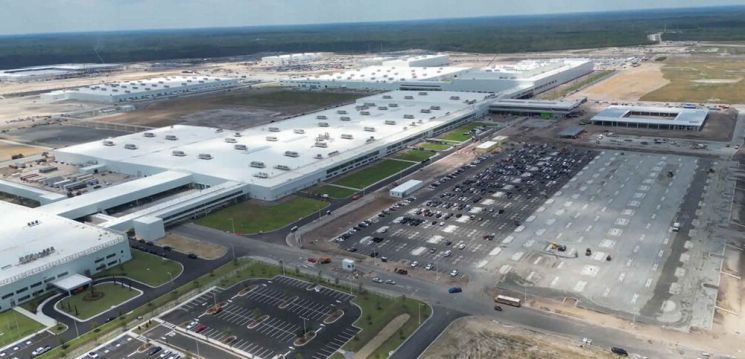 Exterior view of Hyundai Motor Group Meta Plant America (HMGMA) in Georgia, USA. Photo by Hyundai Motor Group
Hyundai Motor Group is the domestic conglomerate most sensitive to changes in U.S. policies. Last year, one out of every four finished vehicles sold globally by Hyundai and Kia was sold in the U.S., making the U.S. an absolutely significant market for Hyundai Motor Group.
To respond to policy changes under the new Trump administration, Hyundai Motor Group replaced its management with U.S. experts. Jose Munoz, CEO of Hyundai Motor, is a U.S. citizen and a North American sales expert with nearly 20 years of experience in North America. Additionally, Hyundai Motor recruited Sung Kim, a former U.S. diplomat, as president in charge of overseas government relations to maintain close communication with the U.S. government.
Hyundai Motor Group has also established a local production system in the U.S. to prepare for tariffs. Adding the production capacity of 400,000 units at Hyundai Motor's Alabama plant, 340,000 units at Kia's Georgia plant, and the newly operational 'Hyundai Motor Group Meta Plant America (HMGMA)' with a capacity of 350,000 to 400,000 units, the group's local production capacity in the U.S. will increase to about 1.1 million units. As of last year, 65% of Hyundai and Kia's U.S. sales volume can be supplied through local production.
The impact of additional tariffs on Mexico or Canada is also expected to be limited. Although Kia operates a factory in Mexico, its utilization rate was not high at around 60% last year, and popular Kia models in the U.S. such as the Sportage and Telluride are all produced either at U.S. local factories or domestic factories, so the tariff impact is expected to be limited. Lee Seung-jo, Vice President of Hyundai Motor's Planning and Finance Division, said, "We are analyzing and preparing countermeasures for the Trump administration's tariff policies based on various scenarios," adding, "Hyundai Motor has a high production ratio in the U.S., so the tariff impact is expected to be less compared to other competitors such as Japanese automakers."
Steel Industry: "Possibility of Korean Reflective Benefits if China Faces Tariffs"
The steel industry is also reviewing various possibilities in preparation for tariff imposition. Hyundai Steel is considering building an automotive steel sheet production base in the U.S. A Hyundai Steel official said, "This is partly to respond to tariffs and also to support Hyundai Motor's global business," adding, "Blast furnace-type steel mills seem difficult as they do not align with the carbon neutrality trend."
The battery industry is also monitoring state-level policies in the U.S. with the possibility of tariffs in mind. A Samsung SDI official said, "If President Trump imposes more tariffs on China, Korea could gain reflective benefits," adding, "For energy storage systems (ESS), we plan to install many in project-based customer regions such as California and Texas."
Experts: "Must Increase U.S. Factory Volumes to Maintain Sales"
Experts also advise that delicate strategies such as factory relocation and adjusting production volumes between factories are necessary. Kim Moon-tae, head of the Industrial Policy Team at the Korea Chamber of Commerce and Industry, said, "Companies with local factories in the U.S. seem to be considering how much they can adjust U.S. production volumes and how much tariff burden they can reduce," adding, "For those without, they need to consider whether to invest in production and build factories in the U.S., which is not an easy decision." Regarding the possibility of relocating factories from low-cost production countries, he said, "This is what the Trump administration intends," but added, "Factory relocation itself requires comprehensive judgment, so if tariffs become a reality, it can be included as an option for consideration."
However, even increasing local production in the U.S. does not guarantee safety. On the 29th, Howard Lutnick, nominee for U.S. Secretary of Commerce, mentioned the possibility of reviewing semiconductor and battery subsidies that the Biden administration had promoted. While the subsidy policy may be maintained, there is also a possibility of adding conditions or requiring investments.
Shin Won-kyu, invited research fellow at the Korea Economic Research Institute, explained, "In 2003, the U.S. Department of Commerce imposed a 57.37% tariff on Hynix Semiconductor, but sales actually increased," adding, "They increased transactions between headquarters and branches to send volumes to the Eugene plant in the U.S., maintaining internal production sales." He emphasized, "However, measures such as establishing special provisions to relax related regulations to allow flexible internal transactions in Korea are necessary."
© The Asia Business Daily(www.asiae.co.kr). All rights reserved.
![Clutching a Stolen Dior Bag, Saying "I Hate Being Poor but Real"... The Grotesque Con of a "Human Knockoff" [Slate]](https://cwcontent.asiae.co.kr/asiaresize/183/2026021902243444107_1771435474.jpg)


















