Fed Holds Benchmark Rate Steady Despite Trump Pressure
Maintains 4.25-4.5% After Three Consecutive Cuts
Powell: "Rates Are Considerably Less Restrictive"
Declines to Comment on Trump... "We Will Do Our Job"
"There is no need to rush policy stance adjustments. The public should be confident that we will continue to do our job."
Jerome Powell, Chairman of the U.S. Federal Reserve (Fed), confirmed a cautious monetary easing stance by keeping the benchmark interest rate unchanged. Despite pressure from U.S. President Donald Trump to cut rates, Powell indicated that the Fed would adjust the pace of rate cuts while assessing the uncertain impact of Trump's second-term policies. Following the Fed's decision to hold rates steady, the New York stock market declined, while the bond market showed little reaction.
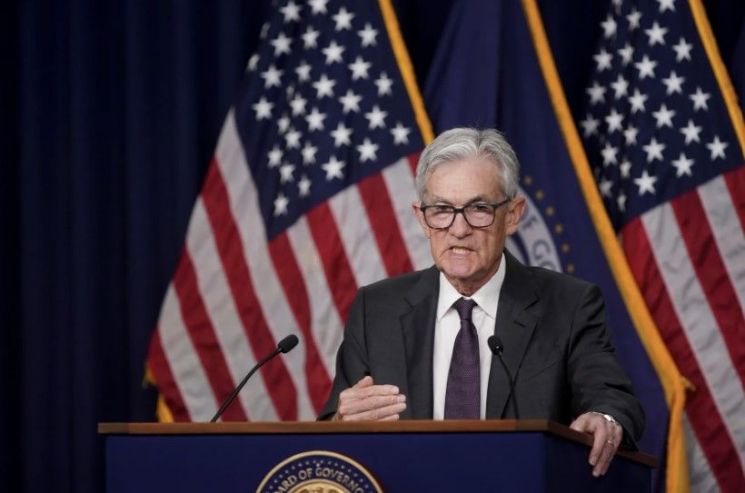
At a press conference held immediately after the first Federal Open Market Committee (FOMC) regular meeting of the year on the 29th (local time), Chairman Powell said that the current benchmark interest rate is "considerably less restrictive" and that "policy and the economy are really in a good place, so there is no need to rush adjustments (to monetary policy)."
The Fed unanimously decided at this meeting to keep the federal funds rate unchanged at 4.25-4.5% per annum. After initiating a monetary easing cycle by lowering the rate from 5.25-5.5% in September last year by 0.5 percentage points for the first time in two and a half years, the Fed further cut rates by 0.25 percentage points in both November and December, marking three consecutive cuts before this first hold. This maintained the interest rate gap with South Korea at an upper limit of 1.5 percentage points.
Chairman Powell expressed optimism about future inflation easing but said, "It seems ready for further progress, but achieving progress is another matter." He also indicated that the Fed would not immediately change its 2% inflation target.
During the press conference, many questions were raised about Powell's stance on President Trump's demands for rate cuts. Earlier, on the 23rd, President Trump, in a virtual speech at the World Economic Forum (WEF, Davos Forum) held in Davos, Switzerland, said he would "demand immediate rate cuts" from the Fed and that "interest rates should be lowered globally."
Powell said he had "not been in contact" with President Trump and that commenting on the president's remarks was "inappropriate." However, he stated, "The public should be confident that the Fed will continue to do its job," implying that the Fed intends to maintain the independence of monetary policy despite pressure from the White House to cut rates.
Powell deferred evaluation of the impact of President Trump's policies on the economy. He said, "Policies need to be concretized before starting to assess the impact of tariffs, immigration, fiscal, and regulatory policies on the economy," adding, "There are too many variables related to policies, so we need to wait and observe." When asked about the impact of trade policies including tariffs, he replied, "I would prefer to avoid even indirect references to tariffs."
The FOMC policy statement that day showed noticeable changes in the Fed's assessment of the labor market and inflation. Regarding the labor market, the Fed had diagnosed in December last year that it had "generally eased" since early this year, but this time revised the phrase to "remain solid." Regarding inflation, it assessed that it "remains somewhat elevated," removing the previous phrase that "progress has been made toward the 2% target."
The Fed stated, "The Committee aims to achieve maximum employment and 2% inflation in the long term," adding, "The economic outlook is uncertain, and the Committee is paying attention to risks on both sides of its dual mandate." It further explained, "We will continue to monitor the impact of incoming information on the economic outlook," and "If risks arise that could impede achieving our goals, we are prepared to appropriately adjust the stance of monetary policy."
Following the Fed's first rate hold after initiating the monetary easing cycle, the New York stock market collectively declined. On the New York Stock Exchange (NYSE) that day, the Dow Jones Industrial Average closed down 0.31% from the previous trading day. The S&P 500 and Nasdaq indices fell by 0.47% and 0.51%, respectively.
Government bond yields moved within a narrow range. The U.S. 10-year Treasury yield, a global bond yield benchmark, fell by 1 basis point (1bp = 0.01 percentage points) to 4.53% compared to the previous day, while the 2-year Treasury yield, sensitive to monetary policy, rose by 2 basis points to 4.22%.
Lindsey Rossner, Senior Multi-Sector Bond Manager at Goldman Sachs Asset Management, evaluated, "With the Fed pressing the pause button, the new year’s monetary easing cycle has entered a new phase," adding, "Strong growth and resilient labor market data have provided room to approach with more patience amid rising (inflation) indicators and policy uncertainty." She further analyzed, "We believe the Fed's easing cycle is not over yet," but "the FOMC will want to see further progress in inflation indicators before the next rate cut."
© The Asia Business Daily(www.asiae.co.kr). All rights reserved.
![Clutching a Stolen Dior Bag, Saying "I Hate Being Poor but Real"... The Grotesque Con of a "Human Knockoff" [Slate]](https://cwcontent.asiae.co.kr/asiaresize/183/2026021902243444107_1771435474.jpg)
















