CBS: About Two Battery Fires Occur Weekly on US Flights
"Storing in Overhead Bins Is Not Carrying in the Cabin... Devices Should Be Held in Hand"
As the cause of the Air Busan passenger plane fire at Gimhae Airport is suspected to be an auxiliary battery, opinions are emerging that regulations on items brought into the cabin should be strengthened.
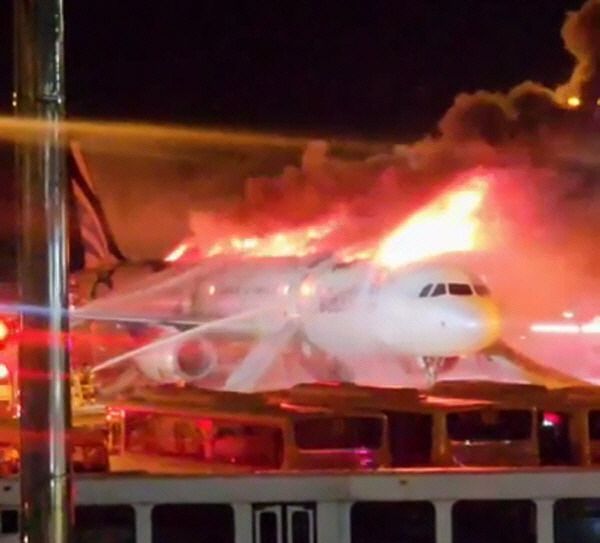 On the night of the 28th, firefighters extinguished a fire that broke out on the tail section of an Air Busan aircraft bound for Hong Kong at Gimhae Airport. Photo by Yonhap News.
On the 29th, an active pilot wrote on his social media (SNS) that "the cause of the fire is narrowed down to luggage such as auxiliary batteries or electronic cigarette vaporizers in the overhead bin, smoking in the restroom, or electrical short circuits in the upper cabin." Previously, on December 12 last year, there was also a fire on an Air Busan aircraft suspected to have been caused by an auxiliary battery. At that time, smoke suddenly appeared inside flight BX142, which was moving on the runway at Busan Gimhae Airport preparing for takeoff. The smoke started from a mobile phone auxiliary battery carried by a passenger.
Although the cabin crew immediately suppressed the smoke with an onboard fire extinguisher, one passenger carrying the auxiliary battery reportedly suffered burns on their hand. The aircraft with smoke turned around on the runway and returned to the boarding gate. Air Busan disembarked all passengers and deployed a replacement flight.
In addition, in April last year, on Asiana Airlines flight OZ8913 departing from Gimpo Airport to Jeju, smoke was emitted from an auxiliary battery in the overhead bin. The crew responded quickly, preventing the incident from escalating into a fire. The aircraft carrying 273 passengers arrived at Jeju Airport as scheduled.
In January last year, a Scoot Airlines passenger plane preparing for takeoff at Taiwan Taoyuan International Airport, bound for Singapore, also experienced an incident where a passenger's mobile phone auxiliary battery exploded. The fire caused by the battery spread to the seat, delaying the plane's takeoff. Then in February, on Royal Air Philippines flight RW602 from Boracay, Philippines to Shanghai, China, a fire broke out from a passenger's auxiliary battery, forcing the aircraft to make an emergency return to Hong Kong.
US CBS News reported on the 18th of last month (local time), citing data from the US Federal Aviation Administration (FAA), that lithium-ion battery fires on US flights have increased by 388% since 2015, occurring on average about twice a week.
As battery fire incidents continue on domestic and international aircraft, there are calls for strengthening regulations on items brought into the cabin. According to aviation hazardous materials transport standards, lithium metal batteries and lithium-ion batteries are classified as hazardous materials and are prohibited from being carried in the cabin or checked baggage. However, transportation is allowed for small quantities used by passengers.
For electronic devices equipped with lithium batteries (cameras, mobile phones, laptops, etc.), if the lithium content of lithium metal batteries is 2g or less, or if the lithium-ion battery is 100Wh or less, they can be checked in or carried in the cabin. Unlike lithium metal batteries, rechargeable lithium-ion batteries between 100Wh and 160Wh can be brought on board with airline approval. However, regarding auxiliary batteries, lithium metal batteries with lithium content of 2g or less and lithium-ion batteries of 100Wh or less are only allowed to be carried in the cabin. Auxiliary batteries cannot be checked in as baggage.
Experts emphasize that lithium-ion batteries, regardless of whether they are installed in electronic devices or auxiliary batteries, frequently swell or explode on their own, so when carried in the cabin, passengers must hold and manage them by hand, and storing them in places out of reach such as overhead bins is dangerous. Putting them in the overhead bin does not count as carrying them in the cabin.
CBS stated, "The FAA requires airlines to include safety information in pre-flight announcements, but generally does not specifically address the risks related to battery fires," and urged, "Passengers should immediately inform the crew if their electronic devices become warm or discolored during the flight."
© The Asia Business Daily(www.asiae.co.kr). All rights reserved.
![Clutching a Stolen Dior Bag, Saying "I Hate Being Poor but Real"... The Grotesque Con of a "Human Knockoff" [Slate]](https://cwcontent.asiae.co.kr/asiaresize/183/2026021902243444107_1771435474.jpg)















