"Immediate Rate Cut Demanded... Will Meet Powell"
Increasing Pressure on Russia to End Ukraine War
"Demanding Oil Price Cuts from Saudi Arabia and OPEC... Cooperating with China"
U.S. President Donald Trump has publicly pressured the Federal Reserve (Fed) ahead of next week's benchmark interest rate decision to cut rates. He also expressed his intention to demand lower oil prices from Middle Eastern oil-producing countries to strangle Russia's "financial lifeline" in order to end the war in Ukraine. Additionally, he reaffirmed the tariff stance against trading partners such as Mexico, Canada, and China.
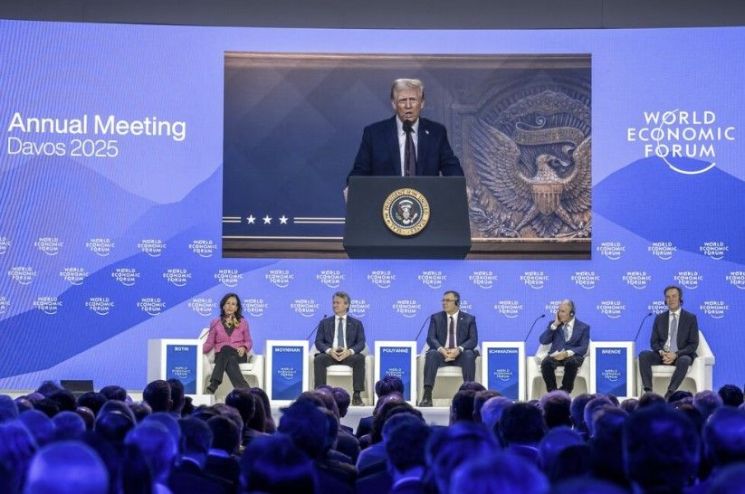
Trump: "Interest rates must be cut immediately... I will demand it from Powell"
On the 23rd (local time), President Trump said in a virtual speech at the World Economic Forum (WEF, Davos Forum) in Davos, Switzerland, "I will demand an immediate rate cut," adding, "Interest rates must come down globally. They should follow our rates." Although he did not explicitly mention the Fed during his Davos speech, he later met with reporters in the White House Oval Office and said he would meet with Jerome Powell, Fed Chair, and "have that conversation at the appropriate time." When asked if he thought the Fed would respond to such a demand, he replied, "Yes," and said, "I will take a strong stance." He also expressed hope that rates would come down "a lot."
This statement is President Trump's first message related to interest rates, issued just three days after his inauguration on the 20th. Having criticized the Fed's high-interest-rate policy and Chair Powell since his candidacy, he has begun pressuring the monetary authorities for rate cuts immediately upon taking office, as many had feared. The Fed will hold its first Federal Open Market Committee (FOMC) meeting since Trump's inauguration on the 29th to decide the benchmark interest rate.
Trump's pressure is expected to place considerable burden on the Fed, which has signaled a slowdown in monetary easing. The Fed recently announced it would slow the pace of rate cuts due to a robust economy and concerns over inflation rebound. Trump's policies on tariff increases, illegal immigration restrictions, and tax cuts raise concerns about upward pressure on prices. The U.S. benchmark interest rate has been lowered by 1 percentage point from a peak of 5.25-5.5% to the current 4.25-4.5% since the Fed ended 30 months of monetary tightening last September and began cutting rates. Trump's intervention in monetary policy is also expected to intensify debates over the Fed's political independence.
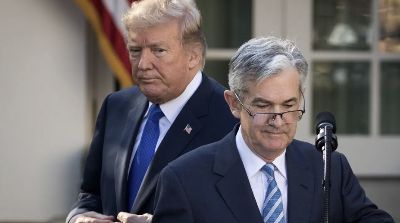
"Demanding oil price cuts from Saudi Arabia and OPEC to end Ukraine war... Reaffirming tariff increase stance"
In his Davos speech, President Trump also expressed his determination to end the Ukraine war by requesting lower oil prices from Middle Eastern oil-producing countries. He said, "If oil prices fall, the war between Russia and Ukraine will end immediately," adding, "Right now, prices are high enough that the war will continue. I will demand Saudi Arabia and the Organization of the Petroleum Exporting Countries (OPEC) to lower oil prices." His intention is to pressure Russia, which depends on energy exports for half of its fiscal revenue, by urging Middle Eastern oil producers to increase production and thus lower oil prices. The day before, Trump warned that if Russia does not agree to a ceasefire, "high levels of taxes, tariffs, and sanctions" would be imposed on all Russian exports.
He also called on China to play a role. He emphasized, "China has a huge influence on the war situation in Ukraine, and we will cooperate with China," adding, "I hope China can help end the war between Russia and Ukraine."
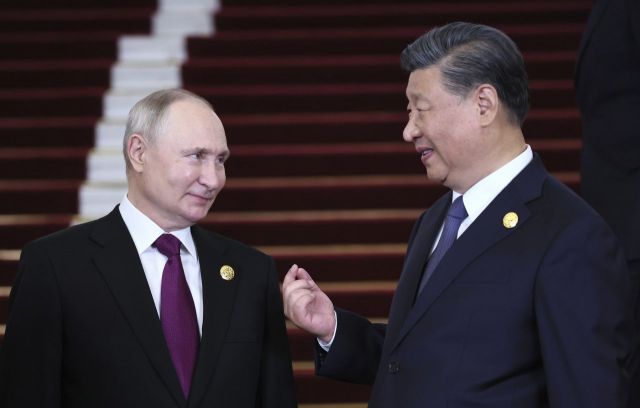
President Trump also reaffirmed his stance on raising tariffs. He said, "If you don't make products in the U.S., that's your privilege," adding, "Then, simply put, you have to pay tariffs. The amounts will vary, but hundreds of billions, even trillions of dollars will flow into our treasury as tariff revenue." He reiterated his plan to impose tariffs starting February 1 on China, Mexico, and Canada as previously announced during a meeting with reporters at the White House that day.
Meanwhile, President Trump announced his intention to appeal after a court ruled that his signed executive order restricting birthright citizenship was "unconstitutional" and issued an injunction against its enforcement. He appeared largely unfazed by criticism from his close aide Elon Musk, CEO of Tesla, regarding his announced artificial intelligence (AI) investment plan. He said, "CEO Musk just dislikes one of the investors," suggesting that the strained relationship between Sam Altman, CEO of OpenAI, one of the investors, and Musk CEO led to unexpected actions.
© The Asia Business Daily(www.asiae.co.kr). All rights reserved.
![Clutching a Stolen Dior Bag, Saying "I Hate Being Poor but Real"... The Grotesque Con of a "Human Knockoff" [Slate]](https://cwcontent.asiae.co.kr/asiaresize/183/2026021902243444107_1771435474.jpg)

















