Constitutional Court's Fourth Hearing on President Yoon's Impeachment: First Witness Examination
Kim Yong-hyun: "I Wrote Both the Proclamation and the Note"... "Yoon Did Not Review the Proclamation Carefully"
Initially Refused Cross-Examination by National Assembly, Later Reversed Decision
Former Minister of National Defense Kim Yong-hyun, who appeared as a witness at the 4th hearing of President Yoon Suk-yeol's impeachment trial, was still regarded as President Yoon's 'Chief of Security.' The biggest point of interest was what statements would be exchanged regarding the drafting and content of the 'Martial Law Proclamation No. 1,' a crucial issue determining whether to dismiss the president, during the first face-to-face meeting with President Yoon after being arrested by the prosecution. However, former Minister Kim showed his role as a close aide and trusted confidant.
Kim, who is one year senior to President Yoon at Chung-Ang High School, served first as the Chief of Security and then as Minister of National Defense, and the two also led the recent martial law plotting process. At the Constitutional Court that day, former Minister Kim immediately drew a line and actively guarded when asked questions related to President Yoon. Encouraged by this, President Yoon raised his voice even more than at the 3rd hearing when he first appeared and gestured more broadly. He nodded repeatedly while listening to Kim’s words and directly questioned Kim while looking him straight in the eye.
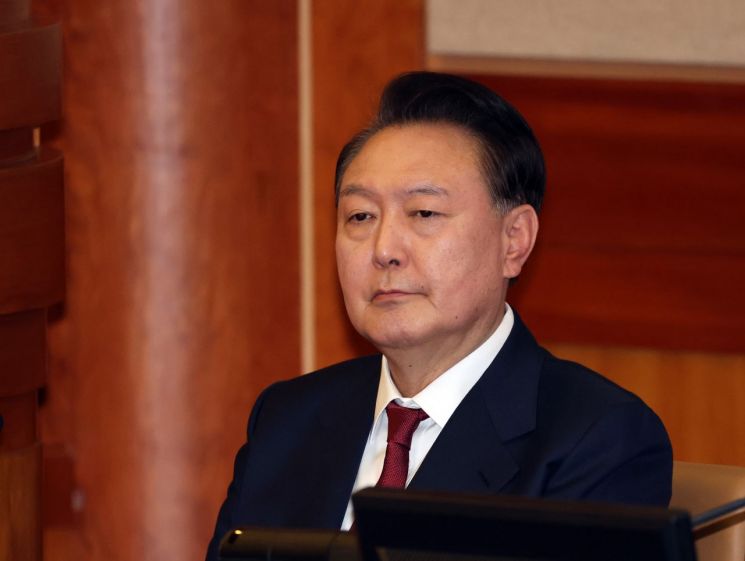 President Yoon Suk-yeol is attending the 4th impeachment trial hearing held at the Constitutional Court in Jongno-gu, Seoul on the 23rd. Photo by Yonhap News
At the 4th hearing of President Yoon Suk-yeol's impeachment trial held at the Constitutional Court on the 23rd, both sides engaged in a battle of words for over four hours, including the direct examination of former Minister Kim. Kim has been identified as the 'second-in-command' in this incident, having proposed the declaration of martial law and conspired in advance. He was arrested and indicted last month on the 27th on charges of engaging in important duties related to rebellion and abuse of authority. Kim, the first among those involved in martial law to be arrested and indicted, also became the first person to be examined as a witness at the Constitutional Court.
On that day, former Minister Kim testified that he personally delivered a 'note on the emergency legislative body' he had written on the day of the Cabinet meeting to Choi Sang-mok, the Acting President (then Deputy Prime Minister for Economy), through a staff member. This contradicted the prosecution's claim that President Yoon had delivered it to Acting President Choi. Kim said, "I typed it myself and worked on it on a laptop. At that time, Acting President Choi came late and we did not meet, so I could not hand it over directly and delivered it through a staff member." He added, "After the Cabinet meeting, I hurriedly left for the Ministry of National Defense and gave it to someone whose face I recognized, but I don't remember who it was."
The note, which Kim claimed to have written, was confirmed to include content such as securing contingency funds promptly and sufficiently, completely blocking various subsidies, support funds, and wages currently in operation related to the National Assembly, and budgeting for the emergency legislative body. Because of this, the 'emergency legislative body' is seen as an attempt to neutralize the legislative function of the National Assembly and disrupt the national order.
Regarding this body, Kim argued that it was not intended to block the activities of the National Assembly. He emphasized, "It means blocking various subsidies and support funds provided through the National Assembly, not completely blocking the activities of the National Assembly." He added, "Since additional budgets would be required once the organization is formed, it means budgeting for the emergency legislative body." He further explained, "It was mentioned in the context of emergency financial legislative authority under Article 76 of the Constitution, and it is completely different in nature from the National Security Legislative Council (Gukbo-wi)."
He also claimed that it was merely a proposal and a memo at the idea level. Kim explained, "The president had submitted about a hundred bills related to people's livelihood and economic revitalization during normal times, but all were blocked by the major opposition party and were at a standstill." He said, "I said that we need to find a way to break through the blockage somehow, so it was organized like this (in the memo)."
On that day, Kim supported President Yoon regarding the drafting of the proclamation order. Kim said, "After seeing the proclamation order I handed over, President Yoon deleted the curfew because it was outdated and would cause inconvenience to the people." He emphasized, "He usually reviews each report carefully, but this time he skimmed through it." When asked whether the political prohibition activities in the proclamation order were intended to obstruct the resolution to lift martial law, he answered, "No."
On that day, Kim initially refused cross-examination by the National Assembly's impeachment prosecution team but later reversed his stance. While he actively answered questions from President Yoon's legal team, he expressed a desire to refuse examination personally, citing ongoing criminal proceedings. After the main examination by President Yoon's side ended and the National Assembly side was about to begin cross-examination, Kim said, "I have a request," and added, "I am personally undergoing a criminal trial. If I respond to cross-examination, there is a high possibility that facts will be distorted, so I want to refuse the witness examination." When Acting Chief Justice Moon Hyung-bae pointed out whether he had not responded to President Yoon's side's examination, Kim explained, "Since martial law is an inherent right guaranteed by the president under the Constitution, I thought it proper to testify and therefore gave up my right to refuse."
Acting Chief Justice Moon then warned that if the right to refuse was exercised, judges generally tend to lower the credibility of the witness and took a six-minute recess. After discussing with other justices, upon returning, Moon said, "The witness has the right to refuse, and the petitioner has the right to examine," and added, "The petitioner can exercise the right to examine, and the witness can listen and then exercise the right to refuse."
Persuaded by Acting Chief Justice Moon's suggestion that it would be better for Kim to respond to the witness examination, Kim changed his attitude and agreed to the cross-examination. He then continued to answer questions from the National Assembly side. Meanwhile, when Kim's lawyer appeared to whisper advice regarding testimony during the National Assembly's questioning, Acting Chief Justice Moon intervened. Kim's lawyer requested permission to assist, but Moon firmly rejected, saying, "Advice cannot be given during testimony."
© The Asia Business Daily(www.asiae.co.kr). All rights reserved.
![Clutching a Stolen Dior Bag, Saying "I Hate Being Poor but Real"... The Grotesque Con of a "Human Knockoff" [Slate]](https://cwcontent.asiae.co.kr/asiaresize/183/2026021902243444107_1771435474.jpg)















