Economic, Social and Labor Council Holds Forum on Continued Employment Measures
"Retirement Age Should Match National Pension Eligibility Age"
Calls for Diverse Employment Types Including Reemployment
As the aging population rapidly progresses, discussions on continued employment are gradually becoming more active. With the second wave of baby boomers (born 1964?1974) retiring in full swing this year, voices calling for a conclusion to the continued employment debate are growing louder. However, opinions are divided not only among management and labor sectors but also within academia, making it difficult to find a solution. Some suggest a phased extension of the retirement age, while others argue for guaranteeing various forms of employment. There are also demands for related legislative measures.
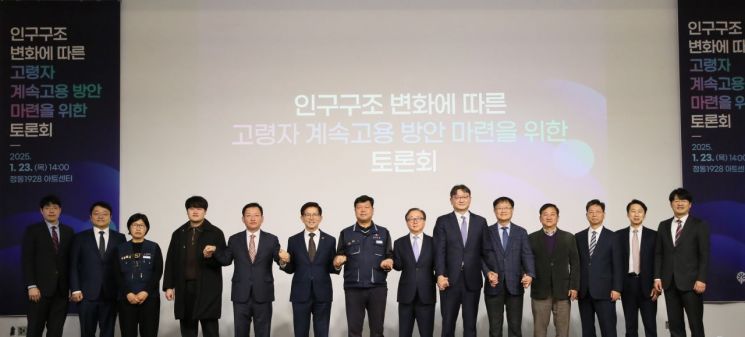 On the 23rd, attendees are taking a commemorative photo at the 'Discussion Forum on Measures for Continued Employment of the Elderly in Response to Changes in Population Structure' hosted by the Economic, Social and Labor Council at Jeongdong 1928 Art Center in Jung-gu, Seoul. Photo by Economic, Social and Labor Council
On the 23rd, the Economic, Social and Labor Council held a forum titled "Discussion on Measures for Continued Employment of the Elderly in Response to Demographic Changes" at Jeongdong 1928 Art Center in Jung-gu, Seoul. This forum was organized to publicize the discussions of the 'Continued Employment Committee Responding to Demographic Changes' under the Economic, Social and Labor Council. Attendees included Kwon Ki-seop, Chairman of the Economic, Social and Labor Council; Kim Moon-soo, Minister of Employment and Labor; Ryu Ki-seop, Secretary-General of the Federation of Korean Trade Unions; and members of the National Assembly’s Environment and Labor Committee.
Kim Sung-hee, Director of the L-ESG Evaluation Institute, who delivered a presentation that day, spoke on the topic "Solutions for Retirement Age Extension ? Maximizing the Effect of Legal Retirement Age Extension and Issues with Reemployment Measures." Director Kim emphasized that, with the postponement of the national pension eligibility age, the retirement age should be gradually extended to 65 by 2033. She also argued that the Japanese-style reemployment system cannot be the solution in the current discussions. Furthermore, she pointed out that rather than only discussing the burden of labor costs, the management sector should focus on fulfilling social responsibility.
She said, "It is essential to design a system that provides more incentives to low-wage, unstable small and medium-sized enterprises (SMEs)," adding, "Priority application to SMEs is necessary." Regarding concerns that extending the retirement age in large corporations and public institutions might reduce youth employment, she explained, "(For retired workers) instead of reducing wages, it is necessary to harmonize with youth employment by reducing working hours or sharing duties."
Another presenter, Lee Soo-young, Special Professor at Korea University’s Institute for Aging Society, spoke on "Employment Extension Measures Compatible with Youth Employment." He emphasized the need for various forms of employment extension measures. His argument was that, benchmarking cases from Japan and Singapore, not only retirement age extension but also reemployment and abolition of retirement age should be considered together. He also explained that post-retirement wage levels should be determined based on rational factors such as the worker’s job value, performance, and productivity.
Professor Lee said, "Japan and Singapore matched the national pension eligibility age through reemployment systems rather than extending the retirement age," adding, "The method of extending the retirement age is too rigid and difficult to respond to changes in corporate and economic conditions." He also argued that "to reduce the gap between retirement age and national pension receipt age, the role of retirement pensions should be expanded." To strengthen the pension nature of retirement pensions, he emphasized, "tax benefits should be expanded and quasi-public pensionization should be implemented."
During the comprehensive discussion that day, various stakeholders including workers, employers, and youth participated and presented their respective views. Kim Seol, Chairperson of the Youth Union, said, "Building a stable old age and livelihood safety net is not simply about whether to legally extend the retirement age or not," adding, "It is necessary to coordinate measures that can guarantee income for the elderly and resolve labor market inequalities, including transitioning the wage system that causes current labor market inequality to the principle of equal pay for equal work."
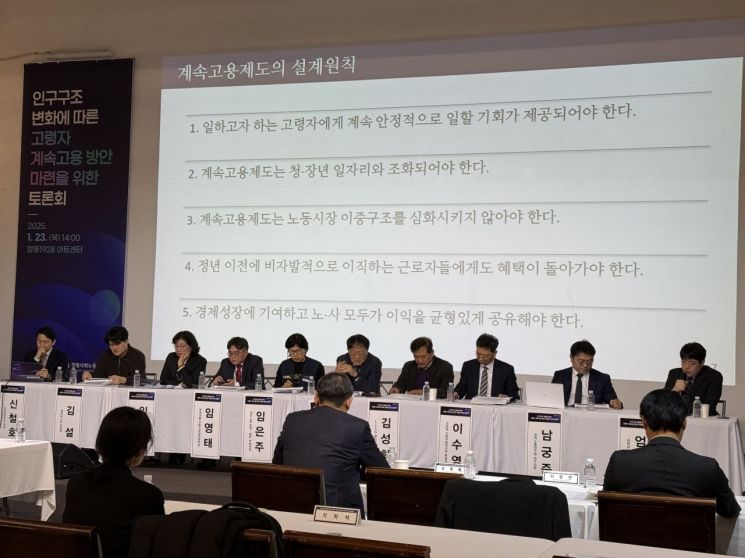 Discussion participants debating at the "Forum on Measures for Continued Employment of the Elderly in Response to Changes in Population Structure." Photo by Kim Pyeonghwa
Im Young-tae, Head of Employment and Social Policy at the Korea Employers Federation, said, "Considering high wage seniority, low employment flexibility, and the dual-structured labor market, choosing one among reemployment, retirement age extension, or abolition of retirement age like Japan is too burdensome for our labor market," adding, "A special law on reemployment of elderly workers after 60 should be enacted to activate post-retirement reemployment in workplaces, provide various incentives to companies, and guarantee legal stability."
The government’s stance is to establish a foundation that allows continued employment discussions centered on labor-management agreements to develop, rather than focusing on specific alternatives. Im Young-mi, Director of the Integrated Employment Policy Bureau at the Ministry of Employment and Labor, explained, "It is not the time to say the government’s position is reemployment, Japanese-style, or retirement age extension," adding, "Whether it is retirement age extension or reemployment, systems should be created in similar types that fit the intended purpose, and this direction is not impossible."
Meanwhile, the Economic, Social and Labor Council plans to accelerate continued employment discussions once the Federation of Korean Trade Unions participates in social dialogue. In addition to the Continued Employment Committee under the council, in-depth dialogues will be promoted at the deputy representative level to reach maximum consensus. Chairman Kwon said, "When the statutory retirement age was extended to 60 in 2013, labor-management conflicts occurred, and legal disputes over the wage peak system also took place," adding, "We must not repeat past trial and error."
© The Asia Business Daily(www.asiae.co.kr). All rights reserved.
![Clutching a Stolen Dior Bag, Saying "I Hate Being Poor but Real"... The Grotesque Con of a "Human Knockoff" [Slate]](https://cwcontent.asiae.co.kr/asiaresize/183/2026021902243444107_1771435474.jpg)
















