Forum on "Key Issues and Structural Improvement Plans for the Domestic OTT Industry"
Netflix and YouTube Provide Services Similar to Broadcasters
But Do Not Pay the Broadcasting Development Fund
If OTT Providers Pay the Broadcasting Development Fund
Up to 14.4 Billion Won Could Be Collected
There have been claims that global online video service (OTT) providers such as Netflix and YouTube, which dominate the domestic market, should also pay the Broadcasting and Communications Development Fund.
At the forum titled "Key Issues and Structural Improvement Plans for the Domestic OTT Industry" held on the afternoon of the 23rd at the National Assembly Members' Office Building in Yeongdeungpo-gu, Seoul, Lee Soo-yeop, a research fellow at the Media Future Research Institute, raised the issue, stating, "As OTT service subscribers increase, the so-called 'cord-cutting' phenomenon, where users cancel paid broadcasting subscriptions, is on the rise, but OTT providers are classified as value-added communication service providers and do not pay the broadcasting development fund."
He added, "With the recent changes in the media environment and the rise of OTT services, there is reverse discrimination in the contribution to the broadcasting development fund. It is fair to impose the broadcasting development fund on OTT as well, just as terrestrial broadcasters, comprehensive programming channels (Jongpyeon), paid broadcasting operators (SO), satellite broadcasting, and home shopping currently do." While OTT continues to grow steadily, the existing broadcasting market is experiencing a downturn. In fact, the revenue of domestic broadcasting businesses in 2023 was recorded at 18.97 trillion won, a 4.1% decrease compared to the previous year.
He further stated, "OTT essentially provides services similar to those of broadcasting operators." It is estimated that if the broadcasting development fund is imposed on OTT providers above a certain scale, up to 14.4 billion won could be additionally collected.
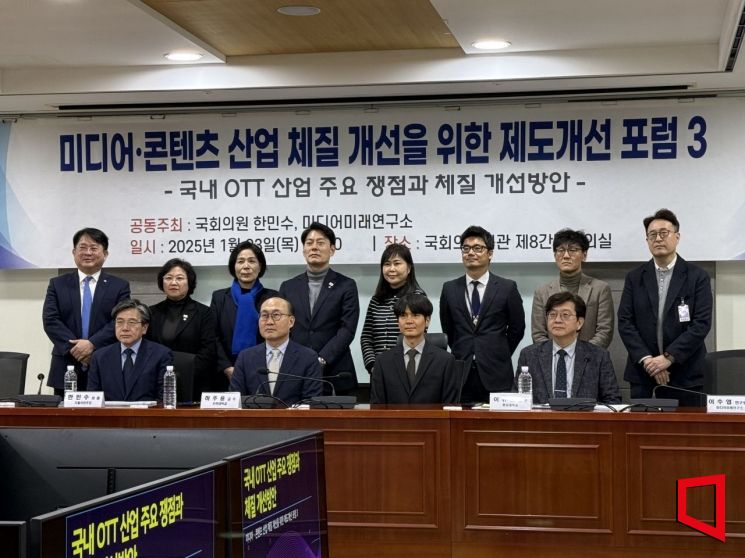 On the afternoon of the 23rd, attendees are taking a commemorative photo at the 'Key Issues and Structural Improvement Plans for the Domestic OTT Industry' forum held at the National Assembly Members' Office Building in Yeongdeungpo-gu, Seoul. Photo by Lee Myunghwan
He also pointed out that among OTT services, global companies rather than native OTTs occupy about half of the domestic market. Last year, based on the number of app users among domestic video and OTT services, only two native OTTs?Coupang Play and TVING?were among the top five. Global services such as YouTube, Netflix, and TikTok accounted for more than half of the user share.
However, Lee emphasized that fairness issues with overseas OTT providers must also be considered. If foreign providers refuse to pay the fund, it could lead to reverse discrimination against domestic providers. If they file lawsuits opposing the fund payment, it could escalate into trade friction. Lee advised, "As the broadcasting market is changing, the regulatory philosophy and system must also change, and the fairness of fund payment needs to be refined."
The forum also addressed the issue of OTT companies not providing additional compensation to creators. Despite the unprecedented success of the drama "Squid Game," which was released on Netflix, director Hwang Dong-hyuk, the creator, reportedly did not receive additional compensation because the copyright was transferred to Netflix under the contract. The forum was co-hosted by the office of Democratic Party lawmaker Han Min-su and the Media Future Research Institute.
© The Asia Business Daily(www.asiae.co.kr). All rights reserved.
![Clutching a Stolen Dior Bag, Saying "I Hate Being Poor but Real"... The Grotesque Con of a "Human Knockoff" [Slate]](https://cwcontent.asiae.co.kr/asiaresize/183/2026021902243444107_1771435474.jpg)

















