Seeking Special Transportation Measures for Large-Scale Developments
“Hearing Residents and Merchants... Close Consultation Needed”
“Shifting to Public Transportation to Minimize Congestion”
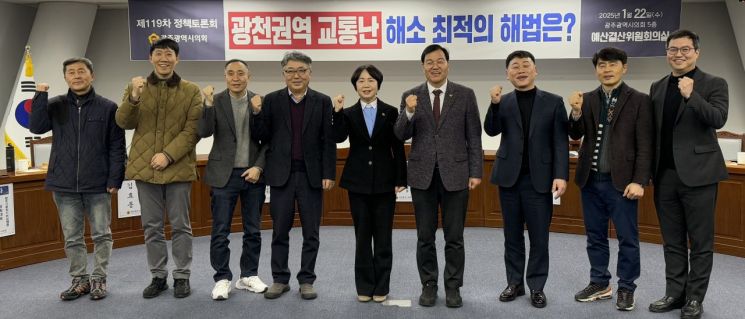 Gwangju City Council held a policy forum on the 22nd at 2 p.m. in the Budget and Accounts Special Committee meeting room to seek solutions for special traffic measures related to the large-scale development plan in the Gwangcheon area. Photo by Gwangju City Council
The Gwangju City Council announced on the 23rd that it held a policy discussion on the 22nd to address traffic congestion in the Gwangcheon area, as large-scale developments such as the expansion of the Shinsegae Department Store near Gwangcheon Terminal, the redevelopment of Gwangcheon-dong, and the opening of The Hyundai Complex Shopping Mall on the Jeonbang site are planned.
The discussion was organized jointly by An Pyunghwan, Chair of the Administrative Autonomy Committee (Buk-gu 1), and Myung Jin, Chair of the Education and Culture Committee (Seo-gu 2), whose districts are adjacent to the Gwangcheon Terminal. The purpose was to hear on-site opinions and seek solutions to relieve traffic congestion in the Gwangcheon area.
In his presentation, Lee Changho, Director of the Gwangju City Transportation Policy Research Office, introduced the city's plans based on the “Final Report on the Special Transportation Measures for the Gwangcheon Area.” These include: ▲ construction of the Gwangcheon-Sangmu urban railway line ▲ introduction of a BRT connecting the Gwangcheon area ▲ operation of urban express buses and “win-win” buses connecting the Gwangcheon area ▲ expansion of bus-only lane sections and hours in the Gwangcheon area ▲ creation of the Gwangcheon Eco-Bridge (Landmark) ▲ establishment of the Gwangcheon Green Road ▲ expansion and construction of new roads in the Gwangcheon area.
Myung Jin, who moderated the discussion, emphasized, “With the implementation of development plans in the Gwangcheon area, it is essential to realize transit-oriented development (TOD) to achieve pedestrian-friendly land use and a public transportation-centered traffic system. To do so, it is crucial to listen to the opinions of residents and merchants in the area and hold close consultations, especially as the seven projects, including the Shinsegae Department Store expansion and surrounding redevelopment, move forward.”
An Pyunghwan, who co-hosted the discussion, stated, “After 2030, the floating population in the Gwangcheon area is expected to be at least 300,000. Considering both current and future road conditions, it is inevitable that we must shift to a public transportation-centered system to minimize traffic congestion. Continuous efforts to persuade and communicate with local merchants and citizens are needed.”
© The Asia Business Daily(www.asiae.co.kr). All rights reserved.
![Clutching a Stolen Dior Bag, Saying "I Hate Being Poor but Real"... The Grotesque Con of a "Human Knockoff" [Slate]](https://cwcontent.asiae.co.kr/asiaresize/183/2026021902243444107_1771435474.jpg)















