The second administration of Donald Trump has announced tariff increases on Mexican products, heightening tensions in the global supply chain. As Korean companies are expected to face direct and indirect impacts, the government has begun preparing countermeasures, but it remains uncertain whether effective measures will emerge.
On the morning of the 23rd, the Ministry of Trade, Industry and Energy held a 'Public-Private Joint Response Meeting on the U.S. New Administration's Trade Policy toward Mexico,' chaired by Deputy Trade Minister Park Jong-won, to assess the impact of changes in U.S. trade policy on Korean companies operating there and to discuss response strategies.
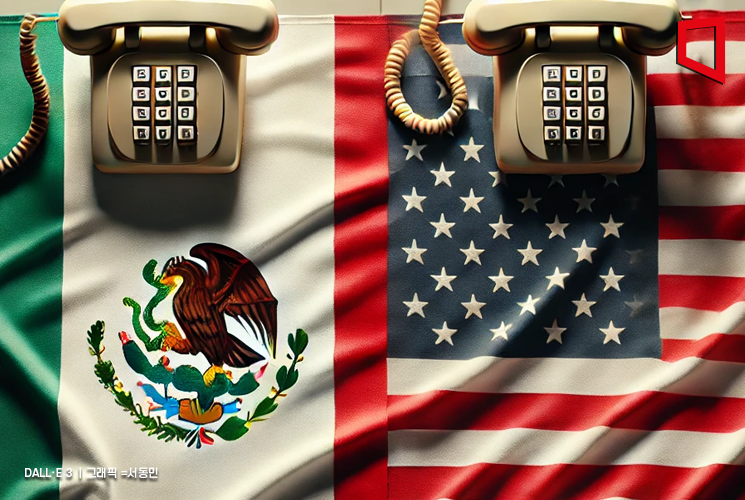
So far, Korean companies have actively expanded into Mexico, especially in the automotive and home appliance sectors, by utilizing tariff-free benefits under the United States-Mexico-Canada Agreement (USMCA). However, after President Trump ordered on the 20th (local time) the imposition of a 25% tariff on Mexico and a review of free trade agreements including the USMCA immediately after his inauguration, Korean companies operating locally are unlikely to avoid negative impacts.
In particular, since Korea maintains deep trade relations with both Mexico and the United States, such tariff policies are highly likely to cause direct and indirect damage. Domestic companies using Mexico as a major production base for automotive parts and electronic products are expected to face increased cost pressures.
According to overseas investment statistics compiled by the Export-Import Bank of Korea, about 525 Korean companies have invested in Mexico from 1980 to June 2024. For example, Kia produces approximately 250,000 vehicles annually at its Monterrey plant in Mexico, exporting about 150,000 of these to the United States. If tariffs become a reality, Kia will inevitably suffer damage across production and exports.
Additionally, Hyundai Mobis and Hyundai Transys operate production plants in Monterrey, Mexico, while Samsung Electronics runs home appliance and TV factories in Quer?taro and Tijuana, respectively. LG Electronics also operates production bases in Reynosa (TV), Monterrey (refrigerators), and Ramos (automotive parts).
The problem is that the tariff dispute between the United States and Mexico is more difficult to resolve because Korea is not a direct party. A manufacturing industry official pointed out the difficulty, saying, "If it were a tariff issue concerning Korea, the government could step in to negotiate, but the issue between Mexico and the U.S. leaves limited room for negotiation."
Accordingly, industry experts recommend that domestic companies take proactive measures, such as seeking alternative supply chains outside Mexico, considering the possibility of a prolonged tariff dispute. There are also calls for the government to provide support measures aligned with changes in the international trade environment.
For now, the government plans to continuously monitor the U.S. government's trade policy toward Mexico and actively convey industry opinions raised at the meeting to the governments of the U.S., Mexico, and other relevant countries.
Deputy Minister Park said, "In uncertain times, it is important for companies and the government to act as one team and communicate and cooperate closely," adding, "Going forward, the government will closely watch U.S. trade policies and actively carry out Mexico outreach efforts to minimize negative impacts on our companies."
© The Asia Business Daily(www.asiae.co.kr). All rights reserved.
![Clutching a Stolen Dior Bag, Saying "I Hate Being Poor but Real"... The Grotesque Con of a "Human Knockoff" [Slate]](https://cwcontent.asiae.co.kr/asiaresize/183/2026021902243444107_1771435474.jpg)















