Democratic Party Plans to Pass Commercial Act Amendment in Legislation and Judiciary Committee This Month
Government and Ruling Party Expected to Oppose... "It Will Be a Bomb to Companies"
Experts debated the amendment to the Commercial Act in the National Assembly. While there are concerns that the amendment, which expands directors' fiduciary duties to include ordinary shareholders, could stifle corporate management activities, there were also arguments emphasizing the need to amplify the voices of ordinary shareholders.
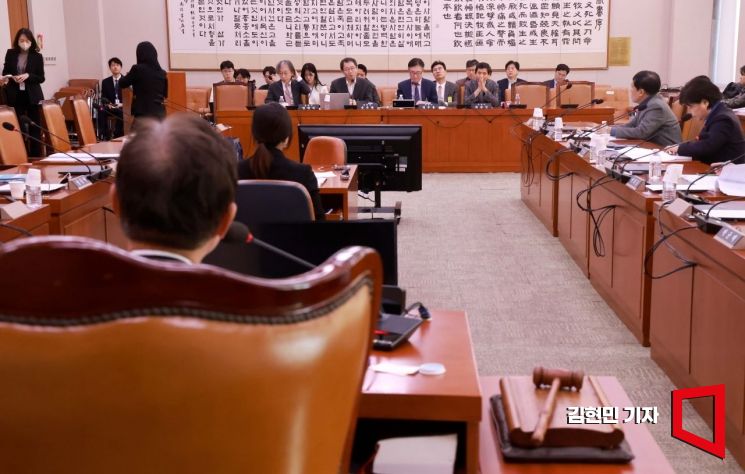 On the 15th, Professor Song Ok-ryeol of Seoul National University School of Law is speaking at the public hearing on the amendment of the Commercial Act held by the Subcommittee on Bill Examination 1 of the Legislation and Judiciary Committee at the National Assembly. Photo by Kim Hyun-min
The Legislation and Judiciary Committee's Subcommittee 1 held a public hearing on the Commercial Act amendment on the 15th at the National Assembly in Yeouido, Seoul. Attendees included Professor Choi Jun-seon of Sungkyunkwan University School of Law, Professor Song Ok-ryeol of Seoul National University School of Law, Vice Chairman Jeong Woo-yong of the Korea Listed Companies Association, and lawyer Myung Han-seok of the law firm Hwahaeon.
Professor Choi argued that if the amendment passes, excessive lawsuits by ordinary shareholders could lead to a contraction in corporate management activities. He stated, "A director is not the representative of the company but acts as an agent," adding, "Considering their role, directors should work for the company and have no legal relationship with shareholders." He continued, "Many people interpret the expansion of directors' fiduciary duties as a confrontation between major and minority shareholders, but in practice, all companies already maintain a policy to protect minority shareholders," emphasizing that "(the amendment) could be misused as a tool to attack sound companies."
On the other hand, Professor Song countered that amending the Commercial Act is necessary to resolve distrust in the domestic stock market. He said, "Leaving the Commercial Act as it is is not a wise choice," and added, "If the Act remains unchanged after such intense debate, investors will all move to the U.S. Nasdaq." Furthermore, he argued, "The amendment is not just a simple signal but can restrain companies from pursuing private interests," and stated, "There are claims in the business community that ordinary shareholders interfere with companies pursuing profits. If the business community truly perceives it that way, the amendment is necessary."
The ruling and opposition parties have clashed over the scope of expanding directors' fiduciary duties. The opposition argues that the duties should be extended to ordinary shareholders to protect shareholder interests, while the ruling party worries about potential contraction in corporate management activities. The opposition is reportedly considering abolishing the crime of breach of trust, taking into account side effects such as the contraction of corporate activities. Additionally, amendments to the Capital Markets Act are also being discussed to consider specific regulatory measures not covered by the Commercial Act amendment.
The Democratic Party of Korea announced a plan to pass the Commercial Act amendment within the regular session of the National Assembly at the end of last year. This was part of a trade-off where Democratic Party leader Lee Jae-myung accepted the abolition of the financial investment income tax (Geumtu Tax) in exchange for proposing the amendment as a means to enhance corporate value (value-up). However, the timing for handling the amendment was repeatedly delayed due to incidents such as the December 3 emergency martial law situation and the Jeju Air passenger plane accident. The recent public hearing was originally scheduled for the 30th of last month at the Legislation and Judiciary Committee's Subcommittee 1 but was postponed due to the Jeju Air passenger plane accident.
The Democratic Party plans to pass the amendment in the Legislation and Judiciary Committee by the end of this month and handle it in the plenary session early this year. It appears that there is internal consensus within the party that the amendment can no longer be delayed. A Democratic Party lawmaker who requested anonymity said, "The party's opinion on the amendment was somewhat unified by the end of last year," and added, "I think it is appropriate to handle it in the plenary session early this year."
However, it is expected that the government and ruling party will oppose it. Although a consultative body involving the government and both ruling and opposition parties was launched to discuss policies, disagreements remain over issues such as the execution of an arrest warrant against President Yoon Seok-yeol and the general special prosecutor law on rebellion. Even if the opposition raises the Commercial Act amendment as an agenda item in the consultative body, the government and ruling party are expected to set the amendment to the Capital Markets Act as their bottom line. Kim Sang-hoon, the Policy Committee Chair of the People Power Party, said at a party floor meeting on the 19th of last month, "(The Commercial Act amendment) will be a bomb to our companies and economy."
© The Asia Business Daily(www.asiae.co.kr). All rights reserved.
![Clutching a Stolen Dior Bag, Saying "I Hate Being Poor but Real"... The Grotesque Con of a "Human Knockoff" [Slate]](https://cwcontent.asiae.co.kr/asiaresize/183/2026021902243444107_1771435474.jpg)















