'Service Robot Report' Released
Improved Operational Efficiency in Food Service and Commercial Facilities
Service robot company VD Company announced the performance of serving robots and cleaning robots through the 'Service Robot Report.' This report analyzes service robot operation data from the past two years.
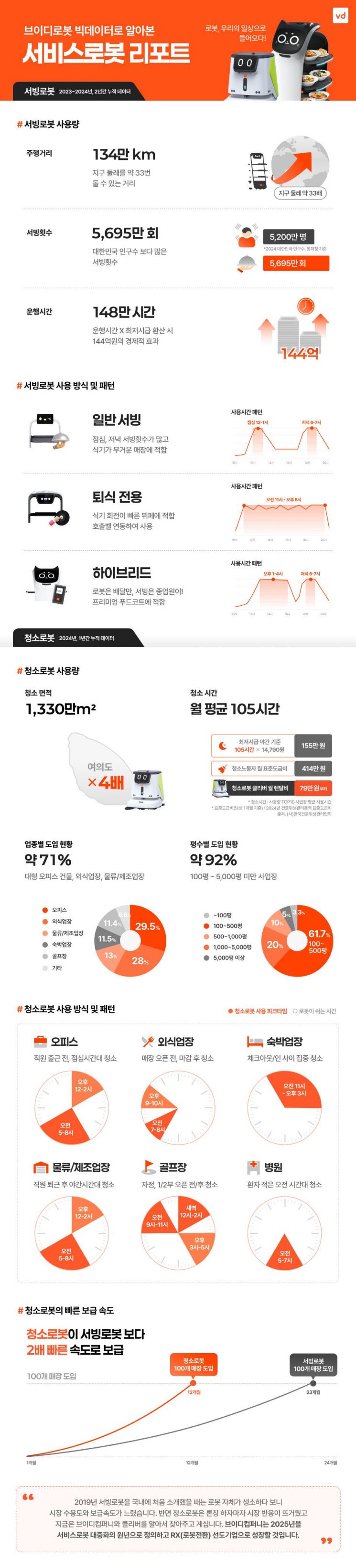
VD Company revealed on the 14th that its serving robots have traveled over 1.34 million kilometers, equivalent to 33 laps around the Earth, in the past two years. The total number of servings reached 56.95 million times, which means that if one serving is assumed per person, every citizen in South Korea has been served at least once.
This result corresponds to an economic value of 14.4 billion KRW. The figure was calculated by applying the statutory minimum wage for each year to the actual operating time of VD Company's serving robots, which totaled 1.48 million hours over the past two years. VD Company explained that this proves the economic effect created by the introduction of serving robots.
The report also includes the performance of VD Company's commercial cleaning robot 'Cleaver,' which was first introduced at the end of 2023. Since its launch, Cleaver has cleaned an area of approximately 1,330㎡, equivalent to four times the size of Yeouido, over 12 months. It was most frequently introduced in facilities sized between 100 and 500 pyeong (61.7%), with over 20% adoption in facilities between 1,000 and 5,000 pyeong. Ultra-large facilities over 5,000 pyeong accounted for 5%.
Cleaver has been active across various industries. It was most widely adopted in offices (29.5%), followed by dining establishments (28%), logistics and manufacturing sites (13%), lodging facilities (11.5%), and golf courses (11.4%), where it handled cleaning tasks. In offices, where it was most commonly introduced, cleaning was conducted before work hours and during lunch breaks to maintain a comfortable environment. Dining establishments operated Cleaver before opening and after closing, while lodging facilities used it between check-out and check-in times, enhancing labor efficiency during critical operating hours.
An analysis of the top 10 business sites with high Cleaver usage showed an average monthly combined usage of 105 hours during day and night. Multiplying this by the nighttime minimum wage, when cleaning is primarily conducted, results in labor costs of 1.55 million KRW per month. If a cleaning worker is employed, the standard male labor cost, including base pay, overtime pay, and annual leave pay, amounts to 4.14 million KRW. In comparison, Cleaver's monthly usage fee starts at 790,000 KRW, making it economically advantageous.
Thanks to this operational efficiency, the cleaning robot market is growing rapidly. Cleaver was introduced in 100 stores within 12 months of its launch, twice as fast as the serving robot, which took 23 months to reach 100 stores. This growth trend is expected to accelerate further this year.
Ham Pan-sik, CEO of VD Company, stated, “While serving robots have quickly established themselves in the market and continued to grow, cleaning robots are spreading even faster. Based on the growth in 2024, we expect an even more explosive market expansion in 2025.” He added, “VD Company defines 2025 as the inaugural year of service robot popularization and will grow as a leading company in RX (robot transformation).”
© The Asia Business Daily(www.asiae.co.kr). All rights reserved.
![Clutching a Stolen Dior Bag, Saying "I Hate Being Poor but Real"... The Grotesque Con of a "Human Knockoff" [Slate]](https://cwcontent.asiae.co.kr/asiaresize/183/2026021902243444107_1771435474.jpg)















