Index Volatility Likely to Continue Due to Policy Uncertainty
Trump Expected to Focus on Domestic Economy in Early Term
There is an analysis that if fear sentiment excessively expands around President Trump's inauguration, it could become a buying opportunity in the U.S. stock market. NH Investment & Securities predicted on January 20 that due to concerns over upward pressure on interest rates and inflation caused by uncertainty surrounding Trump's policies around the inauguration, the volatility phase of the stock index is expected to continue in the short term.
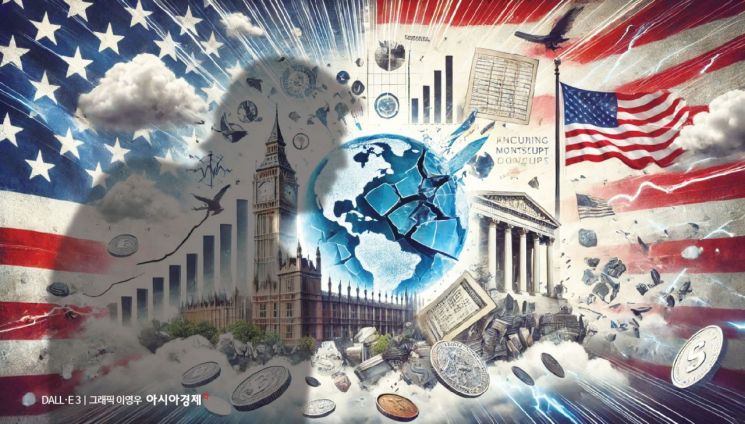
In a report released on the 14th, Yeonju Cho, a researcher at NH Investment & Securities, stated, "The U.S. stock market is experiencing increased volatility due to concerns over rising inflation and interest rates stemming from Trump's tariff policies," and analyzed, "The volatility of the U.S. stock market may temporarily increase around President Trump's inauguration, but as uncertainties are resolved afterward, it is expected to gradually stabilize."
He forecasted that Trump would focus on domestic economic policies in the early stages of his administration. Researcher Yeonju Cho said, "All past presidents have focused on domestic policies that drive economic stimulus during their honeymoon period, and Trump also prioritized tax cuts over imposing tariffs in the early phase of his first term," adding, "In the early phase of Trump's second term, it is expected that he will focus on domestic economic policies aimed at finalizing the FY25 budget by March 15, rather than foreign policies that could cause inflation and economic uncertainties."
Through social media, Trump mentioned honeymoon policies including △strengthening the southern border, △expanding crude oil production, △tax cuts, and △tariff increases. Regarding this, Researcher Cho emphasized, "Since both positive and negative factors are included for the stock market, prioritization will be important."
He advised that if fear sentiment spreads in the stock market around the inauguration, it should rather be taken as a buying opportunity. Historically, the U.S. stock index has shown a downward trend on average from 20 days before the presidential inauguration to one month after. The U.S. policy uncertainty index also peaked 10 days before the inauguration and declined after 30 days post-inauguration.
He said, "During Trump's first inauguration, the stock index rebounded after a decline, with tech, healthcare, utilities, and consumer goods leading the stock price increases in that order."
As beneficiary sectors, he pointed out finance, tech, and space, defense, and aerospace. Researcher Yeonju Cho noted, "Considering the replacement of financial institution heads and deregulation of AI and energy companies during Trump's second-term honeymoon period, the finance and tech sectors are expected to benefit," and added, "Additionally, industrial sectors such as space, defense, and aerospace, where government spending may increase, are also expected to be positive."
© The Asia Business Daily(www.asiae.co.kr). All rights reserved.
![Clutching a Stolen Dior Bag, Saying "I Hate Being Poor but Real"... The Grotesque Con of a "Human Knockoff" [Slate]](https://cwcontent.asiae.co.kr/asiaresize/183/2026021902243444107_1771435474.jpg)















